
Washer toss is horseshoes without the hazard and cornhole without the bean bags. Metal washers are thrown into a wooden box with a pipe in the middle: in the box scores, in the pipe scores more, and points cancel between the teams each round.
The rules below are the standard ones. They are worth printing on a card and putting in the box, because the two questions buyers get asked most are the throwing distance and how the cancellation scoring works.
What You Need
- Two boxes, each with a central pipe or cup.
- Eight washers, four in one colour and four in another.
- A flat area, ideally grass or a hard surface with room to walk between the boxes.
That is the whole kit. There is no assembly, no net, no hardware.
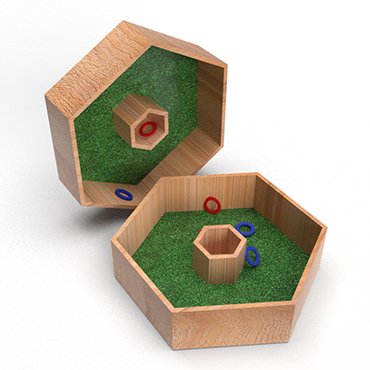
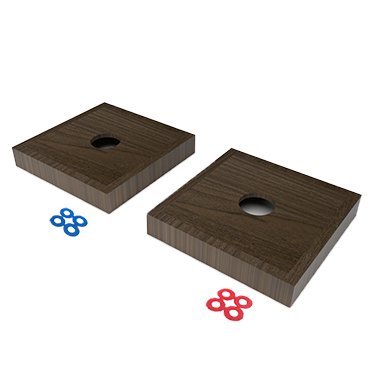
Court and Distance
Place the two boxes facing each other. The standard distance is 21 feet (about 6.4 m) from cup to cup; many casual games use 20 feet, and either is acceptable as long as it stays the same for the whole game.
Players stand at one box and throw towards the other. All eight washers are thrown from that end, then everyone walks to the far box, scores the round, and throws back. That walk is part of the rhythm of the game — it gives the round a natural break.
How to Throw
There is no prescribed technique. Underhand lob, a spinning throw, or a flat slide all work, and players tend to settle on their own method within a round or two.
One rule applies: the thrower must stay behind the front edge of their own box. A foot over the line shortens the distance and is the most common argument in the game, so agree the penalty before the first throw — one warning, then the throw does not count.
Scoring
- Washer in the box — 1 point.
- Washer in the cup or pipe — 3 points.
- Washer outside the box — nothing.
- Washer that bounces out — nothing. It has to come to rest in the box or the cup.
- Washer leaning on the cup — 1 point only. It has to be fully inside to score 3.
Cancellation Scoring
This is the rule that makes the game worth playing, and the one that needs explaining.
Both teams score the round, then the lower score is subtracted from the higher. Only the difference is awarded, and only to the team that scored more.
Worked example: Team A lands two washers in the box and one in the cup, for 5 points. Team B lands one in the box and one in the cup, for 4 points. The difference is 1, so Team A scores 1 point and Team B scores nothing for that round.
The effect is that a big lead is hard to build and a big lead is hard to lose, which keeps games close without making them slow.
Winning
21 points, win by 2, is the standard. 11 or 15 is common for a quicker game. Agree the target before the first throw.
Box Dimensions
If you are sourcing or specifying a set, these are the numbers that matter:
- Box footprint — 16 inches square (about 40 cm) is standard. Smaller boxes are harder to score in and read as cheap.
- Cup diameter — about 4 inches (10 cm).
- Cup height — about 4 inches above the box floor.
- Washer diameter — about 2.5 inches (6.3 cm).
- Box depth — deep enough that a washer does not bounce out on a solid hit.
What Makes a Box Good
- Braced base. A single-skin box rattles and walks on impact. Internal bracing or a weighted base keeps it still.
- Rounded edges. Washers hit the rim constantly; a sharp edge splits.
- Solid cup fixing. The pipe has to be fixed to the box floor, not pushed into a hole. A loose pipe is the most common failure.
- Sealed timber. These boxes live outdoors and get wet. Unsealed end grain rots within a couple of seasons.
Settling the Usual Arguments
- “It bounced out, does it count?” No. It has to come to rest in the box or the cup.
- “It’s leaning on the pipe.” 1 point, not 3.
- “His foot was over the line.” Agree the penalty before the game starts.
- “A washer landed on another one and stayed up.” Score it as in the box if it is above the box and supported. This is a house rule, so state it.
- “Nobody can score.” A round where neither team scores is a wash; play continues.
Safety Note
Washers are steel discs and they hurt when they land on someone. The game is not suitable for unsupervised young children, and it should not be played with spectators standing beyond the boxes. If you are selling into a family market, put a line on the box about supervision — it costs nothing and it is the right thing to do.
Sourcing Notes
- Frame in beech or pine; the deck takes repeated impact from steel, so specify a hardwood deck or a plywood deck with a hardwood rim.
- Stainless or plated washers. Plain steel rusts within a season outdoors.
- Water-based finish with sealed end grain; EN71 and ASTM F963 compliance for anything sold as a toy.
- Minimum 500 sets; samples 5–10 days; production 30–45 days after approval.
Conclusion
The rules take two minutes to learn and the cancellation scoring is the only part that needs explaining. Print them on a card, fix the throwing distance, and agree the line penalty before the first throw.
We build washer toss boxes from 500 sets, with the rules card included and the box dimensions specified to your market.
FAQs
How far apart are the boxes?
21 feet (6.4 m) cup to cup is the standard. 20 feet is common in casual play. Keep it consistent for the whole game.
How many people can play?
Two to four. In doubles, teammates stand at opposite boxes and throw towards the same target, so each team has a player at each end.
What is the winning score?
21, win by 2. 11 or 15 for a shorter game.
What wood is best for the box?
A hardwood rim and deck, or a plywood deck with a hardwood edge. The deck takes direct impact from steel washers, so soft timber dents and eventually splits.
Can the boxes be branded?
Yes. The outside face of the box is a flat panel and takes a burned or engraved logo well. Keep branding off the deck, where it will be hit.
Sourcing Wooden Garden Games in Bulk?
Kangjie is the direct manufacturer behind these games — no trading company, no middleman margin. We supply Kubb, Croquet, Molkky, Ring Toss, Tumble Tower, Cornhole and more to importers, retailers and brand owners worldwide.
- Factory-direct pricing with transparent volume tiers (500 / 1,000 / 5,000 units)
- OEM & ODM: logo, packaging, size and finish built to your specification
- EN71 & ASTM F963 compliant; FSC-certified timber
- Bulk lead time 30–45 days, quotation within 24 hours










2 Responses
You can read this article I wrote.