
The best family game is not the one with the highest rating. It is the one that gets played, and four properties decide that: the age range it covers, the length of a round, whether the player count can change, and how much of the first round is spent reading rules.
Wooden games do well on all four, which is why the category keeps selling into family retail while more elaborate games cycle in and out.
Below: the four formats that fit a family night, how to match one to a specific household, and what “best” means if you are buying to sell rather than to play.
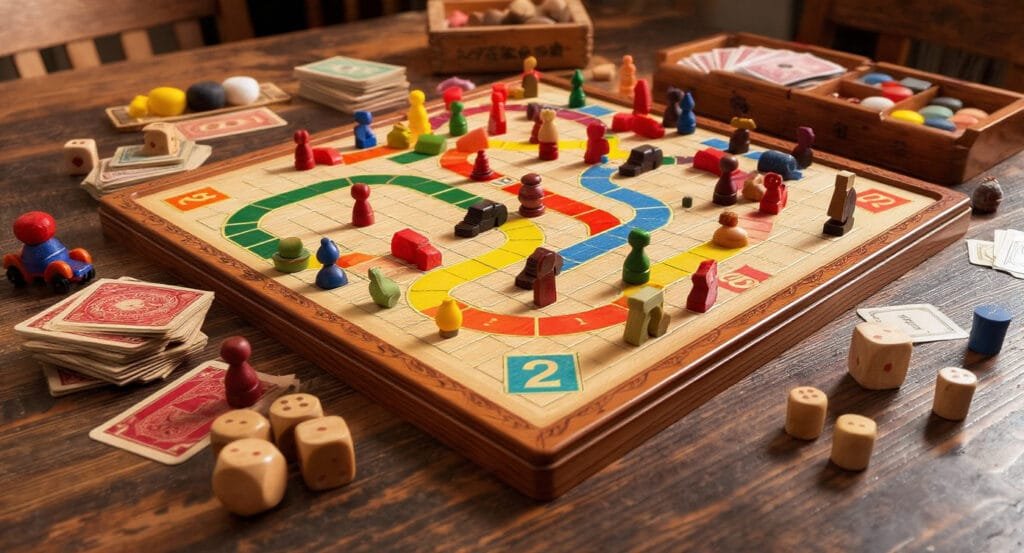
What Makes a Game Work for a Family Night
- Age range. The ideal game is playable by a seven-year-old and interesting to an adult. Games that are only one or the other get played once.
- Round length. Fifteen to thirty minutes. A round that runs long stops the evening rather than filling it.
- Flexible player count. Two players or six, same equipment. Families rarely have a fixed number of people at the table.
- Rules that fit on a card. If the explanation takes longer than the first round, part of the table has already left.
- Adjustable difficulty. The best family games can be handicapped without changing the rules – a shorter throwing distance, a smaller starting stack, a head start.
Four Formats That Fit
Block Tower
The most reliable family game in the category, and the one with the widest age range, because the rules are understood before anyone explains them. Stack the blocks, remove one, place it on top, and the tower eventually falls.
The tension is shared rather than competitive, which is why it works with mixed ages: nobody is losing while somebody else wins. A round takes ten to fifteen minutes and the player count is whatever is at the table.
For a buyer, the specification that matters is block thickness tolerance. A set where blocks vary by half a millimetre stacks badly and feels cheap regardless of the timber. Ask for the tolerance in writing and check it with a caliper.
A note on naming: the generic name is tumble tower or block tower. The trademarked name for the commercial version belongs to its owner and should not appear on packaging.
Dominoes
The best value in the category. A double-six set supports a two-player game and a large family game with the same pieces, the matching mechanic needs one sentence to explain, and the tactile quality is the selling proposition.
It is also the format that ages best: young children play it as matching, older children play it as a game, and adults play it seriously. Very few products cover that span.
Specification point: pips should be burned or engraved rather than painted, because painted pips wear at the edges first and the set looks tired within a season.
Carrom
A flicking game played on a polished wooden board with small discs and a striker, traditional in South Asia and increasingly stocked in Western gift and games retail as a distinctive alternative to board games.
It is the most differentiated product on this list, which is its commercial value: it does not compete on the same shelf as everything else. It is also the one that requires a demonstration, so it suits a shop with staff rather than a self-service display.
The board surface is the product. A rough or uneven surface makes the discs behave unpredictably and the game unplayable, so the finish – usually a hard polish over a smooth substrate – is the specification to protect.
Croquet
The outdoor option, and the one that works best for a family gathering rather than a game night indoors. Six-player sets are the volume item.
The failure points are the wickets and the mallet heads: a loose wicket makes the course unplayable, and an unbalanced mallet makes the game frustrating. Both are visible on a sample within one round.
Matching the Game to the Family
Casual or Competitive
A household that plays for the company wants a game where nobody is eliminated early and the score matters less than the round. A block tower or a throwing game fits. A household that plays to win wants visible scoring and a way to improve, which suits dominoes or carrom.
Getting this wrong is the most common reason a well-made game does not get played: it is the right product for a different family.
Age Spread
The wider the spread, the more the game needs to be handicappable rather than simplified. A block tower with a lower starting stack for younger players keeps the same rules for everyone. A game that has to be simplified for a child becomes two games, and the adult version does not get played.
What “Best” Means for a Buyer
Three criteria that matter to a retailer and not to a household.
Durability. A family game is handled by children, stored in a cupboard and occasionally left outside. Mass, joint construction and finish quality decide whether it survives. A lighter, cheaper version sells once and generates a return.
Branding headroom. The largest flat surface is where a logo goes – the board face, the block ends, the box lid. Engraving detail below roughly 8 mm closes up, so artwork needs simplifying for production size rather than approved on screen.
Packaging. A printed box with a rules card moves a game from toy price to gift price. It is the largest single lever on retail price and the decision most often left until after the sample is approved, when it is already on the critical path.
Sourcing
- 500 sets for a variant or a new design – roughly where setup cost is covered without pushing the unit price above a stock item.
- Samples in 5–10 days, built on the production line rather than by hand, with the charge credited against the order.
- Production in 30–45 days from deposit and sample approval, plus ocean transit of roughly 30–40 days to Europe or 14–25 days to the US west coast.
- EN71 and ASTM F963 compliance, with FSC-certified timber and chain-of-custody documentation tied to the order.
Conclusion
The best family game covers a wide age range, plays in under half an hour, works with whatever number of people are at the table, and can be handicapped without changing the rules. Block tower, dominoes, carrom and croquet all fit that description, and each suits a different household.
For a buyer, the product decision is the same as the family’s: pick the format that gets played, then protect the specifications that decide whether it lasts – block tolerance, pip marking, board surface, wicket fit.
Stocking family games?
We manufacture direct in Guangzhou: 500-set minimum, quotes within 24 hours, samples in 5–10 days, production in 30–45 days, EN71 and ASTM F963 compliance, FSC-certified timber: contact us
FAQs
1. Which wooden game is best for a family with young children?
A block tower or dominoes. Both need no explanation, neither requires a hard throw, and both can be adjusted for younger players by changing the starting condition rather than the rules.
2. Are wooden games better than plastic for family use?
They last longer and support a higher price, but they need more care: untreated timber greys and an outdoor set needs oiling. The trade is durability and perceived value against maintenance.
3. What is the ideal playing time?
Fifteen to thirty minutes for a family night. What matters commercially is that the length matches what the box implies – a product that looks like a filler and plays for two hours generates complaints.
4. Can these games be branded?
Yes. The largest flat surface is where the mark goes – board faces, block ends, box lids. Laser engraving has no plate cost; print needs a screen or plate per colour and a run large enough to absorb the setup.
5. What is the minimum order for a custom set?
500 sets for a variant on an existing product. A genuinely new design with new tooling needs a higher minimum to absorb setup and is quoted as its own project.
Sourcing Wooden Garden Games in Bulk?
Kangjie is the direct manufacturer behind these games — no trading company, no middleman margin. We supply Kubb, Croquet, Molkky, Ring Toss, Tumble Tower, Cornhole and more to importers, retailers and brand owners worldwide.
- Factory-direct pricing with transparent volume tiers (500 / 1,000 / 5,000 units)
- OEM & ODM: logo, packaging, size and finish built to your specification
- EN71 & ASTM F963 compliant; FSC-certified timber
- Bulk lead time 30–45 days, quotation within 24 hours









