
Asking which outdoor games are most popular usually produces a list of whatever trended last summer. That list is not useful for a buyer, because popularity on social media and popularity at the till are different things. A game can be everywhere in video and sell in single units; another can be invisible online and move thousands of sets through garden centres every spring.
The useful question is which formats hold repeat demand across channels and seasons, and which ones only look popular.
This covers the formats that actually sell, where each one sells, and – the part most trend articles skip – which of them can be made in wood and which cannot.
What Popularity Actually Means Commercially
Four measures matter, and a format needs at least three of them to be worth stocking.
- Repeat purchase. A game bought once and never replaced is a one-off sale. Games with consumable or losable parts – bags, balls, pegs – generate a second sale.
- Channel breadth. The same product selling into garden centres, gift retail, hospitality and online is more resilient than one locked into a single channel.
- Seasonal elasticity. Formats that work indoors as well as outdoors extend the selling window past the four months of garden season.
- Recognition. A game the customer already knows needs no explanation on the shelf, which lowers the retailer’s cost of selling it.
The Classics That Keep Selling
These are not fashionable. They are simply bought every year, in every market, by people who already know the rules.
Cornhole
The dominant outdoor game in the United States and increasingly in northern Europe. Its commercial strength is the combination of a low skill floor, an established competitive scene that keeps it in public view, and a product that is easy to brand – the board face is a large, flat, printable surface.
For a buyer, the specification points are the board core and the bag fill. Plywood with sealed edges is the durable choice; a bean or corn fill attracts pests and degrades, so a synthetic pellet fill with a stitched seam is what to ask for.
Bocce
Strong in southern Europe and in the US markets with Italian and Mediterranean communities, and it skews older than most outdoor games, which is commercially useful because that audience buys for quality rather than price. The balls are the product: composition, weight consistency and finish decide whether the set is playable.
Kubb
A Swedish throwing game with a compact, well-defined set: one king, ten kubbs, six batons, four corner markers. It travels well, sets up in a minute, and has a growing following in the US and Germany. Because the whole product is turned and milled timber, it is one of the formats where a wooden manufacturer has a genuine advantage over a plastic one.
Molkky
A Finnish skittle game with a simple scoring system and a strong following in Japan and France as well as the Nordic countries. The product is twelve numbered pins and one throwing pin, which makes it inexpensive to produce and easy to ship. Numbering is the branding opportunity: burned, printed or painted, each reads differently on a shelf.
Competitive Formats
Higher energy, younger audience, and a different manufacturing reality.
Spikeball
A round-net game with a fast, televised competitive scene and a strong presence on university campuses. It sells well to younger buyers and to sports retailers.
It is also, honestly, not a wooden product. The net requires an engineered plastic rim and elastic tension; wood cannot deliver either. A wooden manufacturer should treat this as a market signal rather than a product opportunity – the audience it attracts is real, and the same buyer will purchase wooden yard games alongside it.
Disc Sports
Frisbee and ultimate have permanent demand and almost no manufacturing overlap with timber. Discs are moulded. The adjacent wooden opportunity is in the accessories – a wooden disc rack, a course marker set – not the disc itself.
Family Formats
The largest volume segment, and the one where wood performs best.
Giant Tumble Tower
The strongest family seller in the category. It is instantly understood, plays in groups, photographs well and creates a moment that gets shared. The commercial risk is entirely in block consistency: a set where blocks vary in thickness stacks badly and the product feels cheap regardless of the timber quality. Tolerance on the block dimension is the specification that matters, and it is worth asking for a measured sample rather than a visual one.
Giant Four in a Row
Head-to-head play, a clear win condition, and a strong visual presence in a garden. It sells to families and to hospitality – pubs, campsites, holiday parks. The mechanism is the engineering: discs that jam turn the product into a return. Drop test the assembled unit before ordering.
Croquet
A garden classic with an older, higher-spending buyer and a strong gift market. Six-player sets are the volume item. The wickets and the mallet heads are where quality shows: a loose wicket or an unbalanced mallet makes the set frustrating to play, and buyers notice within one game.
Tug of War
Group play with almost no equipment cost, which makes it a strong add-on for event hire and schools. The rope is the product and is not wood; the wooden contribution is the centre marker and the boundary posts. Sold as a set, it works; sold as a rope, it is a commodity.
Ice-Breaker and Hospitality Formats
Smaller, cheaper, and increasingly the segment that grows when garden sales are flat.
Ring Toss and Hookey
Cheap to make, easy to understand, and unusually effective in bars and cafes because it occupies a table rather than floor space. Base weight is the specification that decides whether it works on a hard surface.
Yard Dice
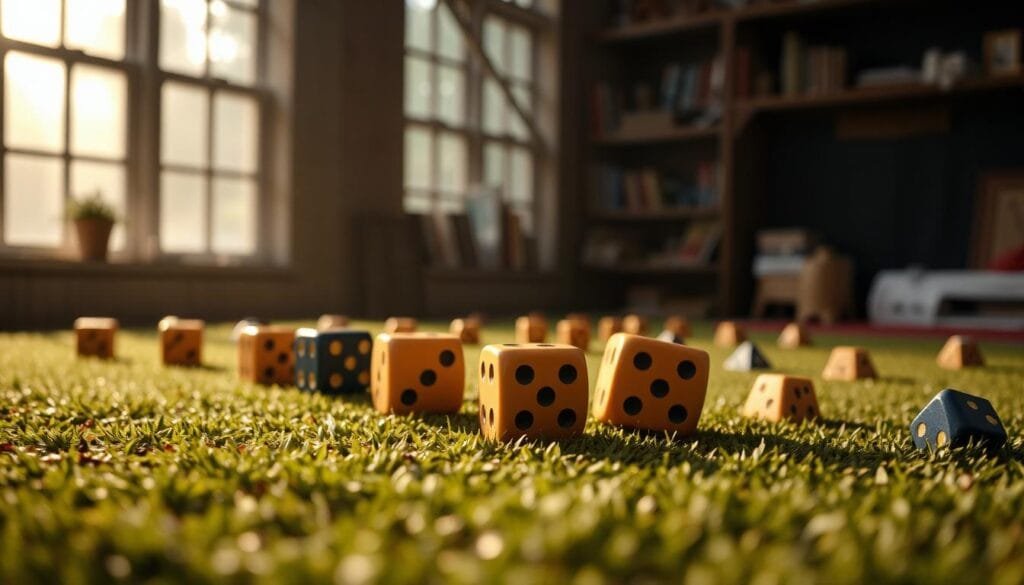
Oversized wooden dice with a rules card, sold as a family game and as a gift. Very low unit cost, large branding area, and a format that works indoors as well as out. It is one of the few products where the packaging does most of the price work.
Lawn Darts
Worth flagging rather than recommending without qualification. The traditional metal-tipped version has been banned in the United States since the 1980s and remains a compliance risk in several markets. The modern safe version uses weighted plastic or soft tips. Any buyer considering this format should confirm the target market’s rules before ordering, because the product’s history is a liability as well as a selling point.
Which Formats Suit Wood and Which Do Not
This is the section that saves a buyer from an expensive mistake.
Wood is the right material for: throwing targets, boards, blocks, pins, mallets, frames and any structural component that benefits from mass and rigidity. Cornhole boards, tumble tower, Kubb, Molkky, croquet and four in a row all fall here, and in each case wood outperforms plastic on both durability and perceived value.
Wood is the wrong material for: anything requiring elastic response, consistent low weight, or a single moulded form. Balls, nets, discs, ropes and elastic cords belong to other processes. A supplier who offers to make a wooden version of a bouncy ball is telling you something about how they quote.
The best products combine materials. Cornhole is wood plus fabric. Croquet is wood plus wire. Bocce is wood plus composite. The wooden component carries the structure and the perceived value; the non-wood component carries the performance. Buyers who specify both get a product that works and looks like it costs more than it did.
Conclusion
The most popular outdoor games are not the ones with the most attention. They are the ones with repeat purchase, channel breadth and recognition – cornhole, tumble tower, Kubb, Molkky, croquet and four in a row, with ring toss and yard dice carrying the hospitality segment.
The manufacturing judgement is separate: wood wins on structure, mass and perceived value, and loses on anything that needs elasticity or moulded precision. Specifying the right material for each component is what separates a product that survives a season from one that generates returns.
Stocking outdoor games for next season?
We manufacture direct in Guangzhou: 500-set minimum, quotes within 24 hours, samples in 5–10 days, production in 30–45 days, EN71 and ASTM F963 compliance, FSC-certified timber: contact us
FAQs
1. Which outdoor game sells best in small batch orders?
Cornhole and tumble tower, because both are recognised without explanation and both support branding on a large flat surface. Ring toss and yard dice are the strongest low-cost entries for buyers testing a channel.
2. Are wooden outdoor games more popular than plastic ones?
They sell at a higher price and into different channels rather than outselling plastic by volume. Wood supports gift positioning and a longer replacement cycle; plastic wins on entry price and on formats that need elasticity.
3. How important is supplier lead time?
It decides whether the order is worth placing. Production runs 30–45 days from deposit and sample approval, and ocean transit adds 14–40 days depending on destination. A container that lands after the season has started loses most of its value.
4. Can outdoor games be customised for branding?
Yes, and the cheapest places to do it are the largest flat surfaces – cornhole board faces, tumble tower blocks, Molkky pins, dice faces – plus the packaging. Engraving below roughly 8 mm of detail closes up, so artwork needs simplifying for production size.
5. Which formats are growing?
Three directions are visible: smaller formats for bars and small retail footprints, gift-tier packaging on standard products, and wooden versions of games that were previously plastic. The growth is in format and presentation rather than in new game types.
Sourcing Wooden Garden Games in Bulk?
Kangjie is the direct manufacturer behind these games — no trading company, no middleman margin. We supply Kubb, Croquet, Molkky, Ring Toss, Tumble Tower, Cornhole and more to importers, retailers and brand owners worldwide.
- Factory-direct pricing with transparent volume tiers (500 / 1,000 / 5,000 units)
- OEM & ODM: logo, packaging, size and finish built to your specification
- EN71 & ASTM F963 compliant; FSC-certified timber
- Bulk lead time 30–45 days, quotation within 24 hours









