
Pickleball was invented in 1965 on Bainbridge Island, Washington, by three fathers whose families were bored on a summer afternoon. They had a badminton court, some ping-pong paddles and a plastic ball, and they improvised a game with them. Within a few days they had written rules, and within a few decades the improvised game had become one of the fastest-growing sports in North America.
What follows is the documented history, including the parts where the popular story and the record disagree.
The Invention
The three men were Joel Pritchard, Bill Bell and Barney McCallum. The Pritchard family had a badminton court; the problem was that nobody could find a full set of rackets, so they improvised with table tennis paddles and a perforated plastic ball, and lowered the badminton net to a height that worked.
The result was a game that was slow enough to be playable by anyone and fast enough at the net to be interesting. The rules were written down over the following days, largely by McCallum, and the game spread through the neighbourhood before it spread anywhere else.
The Name, and Why the Popular Story Is Wrong
The standard account is that the game was named after the Pritchards’ dog, Pickles, who chased the ball.
That story is repeated everywhere and it does not hold up. Joan Pritchard, Joel’s wife, said in interviews that the name came from the term “pickle boat” — a rowing term for a boat crewed by leftover oarsmen from other boats, which is to say a crew assembled from whatever was available. That described the improvised nature of the game.
The dog existed, but by most accounts arrived after the game had a name. The dog story is more memorable than the true one, which is why it won.
Worth knowing if you are writing product copy: the dog story is a widely repeated error, and a brand that repeats it is repeating something the sport’s own historians have corrected.
The Rules That Made It Work
Three design choices turned an improvised game into a sport.
The court is small. A pickleball court is 20 by 44 feet, the same footprint as a badminton doubles court. That means existing facilities could be converted, which is the single biggest reason the sport spread.
The ball is slow. A perforated plastic ball decelerates quickly, so the court plays larger than its dimensions. This is what makes the game accessible to players without tennis-level reflexes.
The non-volley zone. A seven-foot zone on each side of the net where players may not volley. This rule prevents tall or powerful players from simply dominating at the net, and it is the design decision that makes the game genuinely tactical rather than a power contest.
Scoring is to 11, win by two, and in traditional scoring only the serving side can score. That last rule is what makes games long and comebacks possible.
From Backyard to Mainstream
The sport grew slowly for three decades, mostly in the Pacific Northwest, and then quickly.
A national association was formed in the mid-2000s to standardise rules and run tournaments. Growth accelerated through the 2010s as the accessibility argument — small court, slow ball, short learning curve, low impact on the joints — found an audience well beyond the retired communities where it first took hold.
The commonly cited figure is that around 4.8 million Americans were playing by 2021, according to the Sports and Fitness Industry Association. Treat that number as the best available estimate rather than a measurement, and be aware that every subsequent year has produced a larger and more contested figure.
What is not in doubt is the direction. Court construction, paddle sales and facility conversion all moved sharply upward over the same period, which is a more reliable signal than any single participation statistic.
Why the Equipment Matters Less Than You Would Think
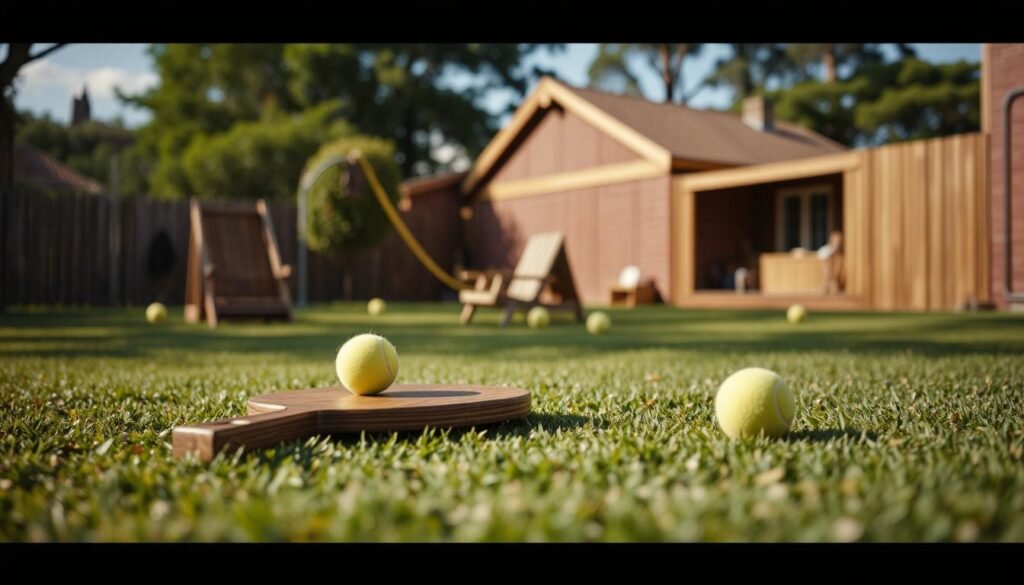
The original paddles were plywood. They were heavy, they had no surface texture, and they worked well enough to invent the sport with.
Modern paddles are composite: a honeycomb core with a fibreglass, carbon fibre or other facing. They are lighter, they generate more spin, and they are governed by a published equipment standard that specifies dimensions, surface roughness and deflection.
Wooden paddles still exist and are still used by beginners and in schools, because they are cheap and nearly indestructible. They are not competitive equipment, and it is worth being clear about that in any product copy: a wooden paddle is an entry-level or recreational product, not a performance one.
Where We Fit, and Where We Do Not
We manufacture wooden garden games. Pickleball equipment is a different product category, and it is worth saying plainly that we are not the right supplier for it.
- Composite paddles. These require moulding, core materials and a surface specification we do not work with. We do not make them.
- Wooden paddles. We can produce these, and they are a legitimate entry-level product. But they are not competitive equipment, and the performance claims in most pickleball marketing do not apply to them.
- Balls. Moulded plastic with a specific hole pattern and bounce requirement. Outside our process.
- Nets and court equipment. Metal and textile. Outside our process.
If you are building a pickleball range, the honest split is: source the performance equipment from a specialist, and source any wooden accessory or garden-game crossover from a wood manufacturer. A supplier who offers you the whole range is probably buying most of it in.
Frequently Asked Questions
Who invented pickleball?
Joel Pritchard, Bill Bell and Barney McCallum, on Bainbridge Island, Washington, in 1965.
Is it named after a dog?
Almost certainly not. Joan Pritchard said the name came from the rowing term “pickle boat”, meaning a crew assembled from leftovers. The dog story is more popular and less well supported.
Why is the court so small?
Because it is the same footprint as a badminton doubles court, which meant the sport could spread using facilities that already existed. That is the main practical reason for its growth.
What is the non-volley zone?
A seven-foot area on each side of the net where players may not volley the ball. It prevents tall or powerful players from dominating at the net, and it is what makes the game tactical.
Do you make pickleball equipment?
We make wooden paddles as an entry-level product. We do not make composite paddles, balls or nets, and we would rather say so than quote for something we would have to buy in.
Sourcing Wooden Garden Games in Bulk?
Kangjie is the direct manufacturer behind these games — no trading company, no middleman margin. We supply Kubb, Croquet, Molkky, Ring Toss, Tumble Tower, Cornhole and more to importers, retailers and brand owners worldwide.
- Factory-direct pricing with transparent volume tiers (500 / 1,000 / 5,000 units)
- OEM & ODM: logo, packaging, size and finish built to your specification
- EN71 & ASTM F963 compliant; FSC-certified timber
- Bulk lead time 30–45 days, quotation within 24 hours









