
Lawn bowls is a game of rolling a biased ball at a small target, and almost all of its difficulty comes from one fact: the bowls are not round. They are shaped so that they curve as they slow down, which means every shot is aimed away from the target and allowed to bend back toward it.
That single property is what separates bowls from bocce, and it is the thing most explanations leave out.
The Equipment, and What It Is Made Of
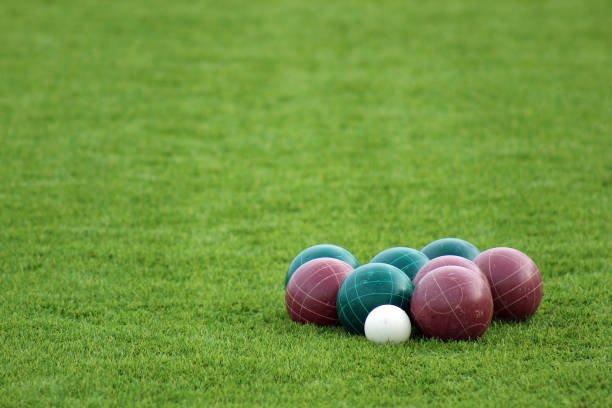
The jack. A small white ball, about 63 to 67 mm in diameter, rolled out at the start of each end to set the target. It is the whole objective of the game.
The bowls. Four per player in singles, and fewer as team size grows. Competition bowls are around 115 to 130 mm in diameter and are made from a dense composite, usually a melamine-based material, so that weight and bias are consistent. Historically they were made from lignum vitae, a timber so dense it sinks in water.
The bias. The bowl is shaped asymmetrically, with one side slightly flatter. It therefore curves toward the flat side as it loses speed. There is a small mark on each bowl indicating which side is the bias side, and that mark is the first thing a player checks.
The Green and the Rink
A bowling green is a prepared lawn, divided into parallel strips called rinks. Each rink is a self-contained game: bowls that leave the rink are dead, and players on one rink do not interfere with another.
For a garden version, none of that precision is required. A flat strip of short grass about 3 metres wide and 20 to 25 metres long is enough to learn on. What matters is that it is flat: a bowl that curves is hard enough to read without a slope underneath it.
How a Game Is Played
Starting the end
A coin toss decides who bowls first. The winner rolls the jack to a distance of at least 23 metres from the mat, and it must finish within the rink. The jack’s final position becomes the target, and it can be moved later by a bowl hitting it.
The order of play
This is the rule beginners get wrong, and it is the rule that makes the game tactical. Players do not simply alternate. After the first bowl of an end, whoever is furthest from the jack bowls next, and continues until they get a bowl closer or run out.
That is why the game has a rhythm: the player who is behind keeps shooting until they catch up or exhaust their bowls, and the player who is ahead waits.
Delivery
Stand on the mat with at least one foot on or directly over it, and deliver underarm with a smooth pendulum swing. The bias does the rest. Most beginners aim straight at the jack and are surprised when the bowl curves away; the correct approach is to aim out to the side and let the bowl come back.
Scoring
Only one side scores in an end. When all bowls have been delivered, count how many of the leading side’s bowls are closer to the jack than the opponent’s nearest bowl. That is the score, and the maximum in singles is four.
Games are played to a set number of ends or to a target score, depending on the competition.
Fouls and Dead Bowls
- Foot fault. If no foot is on or over the mat at delivery, the bowl is dead and removed.
- Out of rink. A bowl that comes to rest entirely outside the rink boundary is dead.
- The ditch. A bowl that ends up in the ditch at the end of the rink is live only if it touched the jack before going in.
- The jack driven out. If the jack is knocked out of the rink, it is re-spotted rather than the end being abandoned. This differs from how it is often described, and it is worth checking the current rule for the competition you are playing.
Etiquette
Do not walk on a neighbouring rink. Stand still and stay quiet when an opponent is on the mat. Do not stand behind the jack in a player’s line of sight. These are not formal rules in most club play, but they are enforced socially and a visitor who ignores them will be told.
Bowls, Bocce and Boules
Three games that look similar and are not.
| Game | Projectile | Bias | Surface |
|---|---|---|---|
| Lawn bowls | Composite bowl, ~120 mm | Yes, by design | Prepared flat green |
| Bocce | Round ball, ~107 mm | No | Any reasonably flat surface |
| Petanque | Metal ball, ~75 mm | No | Gravel or hard ground |
The bias is the defining difference. A bocce ball goes where you roll it; a bowl does not.
Where We Fit
Worth being direct, because this comes up: we do not make lawn bowls. Competition bowls are a moulded composite product with a specified bias, and that is a different manufacturing process from ours.
What we do make is the wooden garden game category: croquet, bocce in timber, kubb, Mölkky, tumble tower, ring toss, ladder toss, cornhole, skittles and tabletop games. If you are building a lawn game range, bowls is a product you would source from a specialist, and a supplier who offers you the whole range is probably buying most of it in.
Frequently Asked Questions
How many bowls does each player get?
Four in singles, four each in pairs, three each in triples and two each in fours. The total per side stays at four in every format, which is why team size changes the tactics.
Can you hit the jack?
Yes, and it is a legitimate tactic. If the jack is moved, the target moves with it and the end continues from the new position. Driving the jack out of the rink does not end the end; it is re-spotted.
What is the difference between lawn bowls and bocce?
The bowls are biased and curve; bocce balls are round and roll straight. The surfaces differ too: bowls is played on a prepared green, bocce on almost anything flat.
What are bowls made of?
Modern competition bowls are a dense composite, usually melamine-based, so that weight and bias are consistent. Historically they were lignum vitae, a very dense timber.
Do you supply lawn bowls?
No. We make wooden garden games. Bowls is a moulded composite product with a specified bias and we are not the right supplier for it.
Sourcing Wooden Garden Games in Bulk?
Kangjie is the direct manufacturer behind these games — no trading company, no middleman margin. We supply Kubb, Croquet, Molkky, Ring Toss, Tumble Tower, Cornhole and more to importers, retailers and brand owners worldwide.
- Factory-direct pricing with transparent volume tiers (500 / 1,000 / 5,000 units)
- OEM & ODM: logo, packaging, size and finish built to your specification
- EN71 & ASTM F963 compliant; FSC-certified timber
- Bulk lead time 30–45 days, quotation within 24 hours









