
The case for outdoor games is usually made in vague terms: fresh air, family time, less screen time. All true, and all difficult to act on if you are deciding whether to stock a category or add a line to a venue.
This article takes a different approach. It sets out what outdoor games actually do for the people playing them, which of those effects are well established and which are overstated, and what the honest commercial case looks like for a buyer. Where a claim is commonly repeated but not well supported, we say so.
The Physical Side
Outdoor games produce movement that does not feel like exercise, which is the whole point. Nobody walks out to a garden to do a workout, but a two-hour session of cornhole, kubb or tumble tower involves a surprising amount of standing, walking, bending, reaching and throwing.
The honest framing is that these games contribute to daily activity rather than replacing it. The World Health Organization’s guidance for adults is at least 150 minutes of moderate-intensity activity per week, and lawn games sit at the light-to-moderate end of that scale. They help, particularly for people who would otherwise sit, but a claim that a game delivers a training effect would not survive scrutiny.
What they do deliver reliably is low-barrier movement. A game has a reason to stand up, a reason to walk to the other end, and a reason to keep going for another round. That is more than most exercise advice achieves.
What Games Train That Gyms Do Not
Throwing games train coordination and proprioception, the sense of where your body is and how much force you are applying. Bocce, ladder toss and washers all require a calibrated underhand release, which is a skill most adults have not practised since school. Croquet adds a static aim-and-strike action that is closer to golf or billiards.
Balance and posture matter too, especially in games played on uneven grass. Standing on a lawn is not the same as standing on a gym floor, and older players notice the difference.
The Mental Side
Two effects are reasonably well described in the literature on play and cognition: attention and planning.
Games with visible state, such as tumble tower or croquet, require you to hold a plan across several turns while the board changes. That is working memory under mild pressure, and it is the same faculty that makes these games satisfying rather than merely diverting. Games with hidden information, such as kubb in its later rounds, add a layer of reading the opponent.
What is often claimed and should be treated with caution is the idea that a specific game produces a specific cognitive improvement. The general finding is that active, social, effortful activity is associated with better cognitive outcomes; the claim that ten minutes of a particular game raises a particular test score is not something to put in marketing copy.
The Attention Argument
The most defensible mental benefit is simpler than any of that. A game holds attention. In a room full of phones, an activity that keeps six people looking at the same object for forty minutes is doing something that is genuinely hard to buy otherwise. That is the argument venues and event organisers respond to, and it does not require a statistic.
The Social Side
This is where outdoor games are strongest and where the evidence is least controversial.
They flatten hierarchies. A game with a short rule set and a luck component lets a ten-year-old beat a director of engineering. That is a rare thing in a structured setting, and it is why these games work at corporate events and family gatherings alike.
They give people something to do with their hands. Conversation at a gathering stalls when everyone is standing with a drink. A game gives the group a shared object to look at, which removes the pressure of maintaining eye contact and small talk.
They work across ages. With the throwing distance adjusted, most of these games are playable from about six to eighty. Few activities span that range.
What Event Buyers Actually Care About
For hotels, hire companies and corporate event organisers, the practical benefits are different from the personal ones. They care about setup time, storage space, how many people one set occupies, and whether the set survives a season of use by strangers. A game that takes twenty minutes to set up will not be used, no matter how good it is.
Why Wooden Rather Than Plastic
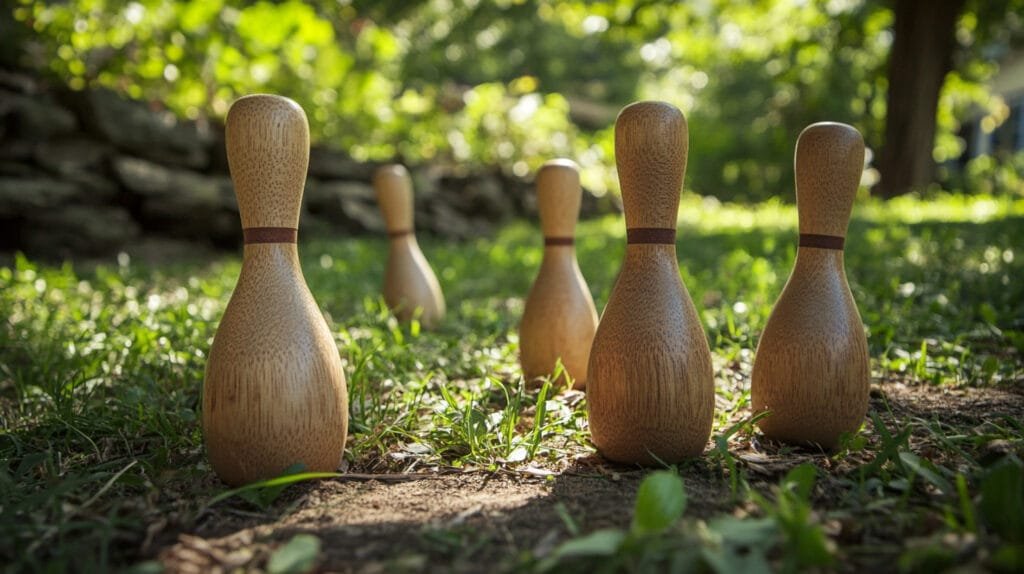
This is a real trade-off, not a marketing position, and it is worth being specific about both sides.
Where Wood Wins
- Repairable. A splintered corner can be sanded. A cracked plastic moulding cannot be fixed at all.
- Weight and feel. Wooden blocks and mallets have mass where it matters. Plastic versions often feel hollow, which players notice immediately.
- Repairable finish. A wooden set can be re-oiled or re-sealed after a few seasons. Plastic fades and there is nothing to do about it.
- Perceived value. A wooden game reads as a considered purchase rather than a disposable one, which supports a higher price and a gift market that plastic does not reach.
Where Wood Loses
- Moisture. Wood moves with humidity. Left outside in the rain for a week, any wooden set will swell, warp or split, no matter what the finish. A wooden game is a garden game, not an outdoor fixture, and the copy should say so.
- Weight in freight. Wooden sets cost more to ship than plastic equivalents of the same size.
- Consistency. Timber colour and grain vary between batches. This is normal and needs to be explained to buyers, because a customer who reorders expects a match.
- Cost. At the entry level, plastic is simply cheaper, and pretending otherwise is not useful.
The honest summary: wooden games are a better product for the customer who intends to keep the set for years and a worse product for the customer who wants the cheapest option for one event.
The Commercial Case
If you are deciding whether to stock outdoor games, four things determine whether the category works for you.
Seasonality. Demand is concentrated in spring and early summer in most markets, with a second smaller peak before Christmas for gift purchases. Ordering needs to be planned backwards from those two windows, and the production lead time sits between them.
Storage. These products are bulky. A pallet of cornhole boards takes space that a pallet of small boxed goods does not. Carton cube, not unit cost, is often what decides whether a line is viable.
Repeat purchase. The wooden parts last; the soft parts do not. Bags, bolas, rings and balls are where the second sale comes from, which means spare-part availability is a commercial feature, not an afterthought.
Differentiation. The category is crowded at the generic end. The two things that separate a line are finish quality and customization: engraved branding, custom colours, a box that photographs well. Those are cheap to add at the manufacturing stage and hard for a competitor to copy once you own the design.
Sourcing Notes
A few specifics that come up on almost every order in this category.
- Sampling. Five to ten days once the specification is agreed. The sample is where you judge feel and finish, so it is worth doing even when the design is a repeat.
- Production. Thirty to forty-five days after sample approval for a custom run. The window assumes the specification is fixed at approval; changes after that point are what push orders back.
- Minimum order. Around 500 sets per design is the usual point at which custom tooling, custom packaging and a workable unit price line up.
- Compliance. EN 71 parts 1 to 3 for Europe and ASTM F963 for the United States, with test reports from a recognised laboratory. For US imports you will also need a Children’s Product Certificate, which the importer issues on the basis of those reports.
- Timber. FSC certification covers the supply chain, not product safety. Both matter, but they answer different questions.
Frequently Asked Questions
What is the minimum order quantity?
Around 500 sets per design for a custom run. Smaller quantities are possible on stock designs with your branding applied.
How long does delivery take?
Samples in five to ten days after the specification is agreed, bulk production in thirty to forty-five days after sample approval. Shipping time depends on the destination and the mode, and we quote it separately rather than folding it into a single figure.
Which certifications do you hold?
Products are tested to EN 71 and ASTM F963 as applicable, and timber is FSC certified. We provide the test reports with the order. We do not claim certifications we have not been audited for.
Can you work from a design we already have?
Yes, and that is usually the fastest route. Send drawings or a physical sample, and we will confirm what can be matched and what needs to change for manufacture.
How is confidentiality handled?
We sign a non-disclosure agreement before drawings are shared, and we do not produce a customer’s custom design for anyone else. If a design is exclusive to you, that needs to be stated in writing at the start, because it affects how we schedule the tooling.
Are these games suitable for commercial use?
They are used in hotels, hire fleets and event venues, but commercial use wears products faster. Specify thicker sections, stainless fixings and a heavier finish if the set will be used by the public rather than a family.
Sourcing Wooden Garden Games in Bulk?
Kangjie is the direct manufacturer behind these games — no trading company, no middleman margin. We supply Kubb, Croquet, Molkky, Ring Toss, Tumble Tower, Cornhole and more to importers, retailers and brand owners worldwide.
- Factory-direct pricing with transparent volume tiers (500 / 1,000 / 5,000 units)
- OEM & ODM: logo, packaging, size and finish built to your specification
- EN71 & ASTM F963 compliant; FSC-certified timber
- Bulk lead time 30–45 days, quotation within 24 hours









