
Finland has an unusually strong claim on garden games for a country of five and a half million people. Two of the most widely played throwing games in Europe were either invented there or codified there, and both are simple enough to manufacture in wood without a licence.
That combination — genuine origin, simple components, no rights holder to negotiate with — is why Finnish games keep appearing in outdoor ranges. Below is what they actually are, how they differ, and what to watch if you are sourcing them.
Mölkky
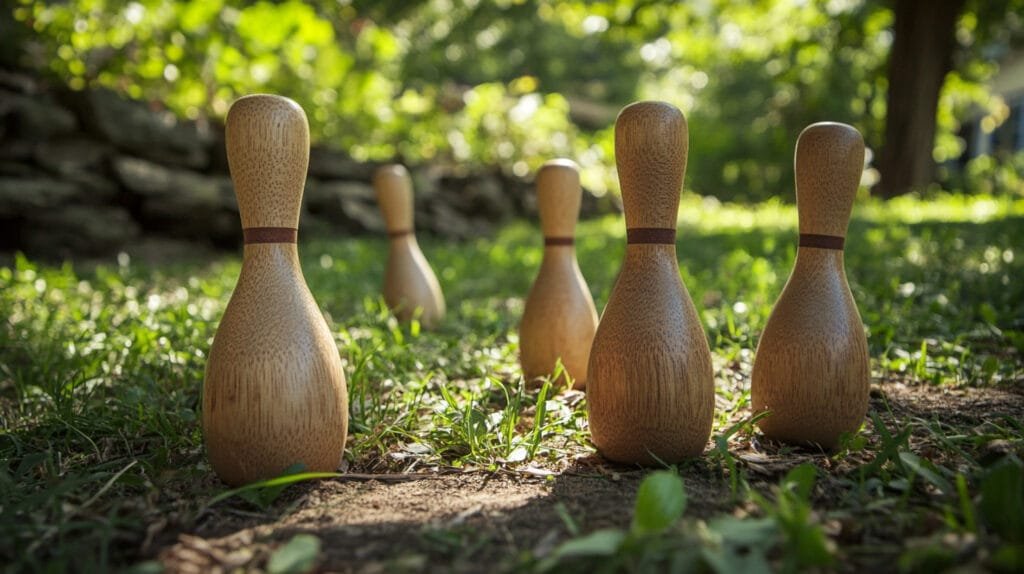
The best-known Finnish garden game, and the one that travels best. Twelve numbered wooden pins are set in a tight group. Players throw a single wooden baton from about three and a half metres, and knock down pins to score.
How the Scoring Works
This is where Mölkky separates itself from every other skittle game.
- One pin falls — you score the number on that pin.
- Several pins fall — you score the number of pins that fell, regardless of which ones.
- Exactly 50 points wins.
- Going over 50 drops you back to 25.
The third and fourth rules turn it into a decision game. At 48 points, knocking down four pins loses you the game; you need a two. That is a genuinely different experience from skittles, and it is why adults keep playing it after the novelty of throwing a stick has worn off.
What to Specify
- Pins. Beech, because they take a direct hit from the baton at speed. Pine pins deform and split.
- Numbers. Burned or engraved before finishing, on the upper part of the pin where they stay legible after the base has been scuffed.
- Baton. Around 55 cm, with rounded ends. A square-ended baton damages the pins.
- Carry bag. Not optional. Twelve pins and a baton loose in a carton arrive as a pile of sticks.
Kyykkä
Older than Mölkky by a considerable margin, and a different game. Kyykkä is a Karelian throwing game in which teams throw heavy batons at a group of wooden cylinders (or a stack of them) on the opposing side, trying to clear them from the play area.
The equipment is heavier and more robust than Mölkky, the play area is larger, and the throwing action is closer to a bowl than a lob. It is played competitively in Finland and in Karelian communities, and it is the game most often described in English as Finnish skittles.
Sourcing note: the batons are the whole product. They are thick, heavy and take a direct impact, so the species and the grain direction matter more than the finish. Beech or another dense hardwood, with the grain running the length of the baton and no knots near the striking end.
How the Two Differ
- Mölkky — light baton, lobbed, twelve numbered pins, individual scoring to exactly 50. A family and pub game.
- Kyykkä — heavy baton, thrown low, teams, clear-the-field objective. A club and tournament game.
They are not interchangeable, and a product described as “Finnish skittles” could be either. Ask for the pin count and the baton weight before quoting.
Why Finnish Games Suit a Wooden Range
- No licensing. Both are traditional games in the public domain. Mölkky as a commercial product was developed in Finland in the 1990s, but the game itself and its equipment are not something a manufacturer needs a licence for; the brand name is a different matter and should not be used as your product name.
- Simple components. Pins, a baton, a bag. No mechanisms, no hardware, no assembly.
- Genuine story. “A Finnish throwing game from 1996” is a better retail story than “a wooden skittle set”, and it costs nothing to tell.
- Compact freight. A twelve-pin set packs into a carton smaller than a cornhole board and weighs less.
Naming and Trademarks
This is the part worth getting right before any packaging is printed.
- Mölkky is a registered trademark in Finland and elsewhere. Selling a game under that name without a licence is not advisable. Describe the product by its type, and use the name only as a reference in body copy.
- Kyykkä is a traditional game name and is used generically, but the equipment specifications of competition versions may be protected by the governing body rather than by trademark law.
- Generic descriptions that work: Finnish skittle game, numbered-pin throwing game, Finnish lawn skittles.
If a buyer asks for “Mölkky” as the product name on the box, the honest answer is that it needs a licence or a different name. That conversation is much cheaper before the artwork than after.
Other Finnish Games Worth Knowing
Beyond the two throwing games, Finland’s game culture is better known for board games and for mobile games than for garden equipment. A few things worth mentioning for completeness:
- Mölkky variants — there are indoor and junior versions with lighter pins and shorter throwing distances. Both are straightforward to produce from the same tooling at a smaller scale.
- Traditional skittle games — regional variants exist across the Nordic countries, and several are close enough to Mölkky that one product can serve two markets with a different rules card.
What we would not do is build a product around a modern branded video game. Those names and characters are protected, and a wooden version sold under the game’s name is an infringement rather than a tribute.
Sourcing Notes
- Species: beech for pins and batons; rubberwood acceptable for a junior set.
- Finish: water-based lacquer; EN71 and ASTM F963 compliance for anything sold as a toy.
- FSC-certified timber available on request, with the chain-of-custody documentation supplied.
- Minimum 500 sets; samples 5–10 days; production 30–45 days after approval.
Conclusion
Mölkky and Kyykkä are the two Finnish games worth stocking. One is a family game with a scoring rule that makes it strategic; the other is a heavier team game with a tournament following. Both are simple to manufacture and neither needs a licence to make — though one needs a different name on the box.
Tell us which one you want and the price point, and we will quote it with the pin count, baton weight and carton dimensions spelled out.
FAQs
What is the difference between Mölkky and Kyykkä?
Mölkky uses a light baton lobbed at twelve numbered pins with individual scoring to exactly 50. Kyykkä uses a heavy baton thrown low at wooden cylinders in a team format. Different equipment, different game.
Can I sell a game called Mölkky?
Not without a licence — the name is a registered trademark. Describe the product generically, for example as a Finnish numbered-pin throwing game, and use the name only as a reference.
What wood should the pins be?
Beech. The pins take a direct hit from a baton and softer species deform and split at the base within a season.
What is the minimum order?
500 sets. Junior and standard sizes can be combined within one order.
How long does production take?
Samples in 5–10 days after the specification is agreed, and production in 30–45 days after sample approval.
Sourcing Wooden Garden Games in Bulk?
Kangjie is the direct manufacturer behind these games — no trading company, no middleman margin. We supply Kubb, Croquet, Molkky, Ring Toss, Tumble Tower, Cornhole and more to importers, retailers and brand owners worldwide.
- Factory-direct pricing with transparent volume tiers (500 / 1,000 / 5,000 units)
- OEM & ODM: logo, packaging, size and finish built to your specification
- EN71 & ASTM F963 compliant; FSC-certified timber
- Bulk lead time 30–45 days, quotation within 24 hours









