
Number Kubb sits between two better-known games. It has the equipment of a skittle game and the scoring of Mölkky, with twelve numbered pins knocked down by a single baton. The name borrows from Kubb, which is a different game entirely, and that confusion is the main thing to clear up before you source it.
This page sets out the rules as they are actually played, the difference between the three games, and what to specify in production.
What It Is
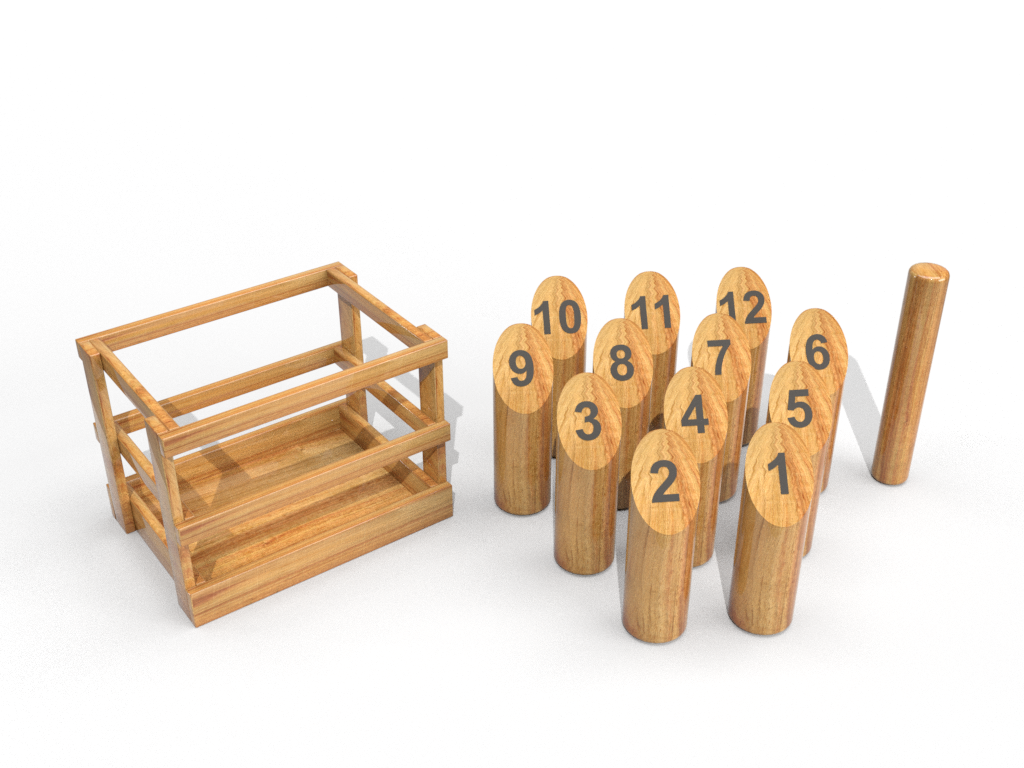
Twelve wooden pins, numbered 1 to 12, set in a tight group. Players throw a wooden baton from a marked line and score by the pins they knock down. The scoring rules — not the equipment — are what make it a game rather than an activity.
Components
- 12 numbered pins, roughly 15–20 cm tall, numbered 1 to 12.
- 1 baton, around 55 cm, with rounded ends.
- Carry bag — required at this piece count.
- Rules card — the scoring needs explaining, so print it.
The Rules
Setup
Group the twelve pins tightly, in the order 1 to 12, about 3 to 4 metres from the throwing line. The exact formation varies by region; a tight group with the highest numbers at the back is the common version, and it makes the low numbers easier to hit.
A Turn
Each player throws one baton, underhand or overarm, at the group. Then the pins are stood back up where they fell and play passes on. That reset is important: unlike skittles, the pins do not stay down between turns.
Scoring
- One pin falls — score the number printed on it.
- Several pins fall — score the number of pins that fell, not their face values.
- No pins fall — score nothing.
Winning
Exactly 50 points wins. Going over 50 drops your score to 25.
Those two sentences are the whole game. At 48 points you cannot simply knock down as many pins as possible — you need exactly two, which means aiming at a specific pin rather than the group. The last few turns become a completely different game from the first few.
The Miss Rule
Many house versions include a penalty for repeated misses: three consecutive turns without knocking down a pin and the player is out. It is optional, and it is worth printing either way so that groups do not invent conflicting versions.
Number Kubb, Kubb and Mölkky
These three get confused constantly, and the confusion costs buyers money because the equipment is not interchangeable.
| Number Kubb | Kubb | Mölkky | |
|---|---|---|---|
| Players | Individual or teams | Two teams | Individual |
| Target | 12 numbered pins | Line of blocks plus a king | 12 numbered pins |
| Scoring | Pin number, or count | Clear the field | Pin number, or count |
| Win condition | Exactly 50 | Topple the king | Exactly 50 |
| Baton | Single, lobbed | Several, thrown | Single, lobbed |
In short: Number Kubb and Mölkky are the same game with different names and slightly different pin sets. Kubb is a different game with different equipment and a different objective. A buyer who orders “Kubb” expecting numbered pins will not get them.
The Naming Problem
“Number Kubb” is a descriptive name rather than a distinctive brand, and several suppliers use it. That creates two risks:
- Confusion with Kubb. A customer searching for Kubb may buy this and be surprised. Put a clear photograph of the pins on the listing and the box.
- Overlap with Mölkky. The game is functionally the same, and the Mölkky name is a registered trademark. Do not use it, and do not describe your product as “Mölkky-style” on packaging.
Generic descriptions that work: numbered pin throwing game, numbered skittle game, 12-pin throwing game.
Production Specification
- Pins. Beech. They take a direct hit from the baton and softer species deform at the base within a season.
- Numbers. Burned or engraved before finishing, positioned where they stay legible after the base has been scuffed.
- Baton. 55 cm, rounded ends, dense hardwood. A square-ended baton damages the pins.
- Bag. Canvas or heavy cotton with a divider. Twelve pins and a baton loose in a carton arrive as a pile of sticks.
- Finish. Water-based lacquer; EN71 and ASTM F963 for anything sold as a toy.
- Minimum 500 sets; samples 5–10 days; production 30–45 days after approval.
Conclusion
Number Kubb is a numbered-pin throwing game with Mölkky-style scoring, and it is the exactly-50 rule that makes it worth playing. It is not Kubb, and the packaging has to make that clear.
We build numbered pin sets in beech from 500 sets, with the pins numbered to your sequence and the rules card printed. Tell us the pin height and the price point and we will quote it.
FAQs
Is Number Kubb the same as Kubb?
No. Kubb uses a line of blocks, a king block and multiple batons, with two teams trying to clear the field. Number Kubb uses twelve numbered pins and a single baton, scored to exactly 50.
Is it the same as Mölkky?
Functionally yes — same equipment, same scoring. The Mölkky name is a registered trademark and should not appear on your product or packaging.
What happens if you go over 50?
Your score drops to 25. That rule is what makes the endgame strategic rather than a simple race.
What wood should the pins be?
Beech. The pins take repeated impact and softer species split at the base.
What is the minimum order?
500 sets. Two pin sizes can usually be combined within one order.
Sourcing Wooden Garden Games in Bulk?
Kangjie is the direct manufacturer behind these games — no trading company, no middleman margin. We supply Kubb, Croquet, Molkky, Ring Toss, Tumble Tower, Cornhole and more to importers, retailers and brand owners worldwide.
- Factory-direct pricing with transparent volume tiers (500 / 1,000 / 5,000 units)
- OEM & ODM: logo, packaging, size and finish built to your specification
- EN71 & ASTM F963 compliant; FSC-certified timber
- Bulk lead time 30–45 days, quotation within 24 hours









