
A life-size four-in-a-row frame is the single most effective crowd-puller in the garden game category, and the one that generates the most after-sales problems. Both statements are true for the same reason: it is a large, mechanical, outdoor product, and every part of it has to work when a stranger drops a disc into it two hundred times in an afternoon.
This page covers what “life-size” actually means in practice, the three build decisions that decide whether the frame survives a season, and the naming issue that matters before you print any packaging.
Why Venues Buy It
- It reads from a distance. A 1.2 m frame with coloured discs is visible across a field or a trade hall, which is what a rental company or a venue is paying for.
- It has no learning curve. One rule, understood in ten seconds, playable by a five-year-old against an adult.
- It produces a crowd. Two players and four spectators is the natural state of the game, and the spectators become players.
- It photographs itself. Every event that hires one gets images of it, which is free marketing for the venue.
What it does not do is sell on specification alone. Two frames that look identical in a photograph can differ by a factor of three in weight and by a year in service life.
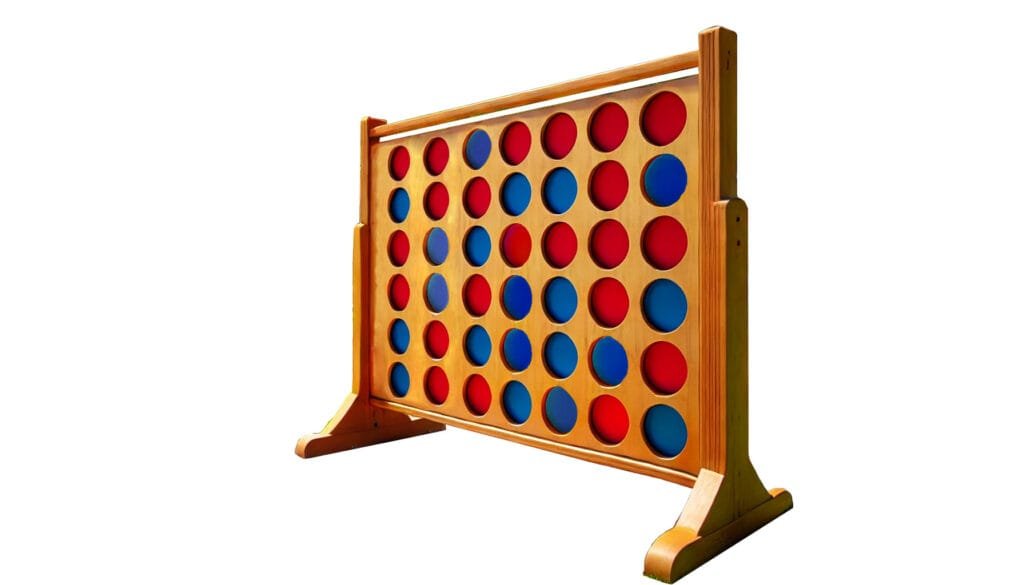
What “Life-Size” Actually Means
The category is loose about sizing. In practice there are three tiers, and they are different products:
- Tabletop — around 30 cm tall, discs 3 cm. A gift product, not an event product.
- Standing — 90–120 cm tall, discs 10–15 cm. The standard event and rental size, and the one most buyers mean.
- Oversized — 150 cm and above, discs 20 cm. Needs a braced frame and two people to move. Sold to venues, not to families.
Ask for the frame height, the disc diameter, the assembled weight and the packed carton dimensions. A supplier who cannot give all four numbers is working from a photograph, not a drawing.
The Three Build Decisions
1. Frame Construction
The frame has to stay square under load. A 120 cm frame holding forty discs is carrying real weight, and the discs drop onto the bottom rail every time.
- Solid timber frame — the premium option. Heavy, stable, and it looks like furniture. Needs proper joinery at the corners; screwed butt joints will open within a season.
- Braced plywood — lighter and cheaper, and fine for the standing size, provided the internal bracing is designed rather than improvised.
- Knock-down frame — bolts together for transport. Essential for rental fleets, and it halves the carton volume. The trade-off is that bolted joints work loose, so specify the fixings properly.
2. Disc Material
Wood discs are the right answer for this product and plastic discs are the common shortcut.
- Wood — consistent weight, no UV degradation, and it matches the frame. Heavier, so freight costs more, and it needs a finish that survives being handled by hundreds of people.
- Plastic — cheaper and lighter, but it goes chalky in sunlight, chips at the rim, and undermines the material story the rest of the product is built on.
A two-colour set in contrasting species — beech against a darker stained hardwood — reads clearly at distance and avoids paint entirely.
3. The Release Gate
This is where cheap frames fail. Each column has a gate at the bottom that holds the stack and releases one disc at a time.
- Sliding bar — simple, durable, and the version we recommend. One moving part per column.
- Pivoting latch — smoother action, more parts, and the springs or pivots are the first thing to fail outdoors.
- Friction fit — no mechanism at all, relying on tolerance. Works when new and stops working once the timber moves.
Test it before you order five hundred: drop twenty discs through one column in a row and see whether the gate still returns cleanly.
Where It Fails in the Field
- Wind. A tall frame with a light base blows over. Either add ballast to the feet or design the frame to fold flat.
- Warping. Timber that was not dried to the right moisture content will bow across a 120 cm span, and a bowed frame jams the discs. This is the most common failure and it is entirely a sourcing problem.
- Gate jam. Dust, grass and grit get into the channel. A gate with clearance and no exposed spring survives; a tight one does not.
- Storage. A fixed frame is awkward to store and gets left outside. A knock-down version gets taken apart and kept, which is why rental companies insist on it.
The Naming Problem
The game is four in a row. The best-known commercial version is a registered trademark, and it is not yours to put on a product, a box or a listing unless you hold a licence.
What is fine:
- Selling the product as four in a row, giant four in a row or life-size four in a row.
- Describing it in body copy as the game people may know by a brand name, once, as a comparison.
- Using your own product name and your own colour scheme.
What is not:
- Printing the brand name on the frame, the box or the instructions.
- Using the brand’s logo, disc colours and grid proportions together as a recognisable copy.
- Listing it on a marketplace under the brand name, which is the fastest route to a takedown.
If you are buying for retail, settle the name before the packaging artwork is signed off. Changing it afterwards means reprinting, and reprinting is the most expensive mistake in this product.
Rental Versus Retail
The two buyers need different products from the same design.
- Rental — knock-down frame, replaceable discs, a flight case or a heavy-duty bag, and a spare gate. Ask whether individual components can be reordered.
- Retail — fixed or lightly knock-down frame, printed carton, assembly instructions with a diagram, and a retail-ready box that survives a pallet.
Both need the same thing underneath: a frame that stays square and a gate that keeps working.
Specification We Build To
- Standing size 90–120 cm, discs 10–15 cm, in beech and stained hardwood.
- Fixed or knock-down frame, with mortised or through-bolted corners.
- Sliding-bar gates with clearance for outdoor use.
- Water-based finish, EN71 and ASTM F963 compliance, FSC-certified timber available.
- Minimum 500 sets; samples in 5–10 days; production 30–45 days after approval.
Conclusion
A life-size four-in-a-row frame is a good product with three failure points: the moisture content of the frame, the corner joinery and the gate. Get those right and it will outlast the venue’s carpet. Get them wrong and it will be the thing the venue complains about.
Send us the height, the disc size and whether it needs to knock down, and we will quote it with the carton dimensions included so you can price the freight properly.
FAQs
How tall should a life-size version be?
90–120 cm for events and rental. Taller frames look more impressive and need a braced base or ballast to stay upright in wind.
Wood or plastic discs?
Wood, for consistency of weight, resistance to UV and a coherent material story. Plastic is cheaper and degrades visibly after a season outdoors.
Can the frame knock down for transport?
Yes, and it is worth specifying for anything going to a rental fleet. It roughly halves the carton volume, which changes the freight cost materially at container volume.
What should I call the product?
Four in a row, or giant four in a row. The well-known branded name is a registered trademark and should not appear on the product or the packaging.
What is the minimum order?
500 sets. Two sizes can usually be combined to reach it.
Sourcing Wooden Garden Games in Bulk?
Kangjie is the direct manufacturer behind these games — no trading company, no middleman margin. We supply Kubb, Croquet, Molkky, Ring Toss, Tumble Tower, Cornhole and more to importers, retailers and brand owners worldwide.
- Factory-direct pricing with transparent volume tiers (500 / 1,000 / 5,000 units)
- OEM & ODM: logo, packaging, size and finish built to your specification
- EN71 & ASTM F963 compliant; FSC-certified timber
- Bulk lead time 30–45 days, quotation within 24 hours









