
They are different games, and the difference is not the number of pins. It is the lane.
Bowling is played down a prepared lane at a fixed distance with a standardised pin set and a formal scoring system. Skittles is played at a short distance, usually outdoors, with no lane, and with regional rule sets that differ from village to village. Everything else follows from that.
The Short Answer
| Skittles | Ten-pin bowling | |
|---|---|---|
| Lane | None | 18.3 m from foul line to head pin |
| Pins | Usually 9, sometimes 5 or 6 | 10, in a triangle |
| Ball | Small, 100 to 150 mm, thrown or rolled | Large, up to 7.26 kg, with finger holes |
| Setting | Outdoors, pub yard, garden | Indoor, purpose-built |
| Scoring | Local, often simple | Standardised across the world |
| Governing body | None internationally | Yes, with world championships |
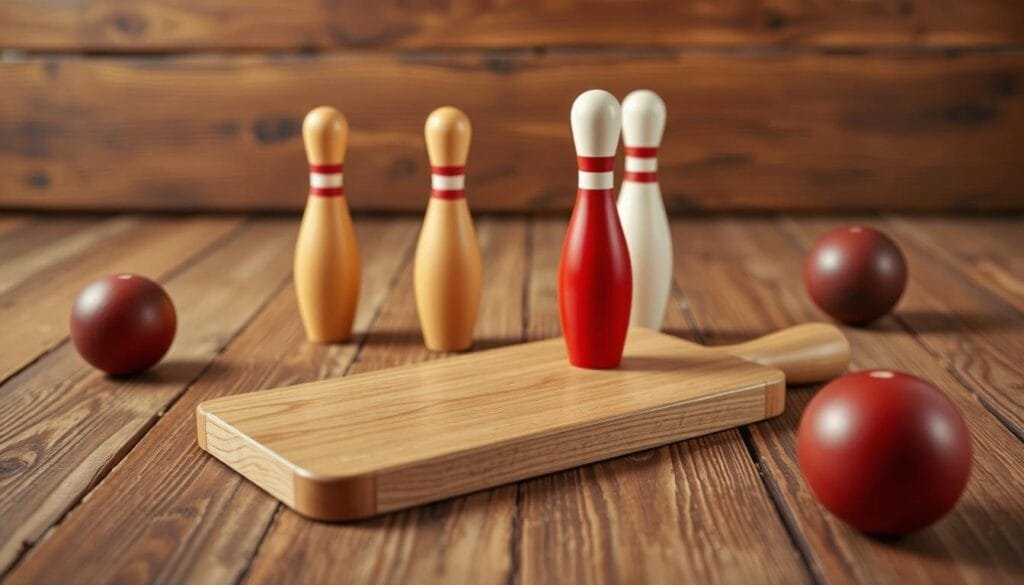
Pin Counts Across the Family
The “nine versus ten” summary is the version you will read everywhere and it is too simple. There are at least six distinct pin-and-ball games in this family, and they differ in ways that matter if you are choosing a product.
| Game | Pins | Ball | Where |
|---|---|---|---|
| Ten-pin | 10 in a triangle | Up to 7.26 kg, finger holes | Worldwide, indoor |
| Nine-pin, European | 9 in a diamond | About 2.5 kg, no holes | Germany, Austria, Switzerland |
| Five-pin, Canadian | 5 in a V | About 1.6 kg, no holes | Canada |
| Candlepin | 10, tall and thin | About 1.1 kg | New England |
| Duckpin | 10, short and squat | About 1.6 kg | Maryland and nearby states |
| West Country skittles | 9 in a square | Small, thrown | South-west England |
Two of those are worth noting for a garden range. Five-pin and candlepin both use a ball small enough to be thrown by a child, which is why they translate to outdoor products so well. A ten-pin ball at 7 kg is not a garden object.
What Actually Separates Them
The lane. A bowling lane is 18.3 metres of oiled wood or synthetic, and the oil pattern is part of the game. Skittles has no lane, so the ball is thrown rather than rolled along a prepared surface, and the skill is in the throw rather than the line.
Ball size. A ten-pin ball is gripped with the fingers and released into a roll. A skittles ball is held in the palm and thrown. That single difference changes the whole physical action, and it is why a garden bowling set is not a bowling set: it is skittles.
Standardisation. Ten-pin is identical in every country. Skittles is not: the West Country game has nine pins in a square and rules about which pins must be knocked for the throw to count, and the pub game of bar skittles is a completely different object, played with a ball on a string inside a box.
Skittles Is Not One Game
Worth stating clearly, because the word covers at least three unrelated things.
Bar skittles. A wooden box with a swinging ball on a cord and a set of small pins on a platform. The player swings the ball around a post and tries to knock the pins off the back. It is a pub game, it is played on a table, and it has nothing in common with lawn skittles except the pins.
Lawn or West Country skittles. Nine pins in a square, a small ball thrown from 6 to 8 metres. This is the version that translates to a garden product.
European nine-pin. Nine pins in a diamond, a larger ball, a proper lane of 20 metres. It is a serious sport in Germany and Austria with its own championships.
If you are buying or specifying, the distinction matters: a product described as “skittles” could be any of the three.
What This Means for a Product Range
A garden product in this category is a skittles set, whatever the packaging calls it. That is not a problem, but the copy should be accurate, because a customer who buys a “bowling set” and receives nine pins and a palm-sized ball will feel misled even though the product is good.
The framing that works: wooden skittles is the outdoor ancestor of bowling, it needs no lane, and it plays in a garden of six by eight metres. That is a true and interesting story, and it does not require pretending the product is something it is not.
What to Specify
- Pin count and arrangement, stated explicitly, because nine-in-a-square and nine-in-a-diamond are different games.
- Pin height, diameter and mass. Pins that vary in mass fall differently, and a set with one heavy pin is a set that gets complained about.
- Ball diameter and mass, and whether it has finger holes. A ball without holes has to fit comfortably in an adult palm.
- Species. Beech for pins, because it takes repeated impact without denting; pine dents at the contact point within a season.
- How the pins are marked, and whether the mark survives being hit. Engraving outlasts printing.
- Whether a mat or a throw line is included.
Minimum order 500 sets, samples 5 to 10 days, bulk production 30 to 45 days, quotation within 24 hours.
FAQs
What is the difference between skittles and bowling?
The lane. Bowling is played down an 18.3 metre prepared lane with a large finger-hole ball; skittles is played at 6 to 8 metres with no lane and a small thrown ball.
How many pins does skittles use?
Nine in most versions, arranged in a square in the English game and a diamond in the European game. Bar skittles uses a smaller set inside a box.
Is a garden bowling set the same as bowling?
No. It is a skittles set. The ball is small and thrown rather than rolled, and there is no lane.
Which is easier?
Skittles, because there is no lane to read and no oil pattern. That is also why it translates to a garden and bowling does not.
What is the minimum order?
500 sets, with volume pricing at 500, 1,000 and 5,000 units.
Sourcing Wooden Garden Games in Bulk?
Kangjie is the direct manufacturer behind these games — no trading company, no middleman margin. We supply Kubb, Croquet, Molkky, Ring Toss, Tumble Tower, Cornhole and more to importers, retailers and brand owners worldwide.
- Factory-direct pricing with transparent volume tiers (500 / 1,000 / 5,000 units)
- OEM & ODM: logo, packaging, size and finish built to your specification
- EN71 & ASTM F963 compliant; FSC-certified timber
- Bulk lead time 30–45 days, quotation within 24 hours









