“Number Kubb” is a trade name for a game called Molkky, and the setup that most descriptions give – twelve pins in a tight cluster you can touch – is wrong in a way that makes the game unplayable. The pins are spaced across roughly 0.6 m, they are not touching, and that spacing is not decoration. It is the difficulty setting.
If you are standing in a garden with a bag of numbered pins and a skittle, here is the setup that works, and the one error that ruins it.

The Setup, Step by Step
- Lay out the pitch. Mark the throwing line and the pin cluster area. The line sits 3 to 4 m from the front pin; competition play uses 3.5 m, junior play 3 m.
- Set the twelve pins in the standard triangle. Ten pins form a triangle, and 11 and 12 stand at the two rear corners. The cluster is about 0.6 m across.
- Face the numbers at the thrower. A pin with its number turned away is unreadable from 3.5 m, and the game stalls while people walk up to check.
- Mark the line and measure to the front pin. Not to the centre of the cluster. The distance is the enforced dimension.
- Decide who starts, if you like, by one throw; then alternate.
The Error That Ruins the Setup
Most instructions say to pack the pins into a touching pyramid, and that is the single worst thing you can do. Two reasons:
- It makes the game trivial. A tight cluster means every throw knocks several pins, and several pins score only their count, so the scoring collapses to “knock the lot down and take 12”. The spacing is what creates the single-pin shot worth 12 points.
- It is not the game. The published diagram puts the pins a hand-span apart. Compress them and you are playing a different game, and the rules that make Molkky interesting – the field drift, the endgame arithmetic – disappear.
If a set arrives with the pins packed touching, spread them. That is the whole fix.
What Each Pin Is For
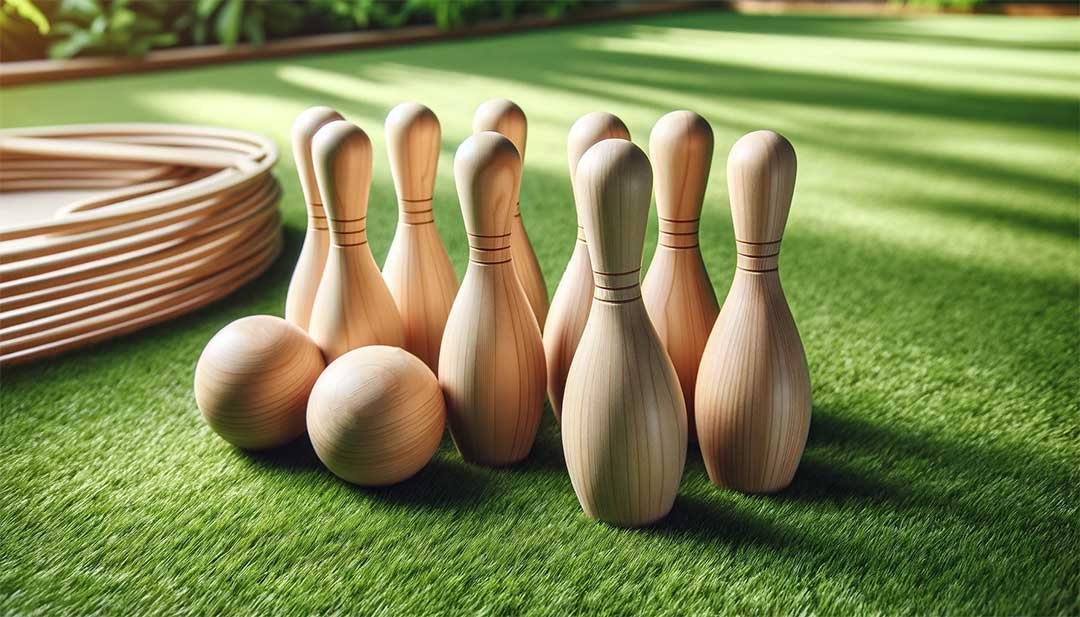
Twelve pins, numbered 1 to 12, one skittle. The number is a score, not an order:
| Throw result | Score | Example |
|---|---|---|
| One pin down | That pin value | Pin 12 alone scores 12 |
| Two or more pins | The count | Pins 4, 9 and 11 score 3 |
| All twelve | 12, not 78 | The values are never added |
| Over 50 | Back to 25 | On 46, a 7 leaves you on 25 |
The Throw and the Turn
- Underarm only. No sidearm, no overhand. It is a rule, not a style.
- Stand fallen pins where they landed. Standing pins stay. Nothing is tidied.
- First to exactly 50 wins. Overshoot and you drop to 25.
- Three throws with nothing down and you are out. Consecutive, not cumulative.
If You Are Setting Up in a Garden
Three conditions decide whether the setup holds:
- Flat, short grass. Slope worse than about 1 in 20 leans the pins; long grass holds them up when they should fall.
- Room behind the line and behind the pins. Misses keep travelling, and a pin that leaves the area goes back on the boundary.
- Dry storage. Pins packed wet grow mould on the numbers and swell at the base.
For the full rules and the scoring quirks, see the companion articles on the rules and on placement. This page is the setup card.
FAQs
What is Number Kubb actually called?
Molkky. Number Kubb is a trade name attached to the same Finnish game, and the rules are Molkky’s rules.
How far apart should the pins be?
Follow the printed diagram rather than a measurement. The cluster is about 0.6 m across and the pins are a hand-span apart, not touching.
How far is the throwing line?
3 to 4 m from the front pin, 3.5 m in competition, 3 m for juniors.
Do the pins have to be in a triangle?
Yes, the standard layout of ten with 11 and 12 at the rear corners. The exact gaps vary slightly between versions, but the shape is fixed.
Can I shorten the distance?
You can, but the game stops being a test of aim. Shorten it only for young children, and only from the same fixed line.
Conclusion
Set up Number Kubb – Moltkky – by spreading the twelve pins into the standard triangle about 3.5 m from the throwing line, numbers facing the thrower, not by packing them into a touching cluster. The spacing is the difficulty, and the single worst mistake is to remove it.
Then play by the two-part scoring rule: one pin scores its value, several pins score their count, exactly 50 wins, and overshooting drops you to 25.
Sourcing Wooden Garden Games in Bulk?
Kangjie is the direct manufacturer behind these games — no trading company, no middleman margin. We supply Kubb, Croquet, Molkky, Ring Toss, Tumble Tower, Cornhole and more to importers, retailers and brand owners worldwide.
- Factory-direct pricing with transparent volume tiers (500 / 1,000 / 5,000 units)
- OEM & ODM: logo, packaging, size and finish built to your specification
- EN71 & ASTM F963 compliant; FSC-certified timber
- Bulk lead time 30–45 days, quotation within 24 hours