
Number Kubb is one of those games where the rules take ninety seconds and the game takes twenty years to get good at, which is the best combination a garden game can have.
There is one thing to clear up first, because it causes more confusion than the rules do: Number Kubb and Mölkky are the same game. One is a registered trade name, the other is the generic name used by everyone else, and the equipment, the target score and the penalties are identical.
What follows is the game as it is actually played, including the mechanic that most explanations leave out and that decides every close game.
What You Need
Twelve numbered pins, one unnumbered throwing pin, a flat surface, and a line on the ground. That is the entire kit.
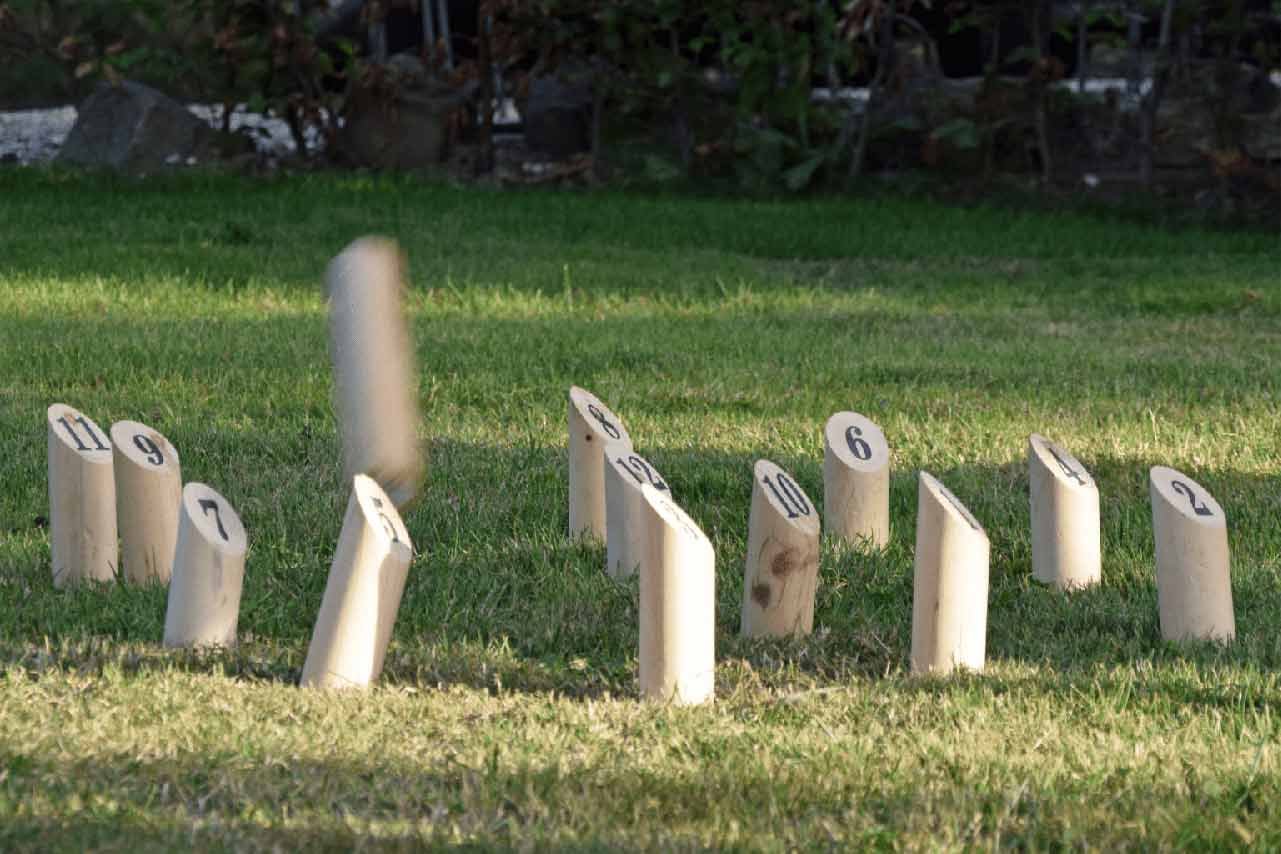
The pins start in a formation: pin 1 at the front, then rows of two, three and four, with pin 12 at the back. The layout matters because it decides which numbers are reachable and which are protected by their neighbours.
The Distance
3.5 metres from the throwing line to the front pin for adults. 2.5 metres for children. Most descriptions give a range of three to four metres, which is why half the games played in gardens are played from the wrong distance and feel either impossible or trivial.
Any flat surface works: short grass, sand, a firm path. Very soft ground makes the pins fall too easily and turns the game into a coin toss.
The Rules
Players throw in a fixed order, one throw each per round, underarm, from behind the line. No run-up.
Scoring
- One pin down: you score the number printed on it. This is the high-value shot.
- Two or more pins down: you score the count, regardless of which pins fell. Five pins is five points, even if one of them was the twelve.
That single distinction is what makes the game strategic rather than lucky. Early on the pins are clustered, so a hit takes several down and scores the count. Late on, when the field has spread, an isolated twelve is worth twelve.
What Counts as Down
A pin is down only if it is entirely on the ground. A pin leaning against another standing pin has not fallen. This causes more arguments than any other rule, so agree it before the first throw.
The Mechanic Most Explanations Miss
Fallen pins are stood back up where they fell. They are not returned to the starting formation.
This is the rule that turns Number Kubb from a throwing game into a positional one. The field scatters as the game goes on: pins end up spread across the playing area, some close to the line, some far away, and the shape is different in every game. A pin that lands two metres to the side is easy to hit and worth only its own number. A pin that ends up at the back of a spread field is hard to reach and is a problem for whoever has to score next.
Most casual players reset the pins after a few rounds, which removes the entire strategic layer. It is also why the game feels flat to people who learned it from a short description.
Winning, and the Two Penalties
The target is exactly 50 points. Not 50 or more: exactly 50.
Going over 50 drops you to 25
If your score would pass 50, it does not stop at 50. It drops to 25 and you carry on from there. A player on 48 cannot simply aim at the biggest available pin; they need a 2, or two pins, and nothing else will do.
Three misses and you are out
A throw that knocks down no pins is a miss. Three consecutive misses and that player is eliminated. It is harsh and it is deliberate: a player who scores 3 every turn will beat a player who scores 12 twice and then misses three times.
Strategy That Actually Works
- Early: take the cluster. Scoring 4 or 5 a turn builds a base and scatters the field into a shape you will have to deal with anyway.
- Middle: hunt isolated high numbers. A single 10, 11 or 12 with clear space around it is the best target on the field, because it scores its full value instead of the count.
- End: do the arithmetic before you pick up the pin. On 47 you need 3. On 45 you need 5, which is either a single 5 or five pins, and the single 5 is far easier.
- The one most players miss: you are shaping the field for the next player as well as scoring. A high number you leave standing and isolated is a gift. Sometimes the correct throw is a low pin, because the low pin is the one that would have given your opponent an easy 11.
What to Specify
For buyers, four numbers decide whether a set plays properly.
- Pin diameter and tolerance across the twelve. Pins that vary in diameter fall differently, and a set with one noticeably heavier pin is a set that gets complained about.
- Species. Birch and beech are the sensible choices. Pine dents at the impact face within a season.
- Moisture content of 8 to 12 percent at machining. A pin that dries after printing loses its number at the end grain first.
- How the numbers are applied. Laser engraving survives. Printing wears off at the impact face, which is exactly where the pin gets hit.
Conclusion
Number Kubb is worth stocking because it is one of the few garden games with a real skill ceiling and a real strategic layer, and both come from rules rather than from equipment. Twelve pins and a stick produce arguments about whether to take the twelve or protect the field.
It also plays in a small space: four by five metres is enough, which is less than a fifth of what nine-wicket croquet needs.
FAQs
1. Is Number Kubb the same as Mölkky?
Yes. Same twelve pins, same throwing pin, same target of exactly 50, same penalties. One name is a registered trademark and the other is the generic name.
2. How far is the throwing line?
3.5 m for adults, 2.5 m for children.
3. What happens at 51 points?
Your score drops to 25 and you continue from there.
4. Do fallen pins go back to the start?
No. They stand up where they fell, and that is the rule that makes the game strategic.
5. How much space is needed?
About four by five metres, including the throwing lane.
Sourcing Wooden Garden Games in Bulk?
Kangjie is the direct manufacturer behind these games — no trading company, no middleman margin. We supply Kubb, Croquet, Molkky, Ring Toss, Tumble Tower, Cornhole and more to importers, retailers and brand owners worldwide.
- Factory-direct pricing with transparent volume tiers (500 / 1,000 / 5,000 units)
- OEM & ODM: logo, packaging, size and finish built to your specification
- EN71 & ASTM F963 compliant; FSC-certified timber
- Bulk lead time 30–45 days, quotation within 24 hours









