
Tennis and pickleball get compared as if one will replace the other. They will not, for a reason that has nothing to do with either sport: they occupy different amounts of time, different amounts of space, and different social situations.
What follows is the comparison that matters if you are deciding what to make, stock or play, with the numbers rather than the enthusiasm.
The Court Is the Whole Difference
Almost every other difference follows from the size of the playing area.
| Tennis | Pickleball | |
|---|---|---|
| Court, doubles | 23.77 x 10.97 m | 13.41 x 6.10 m |
| Court, singles | 23.77 x 8.23 m | Same court, narrower play |
| Area, doubles | About 261 m2 | About 82 m2 |
| Net height at centre | 914 mm | 864 mm |
| Net height at posts | 1,070 mm | 1,143 mm |
| Ball | Felt-covered rubber, 56 to 59 g | Hollow perforated plastic, 22 to 26 g |
| Serve | Overhead, above shoulder | Underhand, below waist |
| Typical rally | Long, baseline to baseline | Short, often at the kitchen line |
The area ratio is roughly three to one. That is why pickleball courts appear in places tennis cannot go: a converted badminton court, a car park, a school hall, the end of a warehouse.
It is also why the two sports feel different in a way that is not about fitness. On a pickleball court you are never more than about three metres from the ball. On a tennis court you can be twenty.
The Claim That Does Not Hold: Easier on the Joints
Pickleball is often described as the gentler option. Less sprinting distance is real. Less joint stress is not automatically true, and the injury data has been moving the other way as the sport has grown.
The reason is the geometry. A short court means more direction changes per minute, and the ready position at the kitchen line is a semi-crouch held for the length of a rally. Achilles and knee injuries are common in older players who moved from tennis expecting it to be easier, and the mechanism is the sudden lateral push rather than the running.
What is genuinely gentler: the ball weighs a third of a tennis ball, so the impact through the arm is much lower, and the underhand serve removes the shoulder load of a tennis serve.
On the Origin Story
The name is usually explained as coming from a family dog called Pickles. That story is repeated everywhere and it is disputed by the family itself, which has said the name came from “pickle boat”, a rowing term for a crew put together from leftover rowers. Both versions are told by people who were there. Treat the dog as folklore.
Equipment, and Where Wood Fits
Pickleball paddles are a real market and they are regulated: the governing body publishes a list of approved paddles, and approval is about surface roughness and deflection as much as about size. A paddle that is not on the list cannot be used in sanctioned play, which matters if you are selling to clubs rather than to households.
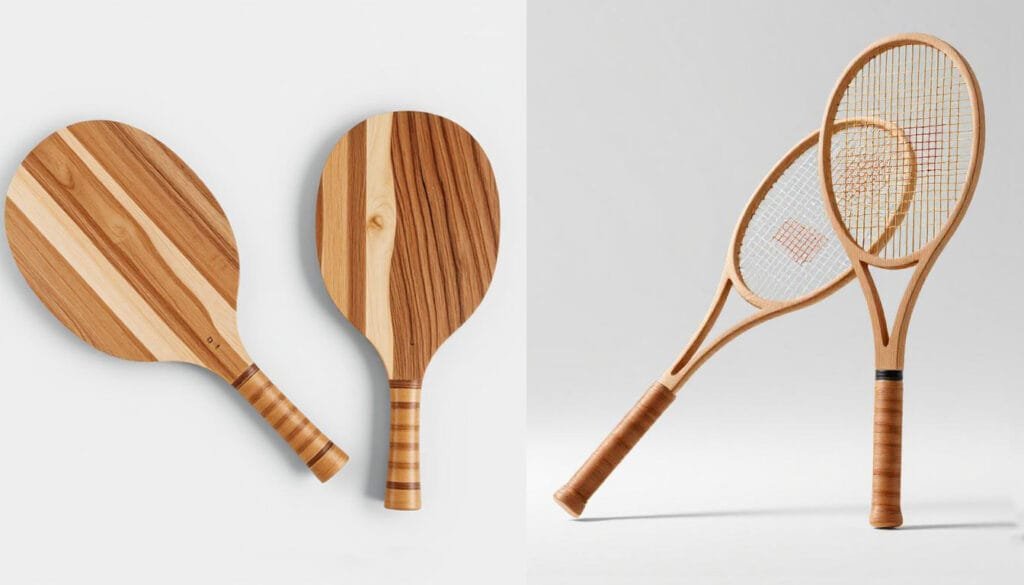
Wooden paddles sit at the entry and rental end. They are legal, cheap, durable and heavy. Heavy is the trade-off: a wooden paddle has less pop and more arm fatigue over a session, and it is the reason most players upgrade within a season.
Where wooden paddles genuinely win is institutional use. A club, a school or a holiday park buying twenty paddles wants something that survives being dropped, stacked and left in a shed, and wood does that better than a composite face at the same price.
Tennis Rackets Are Not Comparable
A tennis racket is a strung frame and its performance degrades as the strings lose tension, which happens within a season of regular play. A pickleball paddle has no strings and its performance degrades much more slowly. That is the real cost difference, not the sticker price.
Learning Curve, Honestly
Pickleball is easier to start and harder to finish. A beginner can hold a rally within twenty minutes, because the underhand serve and the lighter ball remove the two things that make tennis frustrating at the start. Getting past intermediate is a different matter: the soft game at the kitchen line takes years.
Tennis is the reverse in one specific way. The serve is the hardest single motion in either sport, and a player who cannot serve cannot play. Once past that, the rest of the game develops gradually.
| Time to a first rally | Time to competent | Ceiling | |
|---|---|---|---|
| Pickleball | 15 to 20 minutes | A season of weekly play | High, and mostly mental |
| Tennis | Two to five sessions | Two or three years | Very high, and physical |
Calories and Effort
Tennis burns more. The published MET values put recreational singles tennis around 7 to 8 and recreational pickleball doubles around 4.5 to 5.5. Doubles is the default in pickleball, which is why the comparison is usually unfair: pickleball singles is closer to 7.
The honest framing is that pickleball is a social game that happens to be exercise, and tennis is exercise that happens to be social. Both are worth having. They are not interchangeable, and the person who plays pickleball on a Tuesday is often the same person who plays tennis on a Saturday.
Conclusion
Pickleball wins on access: a third of the space, a third of the ball weight, an underhand serve, and a court that fits where a tennis court cannot. Tennis wins on physical demand and on the depth of the game.
For a manufacturer, the interesting question is not which sport is bigger. It is that pickleball has created a new equipment tier where wood is genuinely competitive, because the buyers are institutions that value durability over performance.
FAQs
1. Can you play pickleball on a tennis court?
Yes, but you need a portable net at 864 mm at the centre. The tennis net is too high and the posts are in the wrong place, so taping lines alone is not enough.
2. Is pickleball easier on the knees than tennis?
Less running, more direction changes. Achilles and knee injuries are common in players who switch, so the honest answer is that the load moves rather than disappears.
3. How big is a pickleball court?
13.41 by 6.10 metres for doubles, about a third of the area of a tennis court.
4. Are wooden paddles allowed?
Yes. They are legal and cheap, and they are heavier with less power than a composite paddle, which is why they suit rental and institutional use.
5. Why is it called pickleball?
The dog story is folklore and the family has disputed it. The alternative account is the rowing term “pickle boat”.
Sourcing Wooden Garden Games in Bulk?
Kangjie is the direct manufacturer behind these games — no trading company, no middleman margin. We supply Kubb, Croquet, Molkky, Ring Toss, Tumble Tower, Cornhole and more to importers, retailers and brand owners worldwide.
- Factory-direct pricing with transparent volume tiers (500 / 1,000 / 5,000 units)
- OEM & ODM: logo, packaging, size and finish built to your specification
- EN71 & ASTM F963 compliant; FSC-certified timber
- Bulk lead time 30–45 days, quotation within 24 hours









