
Children’s wooden games are a different product category from adult games, and the difference is not the size of the pieces. It is that the design has to survive a specific kind of use: dropped, mouthed, thrown, stood on, and then handed to a younger sibling.
For a buyer, that changes what matters. Price and appearance still count, but age grading, small-part rules and coating safety decide whether the product can be sold at all in your market.
This page covers the games that work for children, the safety requirements that actually apply, and the design decisions that separate a product that lasts from one that generates returns.
Why Wooden Games Work for Children
- They survive. Wood does not crack in UV, go brittle in cold or snap at a thin section the way moulded plastic does.
- They feel substantial. Weight and texture are part of the appeal for parents, and that is what supports a higher retail price.
- They can be repaired. A lost piece from a wooden set can be replaced. A plastic set with a broken part is scrap.
- No batteries, no screens. The single most common reason parents give for buying them.
The counter-argument is that wood is harder than plastic and a dropped piece hurts more. That is a design problem, solved with rounded edges and appropriate piece weight, not a reason to avoid the material.

Seven Games That Work
1. Tic-Tac-Toe
A grid and two sets of pieces. The cheapest product in the category, the easiest to brand, and the one that works from about four years old. Contrasting species for the two piece sets read better than paint.
2. Tumble Tower
The stacking game, in a child-friendly size. Blocks need all six faces sanded and a rounded edge — a splinter is the most common complaint in this category, and it is entirely avoidable.
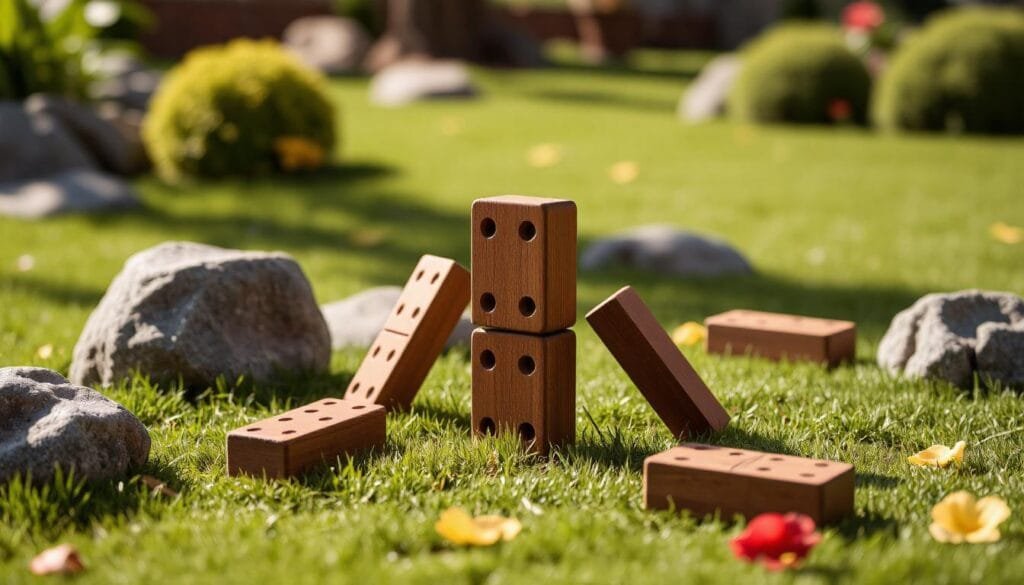
3. Dominoes
Oversized pieces for younger children, standard size for older ones. Teaches matching and counting without announcing itself as educational, which is what parents actually want.
4. Memory Match
Pairs of tiles with printed or engraved images. The advantage over a card version is durability: wooden tiles do not bend, tear or get chewed. Print the images with a coating that meets EN71-3.
5. Skittles and Bowling Sets
Pins and a ball, sized so that a four-year-old can knock them down and an eight-year-old still finds it worth doing. Painted pins with sealed ends are the right specification.
6. Balance and Stacking Games
Irregular pieces that have to be balanced into a structure. Good for children who will not sit still, and the difficulty can be adjusted by the number of pieces rather than by changing the product.
7. Marble Mazes and Wire Trails
A marble guided along a track. Excellent for fine motor control. This is also the product in the list with the highest safety risk, because of the marble, and it needs a design where the marble cannot be removed.
The Safety Requirements That Actually Apply
This is the part that determines whether a product can be sold, so it is worth being precise.
Age Grading Comes First
Everything else follows from the age band on the packaging. A product marked for three years and over is subject to small-part requirements that a product marked six and over is not. Deciding the age band late means redesigning the product late.
EN71 in Europe
- EN71-1 covers mechanical and physical properties: small parts, sharp edges, sharp points, and the strength of joints under tension.
- EN71-2 covers flammability.
- EN71-3 covers migration of certain elements from toy material, and it is the part that matters most for a finished wooden game, because it covers the coating.
Note what the CE mark is: a declaration by the manufacturer that the product meets the applicable directives, supported by a technical file. It is not issued by a certification body, and it is not a test report. A supplier who says “we have CE” without the EN71 report behind it is making a claim without evidence.
ASTM F963 and CPSIA in the United States
ASTM F963 is the toy safety specification, and it sits alongside CPSIA requirements for lead and phthalate content. Both apply to the finished product and the coating, and the report is tied to the specification that was tested.
What Changes When the Design Changes
A test report covers the sample that was tested. Change the finish, the board thickness or the fixings supplier, and the report may no longer apply. This is the most common gap between what a supplier claims and what the paperwork supports.
Design Decisions That Prevent Returns
- Edge radius. Every edge rounded, including the ones that are not visible. A 1 mm radius costs nothing and removes the splinter complaint.
- Piece size. Above the small-part threshold for the stated age band, with no detachable components below it.
- No glue on a surface a child can reach. Adhesive should be internal, and the finish should be the barrier, not the glue line.
- Weight. A piece heavy enough to feel substantial and light enough not to hurt when thrown.
- Storage. A bag or a box with compartments. A set that arrives loose in a carton gets lost piece by piece.
Sourcing Notes
- Species: beech for impact, birch for a clean consistent finish, rubberwood for painted work.
- Finish: water-based lacquer, specified to meet EN71-3.
- Minimum 500 sets; samples 5–10 days; production 30–45 days after approval.
- Test reports supplied for the specific product and coating, not a generic company certificate.
Conclusion
Children’s wooden games are a good category with one hard constraint: the age band on the box decides the design. Get that right at the start, round every edge, specify the coating properly, and the rest is styling.
Tell us the age range and the market, and we will tell you which games fit, what testing applies and what it costs at 500 and 1,000 sets.
FAQs
What age are wooden games suitable for?
From around three years for large-piece games with no detachable parts, and from six or above for anything with small components. The packaging has to state the band accurately.
Is the CE mark a safety certificate?
No. It is a manufacturer’s declaration of conformity supported by a technical file and test reports. Ask for the EN71 report behind it.
Which coating is safest for children’s products?
A water-based lacquer tested to EN71-3 for migration of certain elements. Specify the test, not just the coating type, because the same product name can be formulated differently.
Can we print a brand on a children’s game?
Yes, provided the ink is part of the tested coating system. A logo added after the coating was tested may not be covered by the report.
What is the minimum order?
500 sets per product. Mixed games can be combined within one order as long as each reaches a workable run.
Sourcing Wooden Garden Games in Bulk?
Kangjie is the direct manufacturer behind these games — no trading company, no middleman margin. We supply Kubb, Croquet, Molkky, Ring Toss, Tumble Tower, Cornhole and more to importers, retailers and brand owners worldwide.
- Factory-direct pricing with transparent volume tiers (500 / 1,000 / 5,000 units)
- OEM & ODM: logo, packaging, size and finish built to your specification
- EN71 & ASTM F963 compliant; FSC-certified timber
- Bulk lead time 30–45 days, quotation within 24 hours









