
There is no standard size for a wooden tic tac toe game, and any article that presents one as a standard is quoting a convention rather than a specification. What does exist is a chain of four numbers where each one constrains the next, and getting that chain right is what makes the product work.
The four are: board size, cell size, piece diameter, piece thickness. Everything else, including weight, carton volume and whether the set is legal for the age group you want to sell to, follows from them.
The Four Numbers
| Number | Rule | Why |
|---|---|---|
| Board size | Your choice, 250 to 1,220 mm | Drives everything below |
| Cell size | Board divided by 3 | Fixed by geometry |
| Piece diameter | 0.70 to 0.75 of the cell | Enough clearance to place without nudging |
| Piece thickness | At least 15 mm, 18 to 25 mm preferred | Pieces have to be pickable and stable |
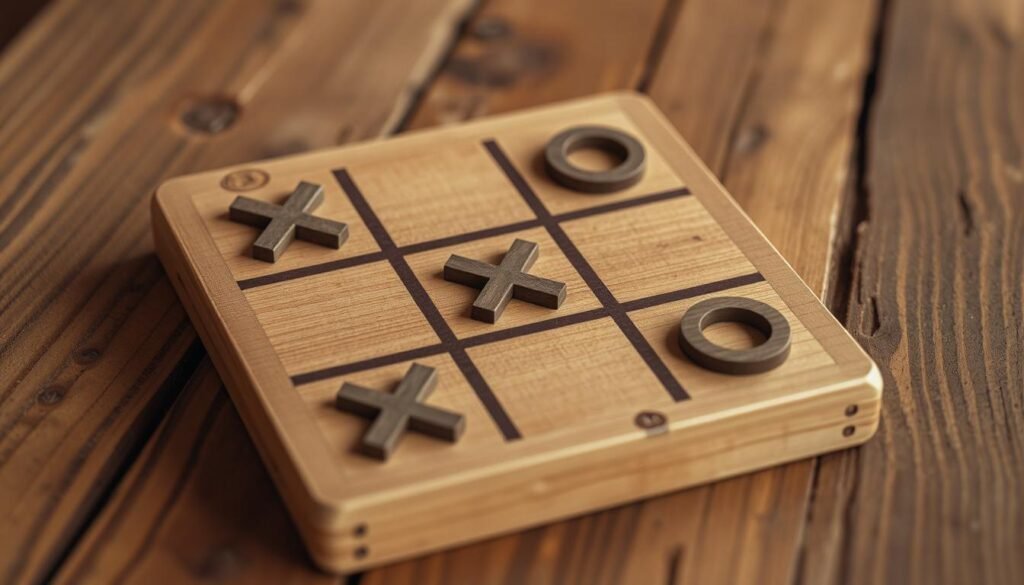
The 0.75 figure is the one worth remembering. At 0.75 of the cell, a piece can be placed in a corner of its cell without touching anything else. Above about 0.85 the pieces start to interfere with each other and the game becomes fiddly, which reads as poor quality even though nothing is broken.
The Tolerance Chain in Practice
Four board sizes, with the numbers that follow from them.
| Board | Cell | Piece diameter | Piece thickness | Approx weight | Carton |
|---|---|---|---|---|---|
| 250 mm | 83 mm | 58 to 62 mm | 15 mm | 1.2 kg | 270 x 270 x 60 mm |
| 305 mm | 102 mm | 70 to 76 mm | 18 mm | 1.9 kg | 330 x 330 x 70 mm |
| 400 mm | 133 mm | 95 to 100 mm | 18 mm | 3.2 kg | 430 x 430 x 80 mm |
| 610 mm | 203 mm | 145 to 152 mm | 22 mm | 7.5 kg | 640 x 640 x 100 mm |
| 914 mm | 305 mm | 215 to 229 mm | 25 mm | 16 kg | 940 x 940 x 130 mm |
The weight column is the one buyers underestimate. A 914 mm board in 18 mm plywood is about 11 kg before any pieces, and ten pieces at 220 mm diameter add another 4 to 5 kg. That is a 16 kg product, which is a two-person lift and a freight decision rather than a parcel.
Weight and Carton Math
Two calculations worth doing before you commit to a size.
Board mass. Birch plywood at 18 mm weighs about 11.5 kg per square metre. A 610 mm square board is 0.372 m², so about 4.3 kg. A 914 mm square is 0.835 m², so about 9.6 kg. Add 15 percent for a solid frame.
Piece mass. A beech disc at 720 kg/m³, 18 mm thick, 100 mm diameter, is about 100 g. Ten of them is 1 kg. At 220 mm diameter and 25 mm thick, each piece is about 680 g and the set of ten is nearly 7 kg, which is more than the board.
That last figure is why giant sets are usually made from a lighter species or a thinner section. A 220 mm beech disc is a beautiful object and an unreasonable component.
The Compliance Line
Piece diameter decides the age grade, and it does so at a specific number.
Pieces below 31.7 mm fall inside the small-parts cylinder used in EN 71-1 and the US 16 CFR 1501 test. A 250 mm board with 60 mm pieces is comfortably clear. A miniature set with 25 mm pieces is not, and if the product is marketed at under-threes it cannot be sold as it stands.
There is a second consideration that cuts the other way. Oversized pieces are not a safety problem, but they are a handling problem: a 220 mm disc is difficult for a small child to place accurately, and a parent will read that as the game being too hard rather than the pieces being too big.
What the “Standard” Actually Is
The 10 inch board that appears in most guides is a convention, not a standard. It corresponds to a 305 mm board with 102 mm cells and 70 to 76 mm pieces, which is a good size for a tabletop product, and it is repeated because it works rather than because anyone specified it.
The same is true of the 24 inch figure that gets called “giant”. It is a garden size. Giant in this category starts at 914 mm and goes to 1,220 mm.
What to Specify
- Board size and the resulting cell size, in millimetres.
- Piece diameter, thickness and count. Ten pieces, five each.
- Board thickness, and whether the back is braced or framed.
- Grid method: printed, engraved or routed. Routed survives outdoor use; printed does not.
- Edge treatment and edge sealing, which is the difference between a board that lasts two years and one that lasts eight.
- Species, and the moisture content at machining.
- Carton dimensions and gross weight.
Minimum order 500 sets, samples 5 to 10 days, bulk production 30 to 45 days, quotation within 24 hours.
FAQs
What are the standard dimensions of a wooden tic tac toe game?
There is no standard. The common tabletop convention is a 305 mm board with 102 mm cells and 70 to 76 mm pieces; garden sizes run from 610 mm to 1,220 mm.
How big should the pieces be?
Between 0.70 and 0.75 of the cell diameter. Above 0.85 the pieces interfere with each other and the game becomes fiddly.
How thick should the board be?
18 mm up to about 400 mm square, 25 mm above that, or 18 mm with a braced or framed back.
What is the smallest size that is safe for children?
Pieces must be above 31.7 mm in diameter to clear the small-parts test. A 250 mm board with 60 mm pieces is comfortably clear.
What is the minimum order?
500 sets, with volume pricing at 500, 1,000 and 5,000 units.
Sourcing Wooden Garden Games in Bulk?
Kangjie is the direct manufacturer behind these games — no trading company, no middleman margin. We supply Kubb, Croquet, Molkky, Ring Toss, Tumble Tower, Cornhole and more to importers, retailers and brand owners worldwide.
- Factory-direct pricing with transparent volume tiers (500 / 1,000 / 5,000 units)
- OEM & ODM: logo, packaging, size and finish built to your specification
- EN71 & ASTM F963 compliant; FSC-certified timber
- Bulk lead time 30–45 days, quotation within 24 hours









