The short answer is tennis and badminton, with a strong debt to table tennis. The court comes from badminton, the net height and the scoring structure come from tennis, and the paddle comes from table tennis.
The more interesting answer is why each of those borrowings happened, because they explain the design of the sport rather than just its ancestry.
The Three Parents
| Element | Borrowed from | Why it matters |
|---|---|---|
| Court size | Badminton | 20 by 44 feet, the same footprint as a badminton doubles court, so existing facilities could be converted |
| Net | Tennis, lowered | 36 inches at the posts, 34 inches at the centre |
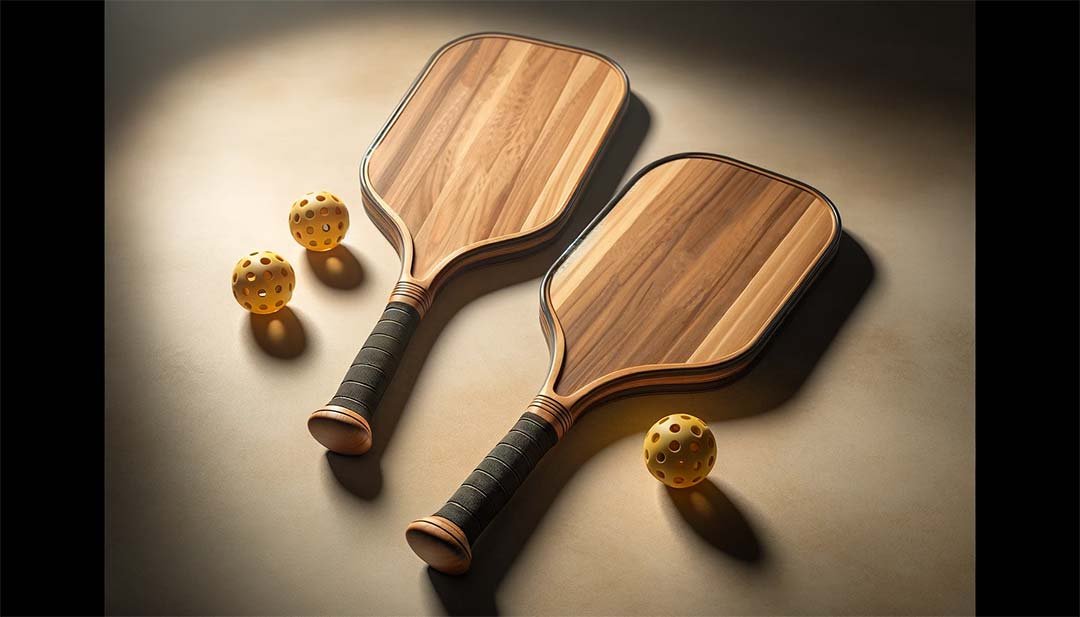
| Paddle | Table tennis | A solid faced paddle rather than a strung racket |
| Ball | Wiffle-style plastic | Perforated and light, so it decelerates quickly and the court plays larger than its size |
| Scoring structure | Tennis, loosely | Games to 11, win by two, and traditionally only the serving side can score |
Why the Court Came From Badminton
The practical reason is that the inventors had a badminton court and no rackets. The strategic reason is that a badminton court is small, which meant the game could be adopted wherever a badminton court already existed: schools, community centres, parks, back gardens.
That single decision is the main reason the sport spread. A game that requires new facilities spreads slowly; a game that converts existing ones spreads quickly.
Why the Net Came From Tennis
A tennis net is too high for a plastic ball hit with a paddle, so it was lowered. But the shape of the game — a net between two sides, a bounce, a rally — is tennis. So is the idea of a service box, though pickleball’s service rules are its own.
One correction worth making, because it appears in a lot of casual writing: pickleball scoring does not use “love”. Points are counted zero, one, two, three, and a score is called as three numbers — server score, receiver score, server number. “Love” belongs to tennis and does not appear in pickleball.
Why the Paddle Came From Table Tennis
A strung racket would be pointless with a perforated plastic ball: the ball is too light to be driven, and the strings would absorb what little pace there is. A solid paddle transfers the hit cleanly and gives control.
The modern paddle is a honeycomb core with a composite facing, and it is governed by a published equipment standard covering dimensions, surface roughness and deflection. That standard exists because the sport has become competitive enough that equipment differences matter.

The Rule That Makes It Its Own Sport
The borrowings explain the equipment. One rule explains why the game plays the way it does.
The non-volley zone. A seven-foot strip on each side of the net where players may not volley. You may stand there, but you may not hit the ball out of the air from there; you have to let it bounce first.
This is what stops tall or powerful players from simply standing at the net and ending every rally. It forces the game into a soft game near the net — dinks, patience, and waiting for a ball high enough to attack. Without that rule, pickleball would be a smaller version of tennis. With it, it is a different sport.
What This Means If You Are Buying Equipment
Understanding the ancestry is useful for one commercial reason: it tells you which parts of the equipment are performance-critical and which are not.
- The paddle is performance equipment. Core material, facing texture and weight distribution all affect play, and competitive players will notice. This is a specialist manufacturing category.
- The ball is performance equipment. Hole pattern, wall thickness and bounce are specified. Moulded plastic, not wood.
- The net and court markers are commodity items. They need to be the right height and to stay up. Nothing more.
- Wooden paddles are an entry-level product. Cheap, nearly indestructible, and used in schools and by beginners. They are not competitive equipment, and any copy implying otherwise will be found out quickly.
We make wooden garden games. We do not make composite paddles, balls or nets, and we would rather say so than quote for something we would have to buy in from someone else. If you are building a pickleball range, the performance items belong with a specialist and the wooden accessories belong with a wood manufacturer.
Frequently Asked Questions
Which two sports is pickleball based on?
Tennis and badminton, with the paddle borrowed from table tennis.
Is the court the same size as a tennis court?
No. It is 20 by 44 feet, the same footprint as a badminton doubles court. That is roughly a quarter of a tennis court.
Does pickleball use the word love?
No. Scores are called as numbers, and a score is announced as three figures: server score, receiver score and server number.
Why can’t you volley near the net?
Because of the non-volley zone, a seven-foot strip on each side. It prevents tall or powerful players from dominating at the net and is the rule that makes the game tactical rather than a power contest.
Do you make pickleball paddles?
We make wooden paddles as an entry-level product. We do not make composite paddles, balls or nets.
Sourcing Wooden Garden Games in Bulk?
Kangjie is the direct manufacturer behind these games — no trading company, no middleman margin. We supply Kubb, Croquet, Molkky, Ring Toss, Tumble Tower, Cornhole and more to importers, retailers and brand owners worldwide.
- Factory-direct pricing with transparent volume tiers (500 / 1,000 / 5,000 units)
- OEM & ODM: logo, packaging, size and finish built to your specification
- EN71 & ASTM F963 compliant; FSC-certified timber
- Bulk lead time 30–45 days, quotation within 24 hours