
Two completely different games share the name “indoor cricket”, and most guides on the internet mix them together. One is an organised sport with eight players a side, a netted court and a published rulebook, played competitively in Australia, New Zealand, South Africa and the UK. The other is what most people mean: cricket in a room, with a soft ball, taped boundaries and whatever rules the group agrees on.
This article covers both, starting with the informal version, because that is the one you can set up this evening.
Two Different Games Called Indoor Cricket
| Organised indoor cricket | Informal indoor cricket | |
|---|---|---|
| Format | 8 a side, pairs bat in set overs | Any number, everyone bats |
| Court | Netted court, roughly 30 x 12 m | A room, a garage, a hall |
| Ball | Hard indoor ball, softer than a match ball | Foam or soft rubber |
| Runs | Scored off the netted walls, with penalties for negatives | Wall counts as boundary, simple scoring |
| Governing body | Yes, with a published rulebook | None |
| Where it is played | Clubs and school competitions | Homes, parties, classrooms |
The organised version is a genuinely different sport rather than a compromise. The court is enclosed by netting on all four sides and the ceiling, batters play in pairs for a fixed number of overs, and hitting the ball into a side net can score runs or cost them depending on where it lands. It exists because it can be played in a stadium-sized shed in any weather, and it produces a faster, denser game than the outdoor version.
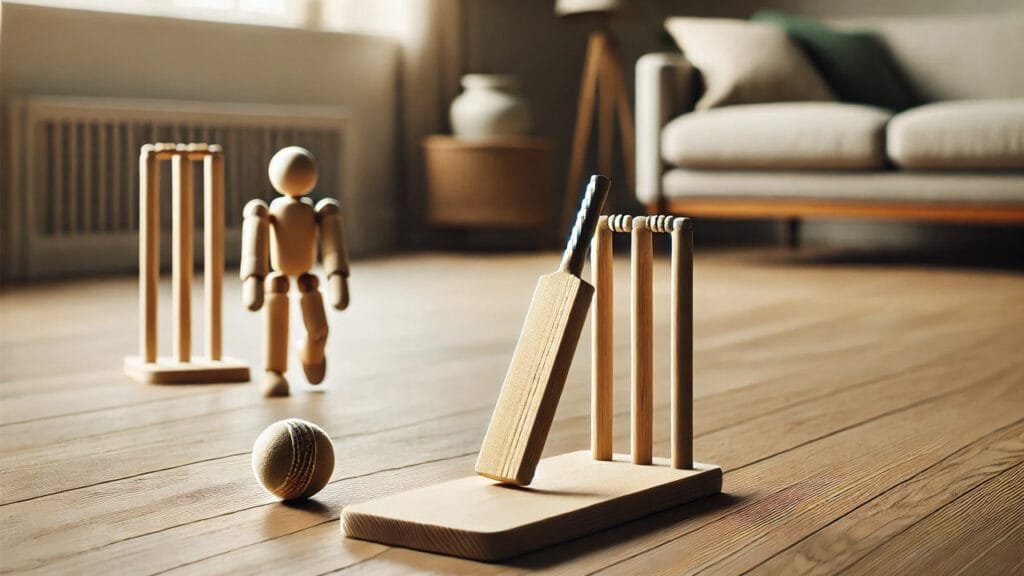
The informal version is what this guide is mostly about. It needs a bat, a soft ball, something to use as stumps and a roll of tape.
What You Actually Need
The equipment list is short, and the important decision is the ball.
- Bat. A 60 to 80 cm wooden or composite bat, or a foam bat for small rooms. A full-size senior bat is 96 cm and simply too long to swing in a room without hitting something.
- Ball. Foam, 65 to 80 g, or a soft rubber training ball. A hard cricket ball indoors is not a game, it is a repair bill. The whole point of the soft ball is that it lets you bowl properly without endangering the room.
- Stumps. Three sticks, a plastic set, or a painted target on the wall. Wooden stumps are more stable on a hard floor than plastic, which skitters.
- Tape. Painter’s tape for boundaries and for marking a target on the wall. It lifts cleanly from paint and from floorboards, which masking tape does not.
If you are buying rather than improvising, a wooden stump set is the part worth spending on. It is also the part that ends up outdoors in summer, so it should be finished for both jobs.
A Rule Set That Actually Works in a Room
Most attempts at indoor cricket fail because nobody agreed the rules first. These work, and they keep a game to about 20 minutes:
- Six-ball overs, two overs per batter. Everyone bats, then everyone bowls. A group of four is finished in 20 minutes.
- No LBW. There is no umpire and no reliable line. Removing it also removes the main source of argument.
- The wall is the boundary. One run for hitting the wall, four if the ball hits the wall above a taped line. Six is not available indoors, because a six means a broken window.
- Caught off the wall is out. This is the single rule that makes the game feel like cricket rather than batting practice, because it rewards keeping the ball down.
- Off-limits zones. Nominate the television, the window and the shelf before the first ball. Hitting one is out and costs five runs, which is enough of a deterrent to change how people bat.
- One wicket, and the batter retires at 25 runs. Retiring stops one strong player from batting for the whole session.
Write them on a card and keep it with the set. Rule arguments are what end these games, not boredom.
Room Dimensions and What Breaks
| Measurement | Minimum | Comfortable |
|---|---|---|
| Clear floor area | 4 x 3 m | 6 x 4 m |
| Batter to bowler distance | 6 m | 8 m |
| Ceiling height | 2.4 m | 2.7 m or more |
| Clear wall behind the batter | 1.5 m | 2 m |
| Clearance above light fittings | None needed if the ball is foam | Move the pendant light |
The failures are predictable. Ceiling light fittings take the most hits, because a lofted drive goes up and back. Anything on a shelf within two metres of the batting end will eventually come down. And a foam ball will not break a window, but a rubber one will, so the choice of ball is really a choice about which room you are playing in.
Safety, Without the Lecture
Three things actually cause injuries in indoor cricket, and none of them is the ball hitting someone.
- Running into furniture. Clear the floor properly rather than pushing things to the edge.
- Bare feet on hard tile. Turning to run in socks on tile is how ankles go. Shoes, or play on carpet.
- The bat follow-through. The person standing behind the batter is at more risk than the batter. Keep the area behind the stumps clear.
If you are playing with a rubber ball rather than foam, eye protection is worth having for the batter. A rubber ball at close range off a bat is faster than it looks.
Why Wooden Stumps Are the Right Product for This
A stump set that lives indoors and outdoors has to do two jobs that pull in different directions. It has to be heavy enough to stay upright when hit on a hard floor, and light enough to carry to the park.
Wood does that better than plastic. A turned hardwood stump has the mass to stay put, and a set of three with a 25 to 30 mm diameter and a 700 to 800 mm length weighs around 1 kg, which is light enough to carry and heavy enough not to fall over on contact. Plastic stumps need a weighted base, which is one more part to lose.
What to look for: solid hardwood rather than hollow sections, a chamfered top so the point does not splinter, and a finish that survives damp grass as well as a living room floor. A water-based clear coat is the right choice for both.
Buying Notes
If you are sourcing cricket sets for retail rather than playing with one:
- Specify stump diameter and length in millimetres, not “standard”.
- Specify the species and the moisture content at machining, because a stump that dries after packing will shrink out of its base.
- Specify whether the set includes a bat, and if so its length and weight. A 96 cm senior bat in a set sold to families is a mismatch.
- Specify the ball. If a set ships with a hard ball and is marketed at children, the age grading and the test package change completely.
Minimum order is 500 sets, samples take 5 to 10 days once the specification is fixed, and bulk production runs 30 to 45 days.
FAQs
Is indoor cricket a real sport?
Yes. The organised format is played eight a side on a netted court, with pairs batting for set overs and runs scored off the walls. It has a published rulebook and national competitions in several countries. The version played in a living room is a different, informal game that shares the name.
What ball should I use indoors?
A foam ball of 65 to 80 g, or a soft rubber training ball. A hard cricket ball indoors will damage the room and the people in it.
How much space do I need?
Four by three metres of clear floor, a 6 metre pitch and 2.4 metres of ceiling height is the minimum for a workable game.
Do you make cricket sets?
We make wooden stump sets and bats to specification. Minimum order 500 sets, sampling 5 to 10 days, production 30 to 45 days.
Which standards apply?
If the set is age-graded as a toy, EN 71-1, -2 and -3 for Europe and ASTM F963 for the United States. A bat is a swinging object, so the physical hazard assessment matters more than the finish. Age grading has to match the packaging and the imagery, not just the label.
Sourcing Wooden Garden Games in Bulk?
Kangjie is the direct manufacturer behind these games — no trading company, no middleman margin. We supply Kubb, Croquet, Molkky, Ring Toss, Tumble Tower, Cornhole and more to importers, retailers and brand owners worldwide.
- Factory-direct pricing with transparent volume tiers (500 / 1,000 / 5,000 units)
- OEM & ODM: logo, packaging, size and finish built to your specification
- EN71 & ASTM F963 compliant; FSC-certified timber
- Bulk lead time 30–45 days, quotation within 24 hours









