
Yes, by the rules of the game. Pickleball’s equipment rules do not name a material, and the first paddles ever used, in 1965 on Bainbridge Island, were plywood. A wooden paddle is a legal paddle.
Whether you can use one in a tournament is a different question with a different answer, and the gap between those two answers is what most articles on this subject miss.
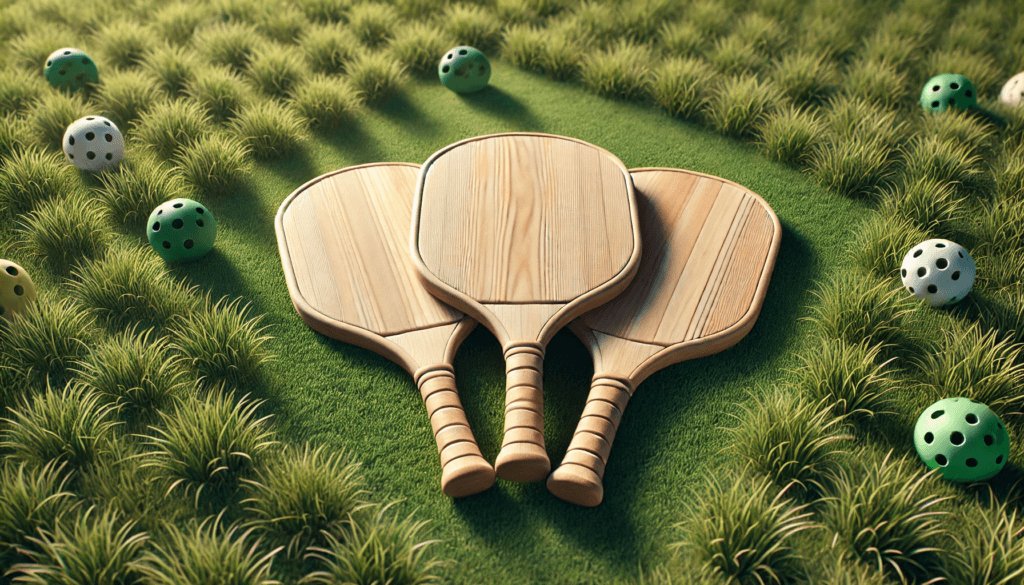
The Rules Say Yes
The equipment specification is about geometry, not material. A paddle must be rigid, with a flat hitting surface, and its overall length plus width must not exceed 610 mm, with the width alone capped at 432 mm. There is no material restriction, and no prohibition on wood.
A standard wooden paddle is around 400 by 200 mm, which is comfortably inside the limit. It is legal by construction.
Sanctioned Play Says Something Else
Tournaments run under the governing body’s sanction require the paddle to appear on an approved list, and approval is a separate process from legality. Very few wooden paddles are on that list, and most of the ones that were have been withdrawn as the approval criteria tightened around surface roughness and spin.
So the accurate answer depends on the question being asked:
| Context | Wooden paddle allowed |
|---|---|
| Rec play, club play, school, beach | Yes, no restriction |
| Local tournament with no equipment check | Usually yes in practice |
| Sanctioned tournament | Only if the model is on the approved list, which almost none are |
| Any event with a paddle inspection | Assume no, and bring a second paddle |
What Changes When You Play With One
The performance gap is real, but it is not the gap the marketing suggests. Five differences matter, in order of how quickly a player notices:
| Property | Wooden paddle | Composite paddle | What you feel |
|---|---|---|---|
| Mass | 280 to 400 g | 200 to 230 g | Arm fatigue, and slower hands at the kitchen line |
| Face thickness | 8 to 12 mm | 13 to 16 mm with a core | Smaller sweet spot, more mishits |
| Surface | Smooth, sealed | Textured or rough within limits | Less spin on serves and dinks |
| Vibration | Transmits straight to the handle | Core damps it | A stinger on off-centre hits |
| Sound | Loud, sharp crack | Duller | Matters at clubs with noise restrictions |
The mass difference is the one that decides games. Forty to eighty grams does not sound like much until you are in a fast exchange at the net, where the paddle has to change direction four times in two seconds. A heavier paddle is slower to redirect, and the kitchen line is where points are won.
The sound difference is underrated. Wooden paddles are noticeably louder, and some facilities have noise limits that make them a poor choice for indoor play regardless of how well they perform.
Where a Wooden Paddle Is Genuinely Good
It is a bad competition paddle and an excellent institutional one, for four reasons that have nothing to do with performance:
- Cost. A plywood paddle costs a fraction of a composite one, which matters when a club needs thirty loaners.
- Toughness. No core to crush, no honeycomb to collapse, no face sheet to delaminate. It survives being dropped, stood on and left in a car.
- Consistency. Every wooden paddle of a given spec plays the same. Composite paddles vary between production runs, which is a problem when teaching.
- Nothing to maintain. No edge tape, no cover, no core that takes on water through a nick.
For beginners, the heavier weight is arguably a feature: it forces a shorter, more controlled swing instead of a wristy slap, which is the habit that stalls most new players.
If You Are Buying or Specifying One
Wooden paddles are plywood, not solid timber, and the specification that matters is the layup rather than the species:
- Seven to nine plies of 1.5 mm birch, void-free. Ply count is what stops a paddle warping; a three-ply paddle will cup within a season.
- 9 to 11 mm finished thickness. Thinner plays livelier and breaks faster; thicker is dead but durable.
- Waterproof glue, and a sealed edge. Delamination always starts at the edge, never in the middle of the face.
- Edge radius of about 3 mm, so the rim does not chip when it hits the ground.
- Handle length around 110 mm, wrapped rather than painted, because paint wears through in a month of play.
FAQs
Are wooden pickleball paddles legal?
Yes under the rules of the game, which set dimensions rather than materials. They are generally not permitted in sanctioned tournaments, because those require a paddle from the approved list.
Why are wooden paddles heavier?
Because the strength comes from the ply stack rather than a stiff face over a light core. A 9 mm birch ply paddle typically weighs 300 to 350 g against 200 to 230 g for a composite.
Do wooden paddles give less spin?
Yes. The face is smooth and sealed, and the roughness that generates friction on a composite face is not present. Serves and dinks sit up more.
Can a wooden paddle break?
Rarely in the face. The failure mode is edge delamination after water ingress, which is why the edge seal matters more than the finish on the face.
Is a wooden paddle good for beginners?
Yes. It is cheap, tough, and the weight encourages a shorter swing. Most players move to composite within a season, which is the right time to spend the money.
Conclusion
A wooden paddle is legal, cheap, almost indestructible and noticeably worse in a fast game. It is the right paddle for a club buying loaners, a school, a resort, or a beginner who does not yet know whether they will keep playing. It is the wrong paddle for a tournament, not because the rules of pickleball forbid it, but because the approved list does.
The one number to remember if you are specifying one: seven to nine plies, not three. That is the difference between a paddle that lasts a season and one that cups in a month.
Sourcing Wooden Garden Games in Bulk?
Kangjie is the direct manufacturer behind these games — no trading company, no middleman margin. We supply Kubb, Croquet, Molkky, Ring Toss, Tumble Tower, Cornhole and more to importers, retailers and brand owners worldwide.
- Factory-direct pricing with transparent volume tiers (500 / 1,000 / 5,000 units)
- OEM & ODM: logo, packaging, size and finish built to your specification
- EN71 & ASTM F963 compliant; FSC-certified timber
- Bulk lead time 30–45 days, quotation within 24 hours









