
The game is solved, and the solution is uncomfortable: with perfect play the first player wins. That was proved in 1988, independently, by James Dow Allen and by Victor Allis, whose strategy shows the first player can force a win by the forty-first move. The winning opening is the middle column.
None of that helps against a human, because humans do not play perfectly. What helps is understanding why the middle column wins, and the one structural fact about the game that beginners never see: you can only block a square you can reach.
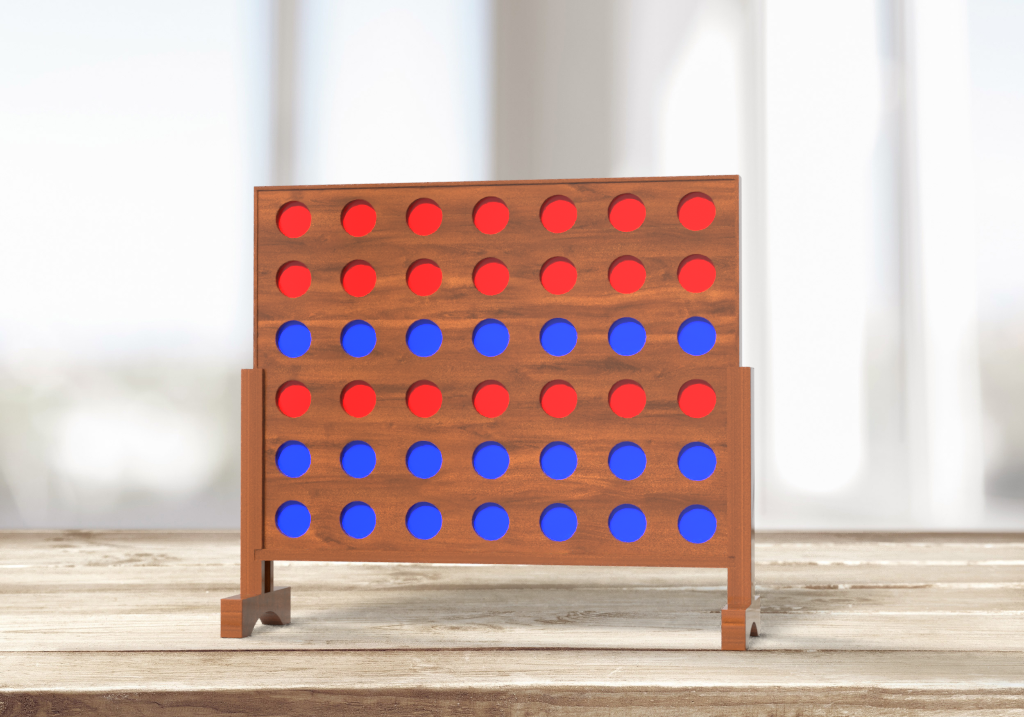
The Board in One Line
Seven columns, six rows, forty-two cells, twenty-one discs each. Gravity is the entire rules engine: a disc falls to the lowest empty cell in its column, and that is the only constraint on where anything can go. Every strategic idea in the game comes from that one sentence.
Five Principles That Work Against Humans
1. Take the middle column first
More four-cell windows pass through the middle column than any other, in all four directions, which means a disc there participates in more potential wins than a disc anywhere else. It is also the only column that is equidistant from both edges, so it keeps options open in both directions. Every published opening line starts there.
2. One threat is not a threat
A single three-in-a-row with one open end is always blockable, and a competent opponent will block it. The only way to win against someone who is watching is to create two threats at once, so that blocking one leaves the other. Beginners lose because they build one threat and are surprised when it is stopped; the fix is to build the second threat before completing the first.
3. You can only block a square you can reach
This is the idea that separates players who understand the game from players who are memorising patterns. To occupy a cell, every cell beneath it in that column must already be filled. So a horizontal three on row four cannot be blocked on row four unless somebody already has a disc on row three in that column.
The practical consequence is that defence happens early. If your opponent is building across row four, you cannot wait until they have three; by then the square you need may be unreachable, or reachable only by a move that hands them the cell above it. Count the empty cells in the columns under a threat before you decide it is safe.
4. Diagonals decide beginner games
New players watch rows and columns. Almost every loss at that level comes down a diagonal, because a diagonal is the one line that is not visible as a line on the board. Before each move, trace both diagonals through the cell you are about to fill.
5. Late in the game, moving is a disadvantage
Because every move fills a cell, a full board is a draw, and near the end the player who must move is the player who has to open something. That inverts normal thinking: a move that gives you fewer options can be better than a move that gives you more, because it leaves your opponent with the forced bad move. This is why strong players sometimes play a disc that appears to do nothing.
The Trap, Precisely
The double threat is easier to build than it sounds, and it has a standard shape:
- Build a three that can be completed at either end – two open ends, one threat.
- Before completing it, build a second three that shares one of those completion cells.
- Now the shared cell completes both. Your opponent blocks one line and the other one wins.
The reason this works is gravity, not cleverness. A cell that completes two lines only needs to be reachable once, and reachability is what most players fail to check.
What the Physical Set Changes
Playing on a standing wooden board is not the same game as playing on a screen, and three differences are worth knowing:
- You can see the whole board at once. No scrolling, no perspective distortion, and diagonals are easier to trace. Physical sets are actually better for learning the game.
- A jammed disc is a lost game. A disc that stops halfway down a column ends the game on the spot, and it is almost always caused by a slot that is too tight or a disc that is out of round.
- Forty-two discs, no spares. The count is exact, and a set that ships one short is unplayable at the end of a full board. Two spare discs cost almost nothing and remove a whole category of complaint.
The ratio that governs whether the set feels right is disc diameter to cell width, at 0.70 to 0.75, with slot clearance of at least 1.15 times the disc thickness. Below that, discs jam; above it, the board feels loose and the game loses its precision.
FAQs
Is four in a row a solved game?
Yes. With perfect play the first player wins, proved in 1988 by James Dow Allen and by Victor Allis. The first player can force a win by the forty-first move, starting in the middle column.
What is the best first move?
The middle column. It carries more potential winning lines than any other column and keeps both sides of the board available.
How do I beat someone who blocks everything?
Build two threats that share a completion cell. One threat is always blockable; two threats in the same cell are not, because blocking one completes the other.
Why do I keep losing to diagonals?
Because rows and columns are visible as lines and diagonals are not. Before each move, trace both diagonals through the cell you are filling. That single habit removes most beginner losses.
How many discs are in a set?
Forty-two, twenty-one per player, matching the forty-two cells. Ship two spares if you are specifying a set; the cost is negligible and it prevents an unplayable board.
Conclusion
Four in a row is solved, which means the interesting question is not whether the first player can win but how a human loses. The middle column is the best opening, one threat is never enough, and the constraint that decides most games is reachability: you cannot block a square you cannot get to, and getting there takes preparation several moves earlier.
Learn to check the cell underneath a threat, and you will beat everyone who has only learned to check the threat.
Sourcing Wooden Garden Games in Bulk?
Kangjie is the direct manufacturer behind these games — no trading company, no middleman margin. We supply Kubb, Croquet, Molkky, Ring Toss, Tumble Tower, Cornhole and more to importers, retailers and brand owners worldwide.
- Factory-direct pricing with transparent volume tiers (500 / 1,000 / 5,000 units)
- OEM & ODM: logo, packaging, size and finish built to your specification
- EN71 & ASTM F963 compliant; FSC-certified timber
- Bulk lead time 30–45 days, quotation within 24 hours









