
There is a mix-up to clear up first, because it is widespread and it makes the scoring system impossible to understand.
Number Kubb is not Kubb with numbers on the blocks. It has no king, no batons and no inkast. It is the twelve-pin Finnish throwing game, sold under a generic name because the familiar name is a registered trademark.
If you have been trying to apply Kubb scoring to a set of twelve numbered pins, that is why nothing added up. Here is the scoring system as it actually works, with a worked example.
What the Equipment Is
| Piece | Count | Notes |
|---|---|---|
| Numbered pins | 12 | Numbered 1 to 12, same size as each other |
| Throwing pin | 1 | Unnumbered. Thrown underarm from behind the line |
| Playing area | 4 x 5 m | Flat surface. Short grass, sand or a firm path |
| Throwing line | 3.5 m from the front pin | 2.5 m for children |
| Target score | Exactly 50 | Not 50 or more |
That is the whole kit. There is no king, no baton and no field to mark out beyond the throwing line.
The Scoring Rules
Two rules, and which one applies depends entirely on how many pins fall.
One pin down: score its number
Knock down exactly one pin and you score the number printed on it. Take down the 12 on its own and you score 12. This is the high-value shot and it gets harder as the field spreads out.
Two or more pins down: score the count
Knock down two pins and you score 2, regardless of which pins they were. Knock down five and you score 5. The numbers on the fallen pins are irrelevant.
This is the rule that makes the game strategic rather than lucky. Early on, when the pins are clustered, every hit takes several down and scores the count. Late on, when the field has spread, an isolated high number is worth its full value.
What Counts as Down
A pin is down only if it is entirely on the ground. A pin leaning against another standing pin has not fallen. Agree this before the first throw, because it causes more arguments than anything else in the game.
The Three Ways a Game Ends
- Exactly 50. You win.
- Over 50. Your score drops to 25 and you continue from there. It is a penalty, not a loss.
- Three consecutive misses. A throw that knocks down no pins is a miss. Three in a row and that player is eliminated from the game.
The over-50 rule is what makes the endgame interesting. A player on 48 cannot simply aim at the biggest pin available. They need a 2, or two pins, and nothing else will do.
A Worked Game
Two players, six rounds. This is a realistic sequence, not a best-case one.
| Round | Player A throw | A score | Player B throw | B score |
|---|---|---|---|---|
| 1 | Four pins down | 4 | Three pins down | 3 |
| 2 | One pin: the 9 | 13 | Five pins down | 8 |
| 3 | Two pins down | 15 | One pin: the 12 | 20 |
| 4 | One pin: the 7 | 22 | Miss | 20 |
| 5 | Three pins down | 25 | One pin: the 11 | 31 |
| 6 | One pin: the 10 | 35 | Two pins down | 33 |
Notice what happened in round 4. Player B missed, which is one of the three that would eliminate them. Notice also that player A is scoring in small increments and player B is taking single high pins. Both are valid, and they lead to different endgames.
The Endgame Arithmetic
On 47 you need 3. On 48 you need 2. On 45 you need 5, which is either a single 5 or five pins, and the single 5 is far easier. Work out the number before you pick up the throwing pin, not after something has fallen.
The trap is 49: you need exactly 1, and the 1 pin may not be where you want it. A player who reaches 49 with the 1 pin isolated at the back of the field has a hard problem and no way around it.
The Rule Most People Miss
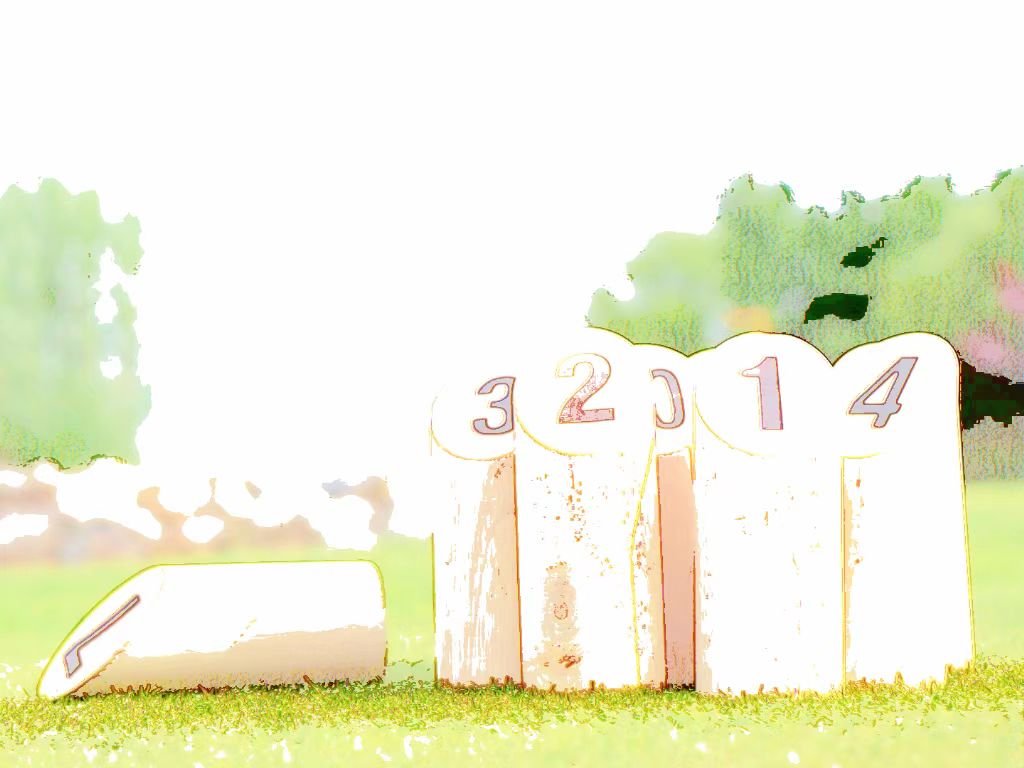
Fallen pins are stood back up where they fell. They are not returned to the starting formation.
This is not a detail. It is what turns the game from a throwing contest into a positional one, because the field scatters as the game goes on and the shape is different every time. A pin that lands two metres to the side is easy to hit and worth only its own number. A pin that ends up at the back of a spread field is hard to reach and is a problem for whoever has to score next.
Groups that reset the pins after a few rounds are playing a much flatter game and usually do not know it.
Scoring Variants
The fifty-point system is the standard and it is the one to print on the box. Two variants exist and both are worth knowing.
- Sudden death to 50. Same target, but a score over 50 is a loss rather than a reset. Faster and much harsher.
- Team play. Two against two, alternating throws within a team, one shared score. Works well and is the standard format at tournaments.
Conclusion
Number Kubb scoring is two rules and three endings. One pin scores its face value, two or more score the count, and exactly 50 wins.
The depth comes from two things: the over-50 reset, and the fact that fallen pins stay where they fell. Everything else follows.
FAQs
1. Is Number Kubb the same as Kubb?
No. Kubb has a king, batons and an inkast. Number Kubb is twelve numbered pins and a throwing pin, and the target is exactly 50.
2. What if I knock down two pins, one of them the 12?
You score 2. The count applies whenever two or more pins fall.
3. What happens at 51?
Your score drops to 25 and you carry on. It is a penalty, not elimination.
4. Do fallen pins go back to the start?
No. They stand up where they fell, and that is the rule that gives the game its strategy.
5. How many misses eliminate a player?
Three consecutive throws that knock down no pins.
Sourcing Wooden Garden Games in Bulk?
Kangjie is the direct manufacturer behind these games — no trading company, no middleman margin. We supply Kubb, Croquet, Molkky, Ring Toss, Tumble Tower, Cornhole and more to importers, retailers and brand owners worldwide.
- Factory-direct pricing with transparent volume tiers (500 / 1,000 / 5,000 units)
- OEM & ODM: logo, packaging, size and finish built to your specification
- EN71 & ASTM F963 compliant; FSC-certified timber
- Bulk lead time 30–45 days, quotation within 24 hours









