
The short answer is that there is no official Number Kubb rulebook, because Number Kubb is not an official name. It is a trade name that attached itself to a Finnish game called Molkky, and the rules that apply are Molkky’s rules.
That is not pedantry. The most-shared description of “Number Kubb rules” on the English-speaking internet gets the game wrong in two places, and a set shipped with that description on the insert comes back as a return rather than a complaint.
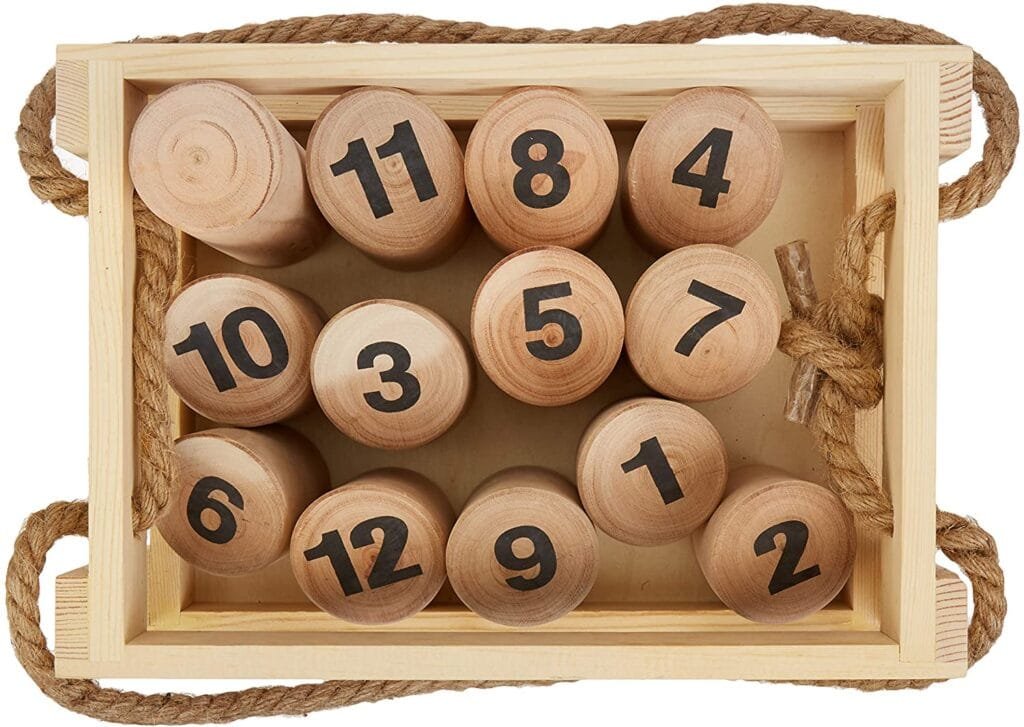
Where the Name Comes From
Molkky was designed by Tuomas Markkula in 1996 for a family games company in Lahti, Finland. It is now published by Tactic Games. Twelve numbered pins, one throwing skittle, a patch of ground. That is the whole product.
The trade name “Number Kubb” appeared later, for an obvious reason: the equipment looks like Kubb. It is a set of wooden blocks that you throw things at on grass. But the two games share nothing beyond that. Kubb is a baton game with a king in the middle and a field the length of a badminton court. Molkky is a skittle game that fits in a tote bag. No rule is shared, and no part is shared.
So when somebody asks for the official rules of Number Kubb, the honest answer is: you are asking for the Molkky rulebook. Here is what is in it.
The Rules, as Played
- Set up the twelve pins in the standard triangle, with 11 and 12 standing at the two rear corners.
- Mark a throwing line 3 to 4 m from the front pin. Competition play uses 3.5 m. Junior play uses 3 m.
- Throw underarm, one skittle, from behind the line. Overarm is not a variant, it is a different game.
- Score the throw using the two-part rule in the table below. This is the rule that makes the game work, and the one most often mis-stated.
- Stand the fallen pins back up where they came to rest, not where they started. Pins still standing do not move.
- Pass the skittle to the next player. The first player to reach exactly 50 wins.
- Three throws in a row with nothing down and that player is out of the game.
Scoring, Which Is Two Rules Not One
| Throw result | Score | Example |
|---|---|---|
| One pin down | That pin face value | Pin 12 alone scores 12 |
| Two or more pins down | The number of pins, not their values | Pins 4, 9 and 11 score 3 |
| All twelve down | 12, not 78 | The values are never added |
| Score passes 50 | The score drops to 25 | On 46, a throw of 7 leaves you on 25 |
| Three throws with nothing down | Player eliminated | Consecutive misses, not cumulative |
Read the first two rows together and the design becomes clear. A big scatter is capped at 12 points, and a single pin can be worth 12. The game rewards precision over force, which is why a child can beat an adult, and why the field drifting toward the throwing line matters so much.
The Two Rules That Get Copied Wrong
“Knock them down in numerical order, 1 to 6”
This appears in a lot of second-hand descriptions, and it is wrong twice over. There are twelve pins, not six, and there is no required order. The number on a pin is a score value, not a sequence position. A set sold with that instruction produces a game that cannot reach 50 by the stated method, and the customer will conclude the set is faulty rather than the leaflet.
There is a real variant where you must take pins in ascending order, and it is a reasonable house rule. It just is not the published game, and it should be labelled as a variant if you print it.
“Knock several pins down and add up their numbers”
This is the single most damaging error, because it sounds natural. Two or more pins score the count. Knock down 7 and 12 and you score 2. Add the values instead and every game ends in four throws, the 50-point target becomes meaningless, and the 25-point reset never triggers.
If you print one sentence larger than the rest on the insert, print that one.
Why a Wrong Rule Card Costs a Retailer Money
A rules leaflet is a physical part with a part number, a print run and a revision. When it is wrong, the failure mode is not a typo report. It is a one-star review saying the game does not work, a return, and in some channels a listing suspension while the return rate is investigated. The reprint is the cheap part.
Four things are worth building into the card from the start:
- Boxed sentence for the 50 and 25 rule. It is the only rule a player cannot infer from play, and the only one that produces an argument at the table.
- Three to five languages on one A5 sheet, folded to A6. Export orders almost always need at least EN, DE, FR and ES, and adding them later means a new plate.
- Number legibility at 3.5 m on grass. This is a contrast problem, not a size problem. Laser engrave 0.8 to 1.0 mm deep and fill with paint, or brand and fill. Ink printed onto a curved face wears off within a season, and a decal lifts at the edges.
- A keyed foot or a flat reference face, so the numbers can be oriented toward the throwing line at setup. Numbers facing away from the thrower are unreadable no matter how well they are printed.
FAQs
Is Number Kubb the same game as Molkky?
Yes. Different trade name, same equipment and same rules. Molkky is the original name and the one used by the publisher.
How far is the throwing line?
3 to 4 m from the front pin. Competition play uses 3.5 m, junior play 3 m. Shorter distances make the single-pin shot too easy and the game runs long.
What happens if I go over 50?
The score drops to 25 and play continues. Going over is not a loss, it is a penalty, which is why the endgame is about arithmetic rather than force.
Do the pins go back where they started or where they fell?
Where they fell, stood upright at the point where they came to rest. The field drifts toward the throwing line over a game, and that drift is the strategy.
Can one throw win the game?
No. The maximum from a single throw is 12 points, reached either by knocking down all twelve pins or by taking pin 12 on its own. Anyone claiming a one-throw win has misread the scoring.
Conclusion
Number Kubb is Molkky under a different label, and the rules are short enough to fit on one side of a card: underarm from 3.5 m, one pin scores its value, several pins score their count, exactly 50 wins, over 50 drops you to 25, three misses and you are out. The two errors worth guarding against are the imaginary 1-to-6 sequence and the habit of adding pin values together.
If you are buying these sets rather than playing them, the rules card is a specification item, not an afterthought. It is also the cheapest place to get the product wrong.
Sourcing Wooden Garden Games in Bulk?
Kangjie is the direct manufacturer behind these games — no trading company, no middleman margin. We supply Kubb, Croquet, Molkky, Ring Toss, Tumble Tower, Cornhole and more to importers, retailers and brand owners worldwide.
- Factory-direct pricing with transparent volume tiers (500 / 1,000 / 5,000 units)
- OEM & ODM: logo, packaging, size and finish built to your specification
- EN71 & ASTM F963 compliant; FSC-certified timber
- Bulk lead time 30–45 days, quotation within 24 hours









