
Croquet is the easiest game in the garden category to buy badly, because the price difference between a good set and a bad one is small and the visual difference is almost nothing. What separates them is whether the mallet head stays on the shaft, whether the wickets are the right width for the balls, and whether the balls are round enough to roll straight.
This is a buying guide rather than a list of shops: what a croquet set consists of, which two versions are commonly sold, and what to inspect before you commit to an order.
Two Different Games Share the Name
Before anything else, decide which one you are selling, because the equipment is not interchangeable.
| Version | Wickets | Court | Market |
|---|---|---|---|
| Nine-wicket, backyard | 9 plus 2 stakes | Whatever space you have; 15 by 30 m is generous | Garden retail, families, events |
| Six-wicket, association or golf croquet | 6 plus 1 peg | A defined lawn, roughly 32 by 26 m for association play | Clubs, hotels, serious players |
Nine-wicket is what almost every retail customer means by “a croquet set”. Six-wicket is a sport with a rulebook. Selling one as the other produces complaints, so state which you are selling.
What Is Actually in the Box
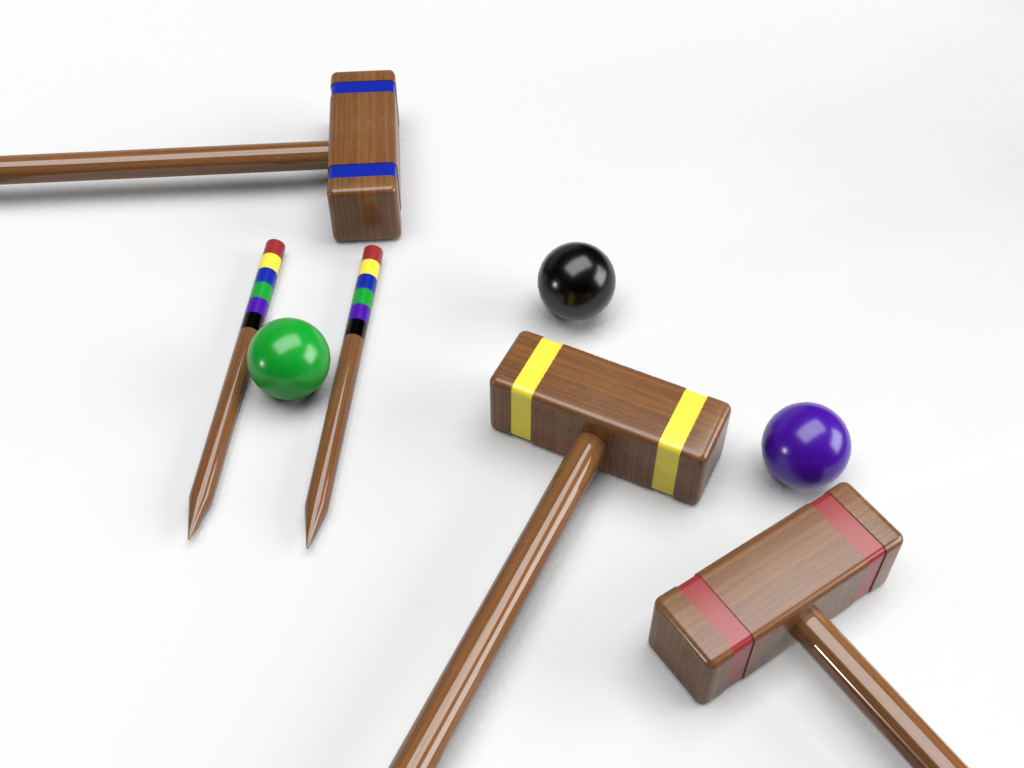
A nine-wicket set: nine wickets, two stakes, four mallets, four balls. That is the standard configuration, and a set with six wickets or two mallets is a different product aimed at a lower price.
The Mallets Are Where the Cost Is
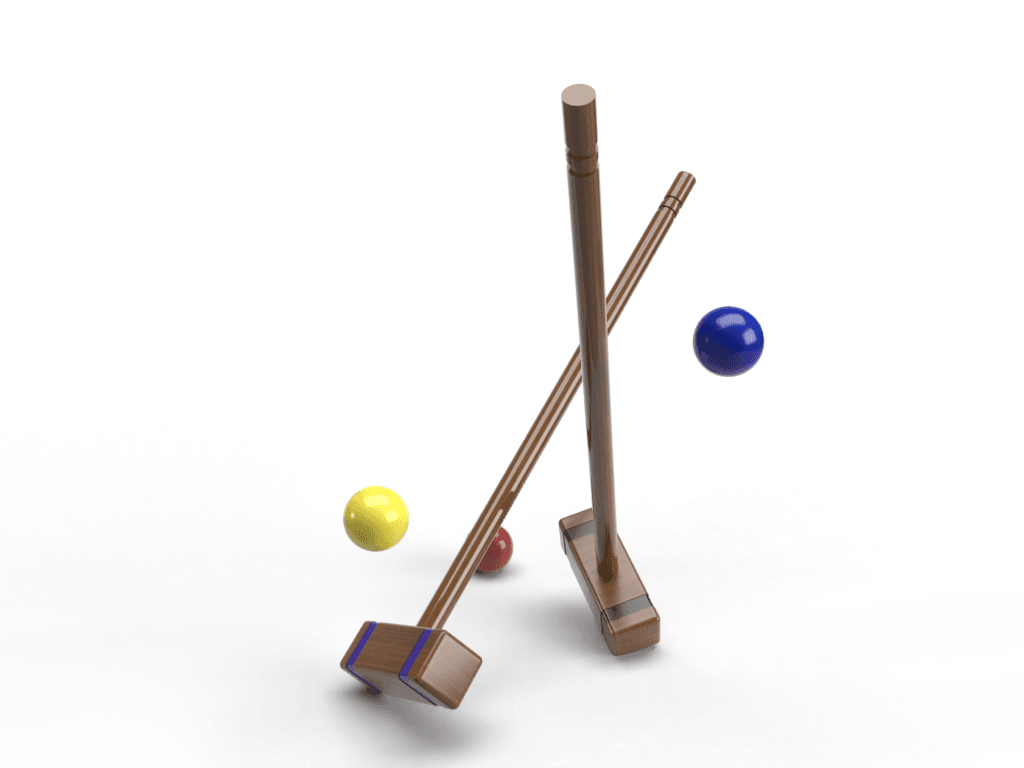
Mallets are the most expensive component and the most common failure, and the failure is almost always the same: the head separates from the shaft.
What to specify. A head that is pinned or through-dowelled to the shaft, not glued alone. Glue on the joint between a cylindrical shaft and a head relies on a perfect fit and clean surfaces, and in damp weather a glued-only head works loose. A pin or a dowel through the joint costs very little and removes the failure.
Head dimensions. A head of roughly 230 to 300 mm long and 60 to 75 mm in diameter is the usual range for a garden set. A larger head is more forgiving to hit with; a smaller one is more precise. Either is fine, but it should be a decision.
Shaft length. Around 800 to 900 mm suits most adults. Junior sets use shorter shafts, which is a legitimate product but should be labelled as such.
Face flatness. The striking faces have to be flat and square to the shaft. A head that is slightly out of square makes every shot pull to one side, and it is invisible until someone plays with it.
Wickets and Balls Have to Match
This is the specification most buyers never think about and the one that decides whether the game works.
A wicket is a gap between two uprights. If the gap is generous relative to the ball, the game is easy and slightly dull. If it is tight, the game is difficult and, on uneven grass, frustrating. Association croquet specifies a ball of about 92 mm and a wicket gap only a few millimetres wider, which is why the sport is played on a prepared lawn.
For a garden set, the sensible ratio is a wicket gap of roughly 1.2 to 1.4 times the ball diameter. Ask for both numbers and check the ratio, because a supplier quoting a wicket width without a ball diameter has given you half a specification.
Ball roundness matters as much. A wooden ball that is slightly out of round will curve, and the player will blame the lawn. Ask how roundness is checked rather than assuming it is.
Timber and Finish
- Mallets and balls: a dense hardwood, because both take impact. Rubberwood, beech or a dense tropical hardwood all work; pine does not.
- Wickets: can be a lighter timber or a coated metal, since they do not take impact. Metal wickets are more durable and read as more serious; wooden wickets look better and break.
- Finish: ask for the type and the number of coats, and whether the end grain on the mallet heads is sealed. Unsealed end grain is where a head splits.
No finish makes a wooden croquet set suitable for permanent outdoor exposure. The product is designed to be used outdoors and stored dry, and the packaging should say so.
Customization
The options that sell are the ones visible before purchase: a branded carry bag, engraved mallet heads, custom ball colours and a carton that photographs well. All are cheap at the manufacturing stage.
Changes that need tooling — a different head profile, a new wicket design — carry a setup cost and only make sense at volume. It is worth being told when they do not.
Ordering
- Minimum order. Around 500 sets per design for a custom run. We do not sell single sets; that is a retail purchase, and it is better served by a shop than by a factory.
- Sampling. Five to ten days after the specification is agreed. On this product a sample has to be played with, because the mallet joint and the wicket-to-ball ratio only show up in use.
- Production. Thirty to forty-five days after sample approval.
- Compliance. EN 71 for Europe and ASTM F963 for the United States if the product is sold for children, with reports from a recognised laboratory. FSC covers the timber supply chain, not product safety.
Frequently Asked Questions
How many wickets should a set have?
Nine for a backyard set, six for association or golf croquet. They are different games and the sets are not interchangeable.
Why do mallet heads come off?
Because the head is glued to the shaft without a pin or dowel through the joint. Ask specifically how the joint is fixed.
How do I choose between wooden and metal wickets?
Metal is more durable and reads as more serious; wood looks better and breaks. For a hire fleet or a hotel, metal. For gift retail, wood.
Is the set suitable for children?
Yes, with a shorter mallet and an age statement that matches the tested configuration. A full-length mallet is awkward for a small child, and a wooden ball is heavy enough to need supervision.
Can we have our branding on the set?
Yes: engraved mallet heads, a branded carry bag, custom ball colours and a custom carton. Send vector artwork and confirm it against a physical sample.
Sourcing Wooden Garden Games in Bulk?
Kangjie is the direct manufacturer behind these games — no trading company, no middleman margin. We supply Kubb, Croquet, Molkky, Ring Toss, Tumble Tower, Cornhole and more to importers, retailers and brand owners worldwide.
- Factory-direct pricing with transparent volume tiers (500 / 1,000 / 5,000 units)
- OEM & ODM: logo, packaging, size and finish built to your specification
- EN71 & ASTM F963 compliant; FSC-certified timber
- Bulk lead time 30–45 days, quotation within 24 hours









