
Most guides to choosing a croquet set start with the material and the mallet length. That is the wrong order, because the single decision that determines everything else is which code you are playing.
Croquet is not one game. It is at least three, played on the same kind of lawn with equipment that is not interchangeable, and a set bought for one is not much use for another.
Choose the code, then the equipment follows.
The Three Codes
| Code | Equipment | Players | Court | Feel |
|---|---|---|---|---|
| Association croquet | 6 hoops, 4 balls, double-tapped hoops | Singles or doubles | 35 x 28 yards | Long, tactical, can take three hours |
| Golf croquet | 6 hoops, 4 balls | Singles or doubles | Same court | One hoop at a time, 20 to 40 minutes |
| Nine-wicket (American) | 9 wire wickets, 2 stakes | 2 to 6 | No fixed size, roughly 20 x 25 m | Backyard, casual, fast to set up |
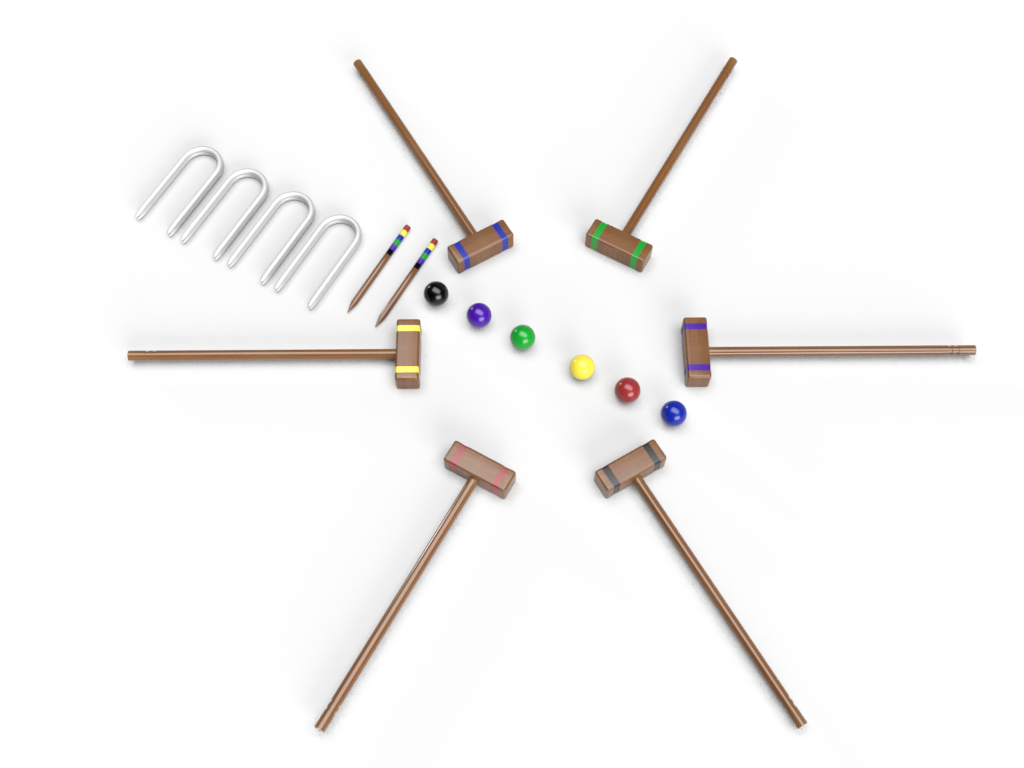
| Garden / simplified | 4 hoops, 4 mallets, 2 stakes | 2 to 4 | Whatever lawn exists | A toy. Fine for children |
Most of what is sold as a garden croquet set is the fourth row. It is a legitimate product and it is not croquet in the sense the other three mean, which is why people who buy one expecting the game they played at a hotel are often disappointed.
Which One You Want
- A serious game for two to four adults: golf croquet. It uses proper equipment, it is easy to learn, and a game finishes in half an hour.
- A family game for a garden: nine-wicket. It scales to six players and it does not need a measured court.
- Children under eight: the simplified garden set, and accept that it is a toy.
The Numbers That Decide Quality
The Hoop Gap
This is the single most important dimension in croquet and it is never on the box. A regulation ball is 92 mm in diameter and a regulation hoop opening is 95 mm. That is 3 mm of clearance total, or 1.5 mm each side.
A hoop set at 120 mm turns a precision game into a putting game. Most garden sets are at 110 to 130 mm, which is why they feel nothing like the real thing.
The Mallet
| Dimension | Regulation | Garden set |
|---|---|---|
| Shaft length | About 915 mm | 750 to 900 mm |
| Head length | 230 to 300 mm | 200 to 280 mm |
| Head diameter | 50 to 60 mm | 45 to 60 mm |
| Head mass | About 450 to 500 g | 300 to 450 g |
| Grip | Leather or cord, replaceable | Usually none |
Shaft length is the one to get right for the player. A mallet that is too short forces a hunched stance and the swing becomes a poke. The rule of thumb: standing upright, the top of the shaft should reach roughly the top of the hip bone.
The Ball
Regulation is 92 mm and 453 g. Garden balls run 80 to 100 mm and are usually lighter, which makes them easier to hit but much harder to control over distance.
Materials, Honestly
Traditional croquet used two species that are now effectively unavailable.
- Mallets were lignum vitae (Guaiacum), one of the densest woods in trade and self-lubricating. It is on CITES Appendix II and trade is restricted.
- Balls were boxwood (Buxus). Slow-growing, fine-grained, and expensive enough that a set of boxwood balls costs more than most garden sets retail for.
What is used now: beech, ash, hickory or rubberwood for heads, ash or hickory for shafts, and a composite or hardwood ball. That is not a downgrade in playability. It is a different product, and calling it traditional invites a comparison it will lose.
What to avoid: fibreglass and plastic-composite mallets sold as “weather resistant”. They are weather resistant, and they also transmit every mis-hit straight into the hands, which is why they feel dead. Wood absorbs the shock; that is the whole point of a wooden mallet.
Player Count and Portability
- Four mallets covers singles and doubles, which is what most people actually play. Six is for nine-wicket with a family.
- A carry bag with a base matters more than it sounds. Four mallets, four balls, nine wickets and two stakes is an awkward bundle, and a bag without a reinforced base fails at the seam in a season.
- Weight. A six-player nine-wicket set is 7 to 9 kg. That is the real limit on whether it gets taken anywhere.
Conclusion
Decide the code first. Golf croquet for adults who want a real game in half an hour, nine-wicket for a family garden, a simplified set for children and nothing more.
Then check two numbers: the hoop gap against the ball diameter, and the shaft length against the player. Those two decide whether the set plays like croquet or like a toy with hoops.
FAQs
1. What is the difference between croquet and golf croquet?
Same court and equipment, different rules. Golf croquet is one hoop at a time and takes 20 to 40 minutes; association croquet is a longer tactical game.
2. How long should a croquet mallet be?
About 915 mm for a regulation mallet. Standing upright, the top of the shaft should reach roughly the top of the hip bone.
3. How big is a croquet ball?
92 mm and 453 g in regulation play. Garden sets vary between 80 and 100 mm.
4. Why are the hoops so wide on garden sets?
Because a 95 mm gap on a 92 mm ball is hard, and a hard game sells badly to a family. It also means the set does not play like croquet.
5. Is lignum vitae still available?
Barely. It is CITES Appendix II and restricted. Modern sets use beech, ash or hickory.
Sourcing Wooden Garden Games in Bulk?
Kangjie is the direct manufacturer behind these games — no trading company, no middleman margin. We supply Kubb, Croquet, Molkky, Ring Toss, Tumble Tower, Cornhole and more to importers, retailers and brand owners worldwide.
- Factory-direct pricing with transparent volume tiers (500 / 1,000 / 5,000 units)
- OEM & ODM: logo, packaging, size and finish built to your specification
- EN71 & ASTM F963 compliant; FSC-certified timber
- Bulk lead time 30–45 days, quotation within 24 hours









