
Three-hole washer toss has no international governing body, which means there is no single official rulebook. What exists is a widely shared set of conventions and a handful of genuine regional variants.
That is worth saying at the start, because the most common argument at a barbecue is not about how to play. It is about which version two people learned.
Here are the rules as most people play them, the variants that are worth agreeing on before the first throw, and the equipment numbers that decide whether a board plays properly at all.
Setup
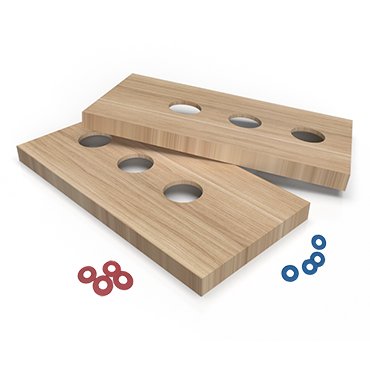
| Element | Common specification | Notes |
|---|---|---|
| Boards | Two, 1,220 x 400 mm, three holes | Sizes vary widely. Match the pair |
| Board spacing | 6.1 m (20 ft) board to board | Some leagues use 7.6 m (25 ft) |
| Holes | Three, in a line, 100 to 115 mm diameter | Must be larger than the washer, or it will not drop |
| Hole spacing | About 300 mm centre to centre | Closer and the holes merge visually |
| Washers | 2.5 inch outside diameter, steel | All washers in a set must be identical in mass |
| Washers per player | 3 per turn | Six per team of two |
The one specification that gets ignored and should not: all washers identical. A set assembled from a hardware shop bin will contain washers that differ by ten percent in mass, and the game becomes a lottery rather than a skill.
The Ground
Level ground, and if it is grass, a board that sits flat. A board that rocks on a tussock makes every throw unpredictable and nobody can diagnose why. A sheet of plywood under each board costs nothing and solves it.
Scoring
Three holes, three values, and the values are almost always the same.
- Nearest hole: 1 point
- Middle hole: 3 points
- Farthest hole: 5 points
That arrangement is deliberate. The hardest hole is the most valuable, so the game rewards ambition rather than safety.
The Rule That Must Be Agreed
A washer counts only if it is entirely inside the hole. A washer leaning against the rim, resting on another washer, or bridging the edge does not count. This is the single rule that produces the most disagreement, and it is worth stating out loud before the first throw.
Cancellation
Washers cancel. If you land one in the 3 hole and your opponent also lands one in the 3 hole, those two cancel and neither scores. The net difference is what counts for the round.
Cancellation is what keeps the game close and what makes the last throw matter. It is also why the order of throwing within a turn is a real decision: throwing last lets you see what you need to cancel.
The Target Score, and the Variant
This is the part where two people at a barbecue will disagree, and both will be right.
| Variant | Rule | Effect on the game |
|---|---|---|
| Exact 21 | You must land on exactly 21. Going over is a bust and the score resets | Longer, tenser, and the endgame is the whole game |
| 21 or more | First to 21 or above wins | Faster and simpler, and the endgame has no tension |
| Bust to 15 | Going over 21 resets your score to 15 | A specific house rule. Agree it before you start |
| Bust to 13 | Going over resets to 13 | The same rule with a different number. Also a house rule |
The “bust back to 15” version that circulates widely is a house rule, not a standard. It is a good house rule: resetting to zero is so punishing that players stop taking the 5 hole, and the game gets dull. Resetting to 15 keeps the risk alive without ending the game.
What matters is that the four players agree on one of these before the first throw. A game that changes rules halfway through is not a game.
Strategy
- At 20, do not aim at the 5. You need 1. The 5 hole is the most satisfying throw in the game and it is the one that loses it.
- Middle hole over corner hole. The 3 hole is worth 60 percent of the 5 and is far easier to hit. Two 3s beat one 5 and a miss.
- Throw last if you can. Cancellation means information is worth points. Seeing your opponent’s washers before you throw is an advantage.
- Watch the slide. A washer that lands short and slides into a hole counts. Aiming slightly short of a hole is a legitimate technique and it looks like a miss until it drops.
Teams
Two against two, partners at opposite boards. Each player throws three washers at the board in front of them, and the scores are combined. The format is the same as cornhole and the reason is the same: it lets four people play without one person standing idle.
Washer Toss and Cornhole Are Not the Same
Both are target games with cancellation scoring and both use two boards. The differences that matter: cornhole has one hole and a sloped board; washer toss has three holes and a flat board. Cornhole bags absorb impact and stay where they land; steel washers slide, bounce and can drop in late.
The consequence is that washer toss rewards a different skill. Cornhole is about a soft, repeatable arc. Washer toss is about reading a slide on a hard surface, which is closer to bowls.
Conclusion
Three holes worth 1, 3 and 5. Washers cancel. The target is 21, and whether you must land on it exactly is the one thing to agree before you start.
The equipment rule that actually matters is that every washer in the set is identical, and the setup rule is that both boards sit flat. Everything else is a variant, and variants are fine as long as everybody knows which one is being played.
FAQs
1. How far apart are the boards?
6.1 metres (20 feet) board to board is the common distance. Some leagues use 7.6 metres.
2. How many points is each hole?
1, 3 and 5, from nearest to farthest.
3. What happens if I go over 21?
Depends on the variant. In the common house rule your score resets to 15. In the strict version you bust and start again.
4. Does a washer leaning in the hole count?
No. It must be entirely inside. Agree this before the first throw.
5. Is washer toss the same as cornhole?
No. One hole and a sloped board versus three holes and a flat board, and washers slide where bags stop.
Sourcing Wooden Garden Games in Bulk?
Kangjie is the direct manufacturer behind these games — no trading company, no middleman margin. We supply Kubb, Croquet, Molkky, Ring Toss, Tumble Tower, Cornhole and more to importers, retailers and brand owners worldwide.
- Factory-direct pricing with transparent volume tiers (500 / 1,000 / 5,000 units)
- OEM & ODM: logo, packaging, size and finish built to your specification
- EN71 & ASTM F963 compliant; FSC-certified timber
- Bulk lead time 30–45 days, quotation within 24 hours









