
Tic tac toe is the most-solved game in the world, and almost every guide to it leaves that fact out. With perfect play from both sides the result is always a draw. There is no winning strategy, only a non-losing one, and knowing it changes how the game is taught.
This guide covers the rules, the drawing strategy, the woods that make a set last, and what to specify if you are buying boards rather than playing on one.
The Rules, in Full
A three by three grid, nine cells. One player takes X, the other O. Players alternate placing a mark in an empty cell. The first to get three in a line, horizontally, vertically or diagonally, wins. If all nine cells fill with no line, the game is a draw.
X moves first. That is the only asymmetry in the game, and it is why the first player cannot lose against imperfect play.

The Fact Most Guides Leave Out
The game is solved. It was analysed long before computers existed and it has been exhaustively confirmed since: with optimal play, every game is a draw.
That is not a reason to stop playing it. It is a reason to teach it differently. Tic tac toe is not a game of winning, it is a game of not losing, and the skill it actually teaches is spotting a fork before it happens.
How to Never Lose
Two short procedures, one for each side.
If you move first, take a corner. A corner creates more lines than a centre move in practice, because it forces the second player to respond in a specific way rather than choosing freely. The centre is also strong, and both are winning openings against a careless opponent, but the corner gives you more chances to be given the game.
If you move second and the first player takes the centre, take a corner. If they take a corner, take the centre. Those two responses are enough to draw against any first move.
Then look for the fork. A fork is a move that creates two threats at once, so the opponent can only block one. Forks are the only way to win against a competent player, and the way to avoid losing is to check, before every move, whether the square you are about to take gives the opponent a fork.
The most common beginner error is to block the obvious threat and hand over a fork on the next move. The fix is to count threats rather than respond to the loudest one.
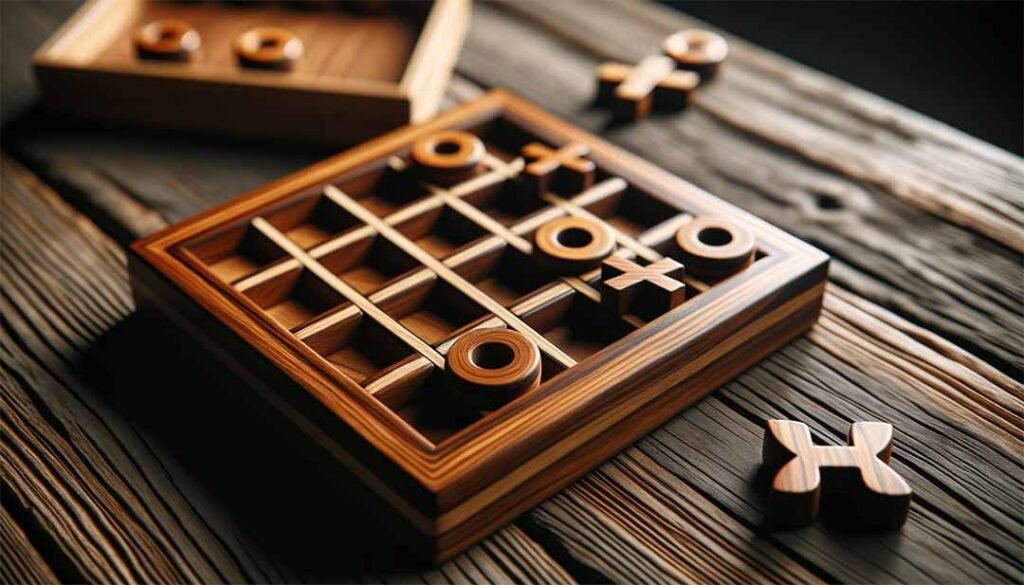
The Wood
Four species cover almost every set sold, and one popular recommendation should be avoided.
| Species | Density (kg/m3) | Behaviour | Verdict |
|---|---|---|---|
| Beech | 680 to 730 | Hard, dense, turns and finishes cleanly, holds detail | Best all-round choice |
| Birch | 600 to 660 | Takes paint and print well, stable, moderate hardness | Good for printed or branded sets |
| Rubberwood | 560 to 640 | Consistent, cheap, machines well, dents more easily | Volume retail |
| Pine | 450 to 520 | Light, cheap, marks easily, poor at holding fine detail | Budget only |
| Mahogany | 500 to 650 | Beautiful, but Swietenia species are CITES Appendix II | Avoid unless you can document the chain of custody |
Mahogany is worth a separate note because it appears in almost every article recommending premium tic tac toe sets. The genus Swietenia has been listed on CITES Appendix II since 2003, which means international trade requires a permit and the paperwork has to follow the timber. A manufacturer offering mahogany without a documented chain of custody is offering a customs problem. Beech and birch do everything mahogany does for this product at a fraction of the risk.
On bamboo, which also gets recommended: bamboo is a grass, not a wood. It is genuinely sustainable and it works for boards, but it is not a suitable material for small turned pieces because the grain runs one way and the pieces split along it.

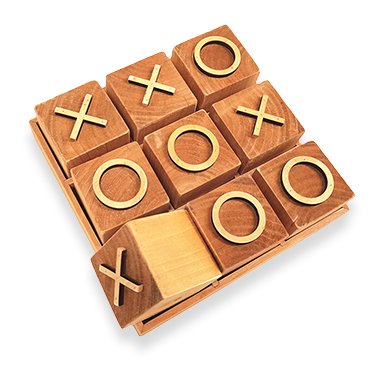
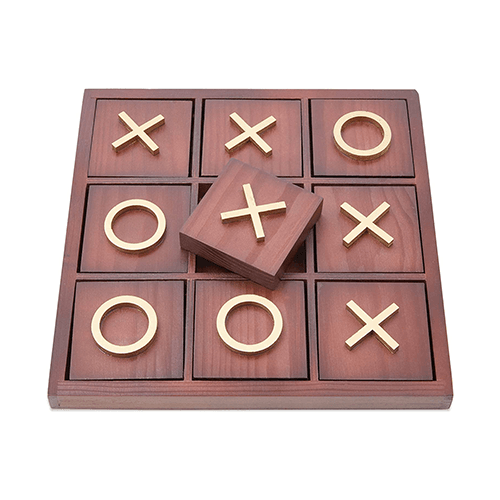
The Three Board Types
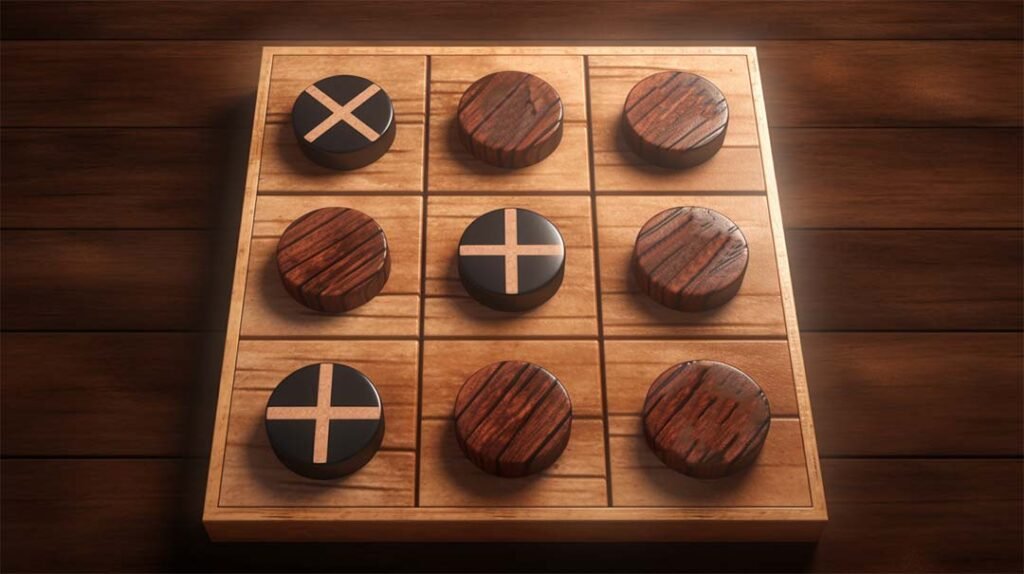
Flat board. A panel with a routed or printed grid. Cheapest, lightest, and the most likely to warp if it is under 18 mm and unsupported.
Box or folding board. The board is the lid of a box that holds the pieces. Better as a gift, better as a product, and it solves the storage problem that flat boards create. This is the format most of the retail market uses.
Giant garden board. 600 to 1,200 mm, with pieces 45 to 120 mm. Sold to pubs, holiday parks and events. The design constraint here is that the grid cell has to be at least a third larger than the piece, or the pieces will not sit in the cells cleanly.
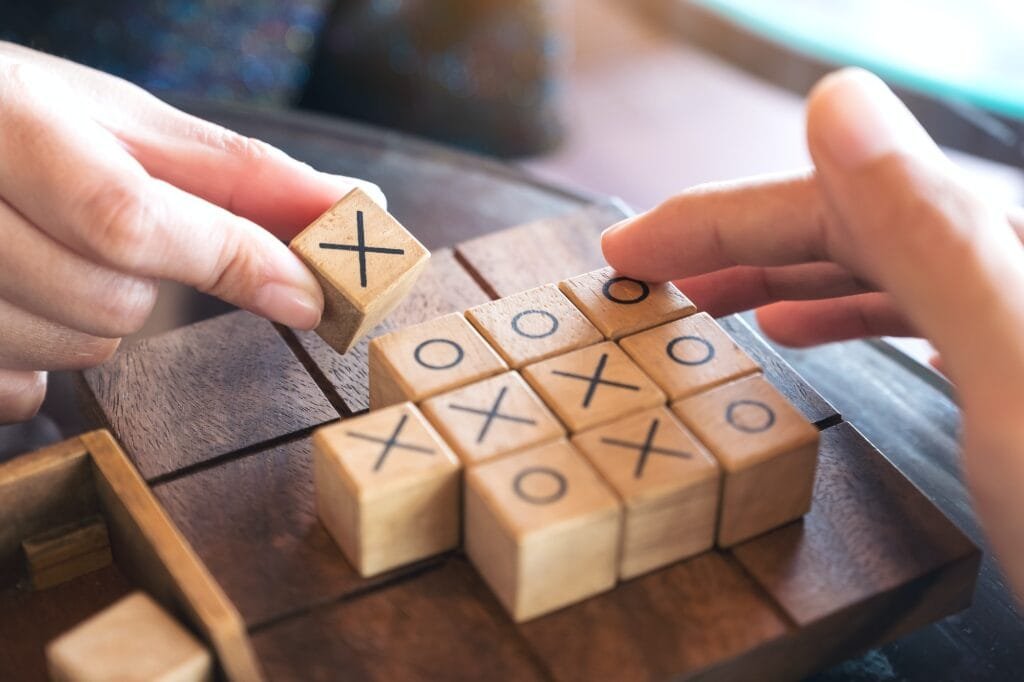
What Makes a Set Last
Four things, and none of them is the species.
- Board thickness. 18 mm minimum for a small board, 25 mm for anything above 400 mm square. Below that, cupping is a matter of when.
- Edge sealing. If the board is plywood, the edges are the failure point. Water wicks into the laminations and the layers separate. Edge banding or a solid frame solves it; nothing else does.
- Grid method. Printed grids wear where fingers land and fade in UV. Routed or engraved grids do not, and a routed grid also gives players a physical channel that makes the game easier to play on an uneven surface.
- Piece size against cell size. A piece should be no more than three quarters of the cell. Oversized pieces look generous in a photograph and are annoying to play with, because placing one nudges its neighbours.
One safety note that is decided by the size you choose. Pieces below 31.7 mm in diameter fall inside the small-parts cylinder used in EN 71-1 and the US 16 CFR 1501 test. A tabletop set with 25 mm pieces is right at that boundary, and if the product is age-graded for under-threes it cannot be sold as it stands.
What to Specify
- Board size and the resulting cell size, in millimetres.
- Piece diameter and thickness, and the count. Ten pieces, five each.
- Board thickness, and whether the back is braced.
- Grid method: printed, engraved or routed.
- Edge treatment and edge sealing.
- Species, and the moisture content at machining.
- Whether the set is a flat board or a boxed set, and the carton dimensions either way.
Minimum order 500 sets, samples 5 to 10 days, bulk production 30 to 45 days, quotation within 24 hours.
FAQs
Can you win at tic tac toe?
Only against imperfect play. With optimal play from both sides the game is always a draw; it is a solved game.
What is the best first move?
A corner. It gives the second player more ways to go wrong than the centre does.
What wood is best for a wooden tic tac toe set?
Beech for the pieces and birch plywood for the board. Both are dense enough to hold detail, stable, and available with FSC certification.
Is mahogany a good choice?
Not without documentation. Swietenia species are on CITES Appendix II, so international trade needs a permit and a chain of custody that follows the timber.
What is the minimum order?
500 sets, with volume pricing at 500, 1,000 and 5,000 units.
Sourcing Wooden Garden Games in Bulk?
Kangjie is the direct manufacturer behind these games — no trading company, no middleman margin. We supply Kubb, Croquet, Molkky, Ring Toss, Tumble Tower, Cornhole and more to importers, retailers and brand owners worldwide.
- Factory-direct pricing with transparent volume tiers (500 / 1,000 / 5,000 units)
- OEM & ODM: logo, packaging, size and finish built to your specification
- EN71 & ASTM F963 compliant; FSC-certified timber
- Bulk lead time 30–45 days, quotation within 24 hours









