
Tabletop versions of garden games exist because of a retail constraint rather than a design idea. A full-size cornhole set occupies close to a cubic metre and weighs around 20 kg; a tabletop version occupies a shoebox. That single difference decides which channels a product can be sold through, and it is the reason this category keeps expanding while full-size sets stay confined to garden centres and sports retailers.
For a buyer, the tabletop format is the cheapest way to enter a game category: lower unit cost, lower freight, wider channel coverage, and a price point that supports gifting.
Below are fifteen formats worth stocking, with the commercial case for each rather than a description of how to play. The last section covers the four decisions that determine whether a tabletop line makes money.
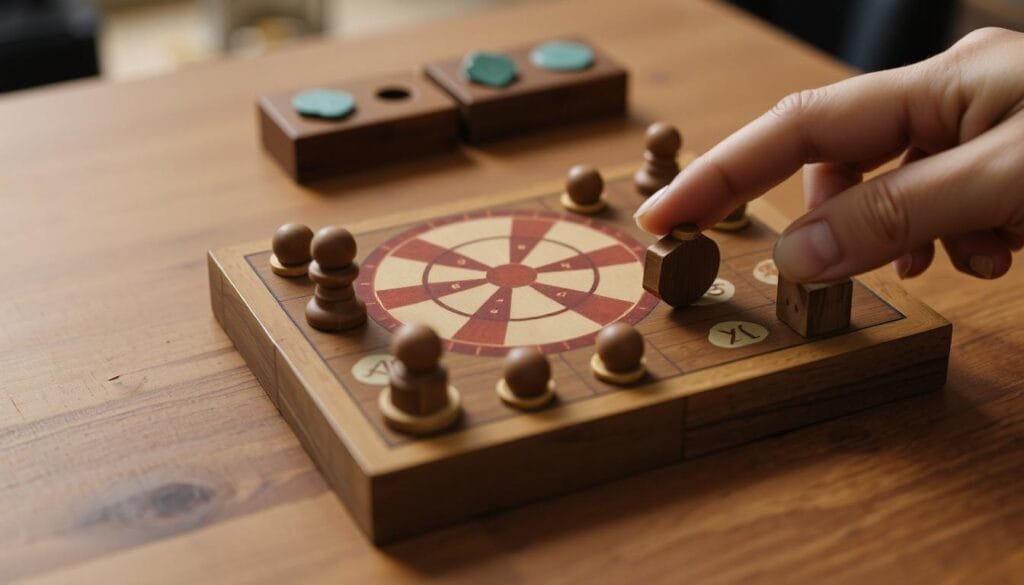
Why the Tabletop Format Works Commercially
Four structural advantages, none of them about novelty.
Shelf economics. A tabletop set fits a gift-shop shelf, a bookshop display table, a museum shop counter and a hotel reception. A full-size set needs floor space and a decision. Retailers stock what fits.
Freight economics. Ocean freight is billed on whichever is greater, actual weight or volumetric weight. A tabletop set usually bills on volume rather than mass, so the per-unit freight cost falls to a fraction of a full-size set. That is margin the buyer keeps.
Channel breadth. The same product sells into gift retail, hospitality, corporate gifting, bookshops and online. A full-size cornhole board sells into two of those.
Price band. Tabletop sets typically retail between roughly 20 and 45 dollars or euros. That is low enough for an impulse purchase and high enough to carry a real margin, which is a narrower band than most toy categories manage.
Four Decisions Before You Order
These are the choices that determine cost, and they are all settled at the quoting stage rather than after the sample.
1. Minimum Quantity and Setup Amortisation
A new design carries a setup cost – tooling, programming, a first-article check. Spread across 500 sets that cost is visible in the unit price; spread across 5,000 it is close to invisible. Our minimum is 500 sets for a variant and for most new tabletop designs, which is low enough to test a format before committing to container volume.
2. Lead Time Against the Season
Garden games are bought in a narrow window. Production runs 30–45 days from deposit and sample approval, and ocean transit adds roughly 30–40 days to Europe or 14–25 days to the US west coast. Working backwards from a March shelf date means the order has to be placed in the autumn of the previous year, not in January.
3. Age Classification and Certification
A tabletop game with small parts is a toy in regulatory terms, which brings EN71 in the EU and ASTM F963 plus CPSIA in the US. A game with no parts under the choke-test size, marketed to adults, may fall outside the toy directives entirely – which changes both the testing cost and the labelling. Deciding the target age before the design is fixed is cheaper than reclassifying afterwards.
4. Where the Customisation Sits
Engraving on the frame is the cheapest visible change. A specified wood species or stain is the next cheapest and changes perceived value the most. Custom packaging is the largest single lever on retail price and the one most often left until too late, because packaging artwork needs to be approved before production rather than after.
Fifteen Tabletop Formats Worth Stocking
Each entry gives the commercial case and the customisation that actually sells, not a rules summary.
1. Folding Tic-Tac-Toe
The lowest-risk entry in the category. Universal recognition, no learning curve, and a hinge that lets the board close into its own storage. The commercial value is in the finish: a hardwood frame with a stained or painted grid reads as a desk object rather than a toy, which is what moves it from the toy shelf to the gift shelf. Engraving a name or a company mark on the lid is a small cost addition and the main reason corporate buyers order it.
2. Mini Cornhole
Cornhole has an established audience in the US and a growing one in Europe, and the tabletop version inherits that recognition without the floor space. The engineering question is the bag: bean fill degrades and corn fill attracts pests, so a synthetic pellet fill with a stitched seam is the specification to ask for. Boards should be plywood with sealed edges, because an unsealed edge wicks moisture and delaminates within a season. Branded bags are the cheapest customisation and the one that gets reordered.
3. Domino Run
Not dominoes as a tile game but the chain-reaction format, which has a large video audience and therefore a large gift market. The product is the packaging as much as the pieces: a wooden box that doubles as the build surface justifies a higher price than a bag of blocks. Consistent thickness matters more than any other dimension, because a single undersized piece stops the run and the customer blames the product, not the setup.
4. Ring Toss
Simple to manufacture, easy to understand, and unusually good for hospitality – bars, cafes and hotel terraces buy it as a table accessory rather than a game. The two specification points are base weight and ring material. A base that tips on a hard surface ruins the product; rope rings outlast plastic ones and photograph better. Tiered peg heights add difficulty levels at almost no cost.
5. Magnetic Fishing
A preschool staple with a reliable replacement cycle, because the pieces get lost. That is the commercial argument: it is a consumable as much as a durable. The magnet must be fully encapsulated, since an exposed magnet is a choke and ingestion hazard and a recall risk. A rotating base adds perceived value; non-toxic paint certification is not optional for this age group.
6. Tumble Tower
The strongest seller in the category and the easiest to differentiate, because block dimension consistency is the whole product. A set where blocks vary by half a millimetre stacks badly and feels cheap. Three SKU variations come from one construction: natural, stained ends, and printed blocks with prompts. Tabletop size suits bars and offices; the same tooling scaled up serves the garden market.
7. Shut the Box
A pub game with a long history and an adult audience, which means it escapes toy classification and the associated testing burden. The hinged lid that doubles as storage is what separates a gift item from a pub supply item. Felt lining is worth the small cost: it quietens the dice and signals quality in a way buyers notice in a shop but rarely specify in an order.
8. Marble Solitaire
The one single-player format on this list, which matters for retail because it sells to people shopping for themselves rather than for a gift. Precision drilling is the product: holes that vary in diameter make the game feel broken. Board shape variations – cross, circle, star – create separate SKUs from the same process, and a storage drawer underneath adds a price tier.
9. Four in a Row
Instant recognition and head-to-head play, which makes it a strong hospitality and office item. The mechanism is the risk: a disc that jams once is a return. Ask for the tolerance on the disc-to-slot fit and for a drop test on the assembled unit. Natural wood against stained discs is the cheapest way to make the product look designed rather than manufactured.
10. Cup and Ball
Very low production cost, high perceived craft value, and a nostalgic reference that sells to adults. Turned hardwood is where the value sits, so the finish and the balance of the cup matter more than the decoration. It works as an add-on item at a low price point, which makes it useful for filling a container or reaching a tier break.
11. Rings on Pegs
A scoring variant of ring toss with more depth, and a better fit for adult retail because the scoring system gives it a reason to exist beyond novelty. A scored base with numbered pegs is the differentiator, and themed versions – a ship deck, a castle – create gift-shop SKUs without new tooling. Weighted base again, for the same reason as ring toss.
12. Dice Tower
Sells to the board-game hobby market, which is large, spends well and buys accessories repeatedly. It is also the easiest item on this list to sell as functional art, because the object is on the table during play rather than in a box. Felt-lined interior, consistent internal angles so rolls are fair, and a design language that matches the buyer’s other accessories. Sold blank to distributors, branded to retailers.
13. Balancing Figures
Laser-cut pieces balanced on a central stem. The appeal is visual rather than competitive, which puts it in the gift and desk-object channel instead of the toy channel. Flat-packed and self-assembling, so freight cost is minimal. The tolerance on the cut and the balance point decides whether it works at all, so this is a format to sample before ordering rather than to specify from a drawing.
14. Mini Croquet
A lawn classic compressed to a patio table, with strong gift appeal and a natural tie-in to the full-size version for buyers who stock both. Turned mallets and balls are the cost driver; wire wickets set into a wooden base are the engineering risk, since a loose wicket makes the game unplayable. Ball roll quality depends entirely on the finish, which is the specification to protect if the budget is under pressure.
15. Tabletop Dice Set
Oversized wooden dice with a rules card for a family of games – Yahtzee-style scoring, bluffing games, simple number games. The cheapest product on this list to manufacture and the easiest to private-label, because the dice are a blank surface. A printed rules card and a drawstring bag turn six blocks into a retail item; without them it is a bag of wood offcuts. Strong corporate-gifting item because the branding area is large and the unit cost is low.
From Sample to Shelf
The sequence is short and the timing is predictable.
- Specification and quote. Format, dimensions, species, finish, branding, packaging, quantity and target retail price. Quotes come back within 24 hours when the specification is complete.
- Sample. 5–10 days to produce plus 3–7 days in transit, built on the production line rather than by hand in a workshop. The charge is credited against the order.
- Production. 30–45 days from deposit and sample approval to goods ready at the port.
- Packaging. The decision that sets the retail tier. A plain carton sells at toy price; a printed box with a window and a rules card sells at gift price, and the manufacturing difference is small.
Conclusion
The tabletop format is a channel decision before it is a product decision. It lowers freight, widens the retail base and lands in a price band that supports both impulse purchase and real margin.
The formats above are all proven sellers, and none of them is difficult to manufacture. What separates a profitable line from a shelf of samples is whether the specification was settled before the order – block tolerance on the tower, base weight on the ring toss, fill material on the cornhole bags, and the packaging that decides which shelf the product lands on.
Building a tabletop game line?
We manufacture direct in Guangzhou: 500-set minimum, quotes within 24 hours, samples in 5–10 days, production in 30–45 days, EN71 and ASTM F963 compliance, FSC-certified timber: contact us
FAQs
1. Is the minimum really 500 sets?
Yes, for a variant on an existing product and for most tabletop designs. A genuinely new construction with new tooling may need a higher minimum to absorb setup, and it is quoted as its own project rather than as a variation.
2. How long does a sample take?
5–10 days to produce, plus 3–7 days in transit. The sample is built on the production line, so approving it means approving what will actually be manufactured.
3. Which certifications apply to tabletop games?
If the product has small parts or is marketed to children, EN71 applies in the EU and ASTM F963 plus CPSIA in the US. Adult-marketed games without small parts may fall outside the toy directives. The classification is worth settling before the design is fixed.
4. Which woods do you use?
Beech, birch, rubberwood and pine depending on the format, with FSC-certified timber available and chain-of-custody documentation tied to the order. Moisture content is specified at 8–12% for outdoor use and 6–8% for indoor pieces.
5. Can one design serve both tabletop and full-size markets?
Often yes, particularly for tumble tower, four in a row and cornhole, where the construction scales. Scaling changes the block count, the base weight and the packaging, so it is quoted as a separate variant rather than as the same product at a different size.
Sourcing Wooden Garden Games in Bulk?
Kangjie is the direct manufacturer behind these games — no trading company, no middleman margin. We supply Kubb, Croquet, Molkky, Ring Toss, Tumble Tower, Cornhole and more to importers, retailers and brand owners worldwide.
- Factory-direct pricing with transparent volume tiers (500 / 1,000 / 5,000 units)
- OEM & ODM: logo, packaging, size and finish built to your specification
- EN71 & ASTM F963 compliant; FSC-certified timber
- Bulk lead time 30–45 days, quotation within 24 hours









