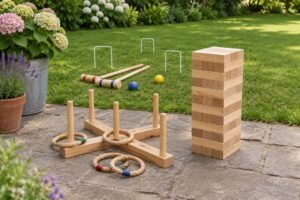
Garden games stop when the light goes. That is a real constraint on the product category in northern Europe and North America, where the summer evenings people actually want to use the garden are exactly the ones that end early.
There are two ways to solve it: make the game visible, or light the space around it. The first is a product decision with real manufacturing consequences; the second is a purchase the customer makes anyway.
What Actually Works After Dark
Three approaches, in order of how well they survive a season outdoors.
- Light the play area. Solar path lights, a string of festoon lights, a lantern. Cheap, reliable, and it makes every game playable. This is what most people should do.
- Photoluminescent markings. Numbers, outlines and scoring bands printed or inlaid with a glow pigment that charges in daylight and emits for a few hours. No electronics, no failure mode beyond fading over years.
- Integrated LEDs. Battery-powered lights in or on the game. The most striking result and the least reliable, because water, batteries and timber do not combine well.
Glow Pigments: What They Can and Cannot Do
Photoluminescent pigments absorb light and re-emit it. The behaviour that matters commercially:
- Charge time. Several hours of daylight, or a much shorter period under direct sun.
- Emission time. Bright for the first twenty to thirty minutes, then a dim tail that lasts a few hours. It is not a light source; it is a marker.
- Degradation. The pigment itself is stable, but the binder around it yellows and the effect fades. Expect a visible decline over several seasons.
- Colour options. Green and blue-green are the brightest and the longest-lasting. Other colours are dimmer.
Practically, glow is best used on the parts a player has to see: the numbers on a set of skittles, the outline of a cornhole board hole, the scoring bands on a ring toss peg. Coating an entire product in glow paint produces a dull result and costs more.
Is Glow Paint Safe for Children?
It depends entirely on the formulation, and “non-toxic” on a supplier’s website is not evidence of anything.
- For a toy sold in Europe, the coating falls under EN71-3, which covers migration of certain elements from toy material. Ask for the test report for the specific coating, not a general certificate.
- For the United States, ASTM F963 and CPSIA requirements apply to the coating in the same way.
- Ask what the pigment is based on. Zinc-sulphide pigments are the common type and are used widely in toys; the binder is often the greater variable.
- If the coating changes — a different glow colour, a different clear coat over it — the test report may no longer cover the product.
We would not describe a glow finish as “safe for kids” without the report behind it, and neither should a retail listing.
Integrated LEDs: The Hard Part
Adding lights to a wooden game is easy to design and difficult to make last. Four things decide whether it works.
- Water ingress. Any outdoor electronics need an ingress protection rating, and the battery compartment is the weakest point. A wooden housing that is not sealed will admit condensation even if rain is kept out.
- Battery access. The customer has to be able to change the battery without dismantling the game. A compartment behind a screwed panel will not be used.
- Repairability. A failed LED strip in a sealed wooden block makes the whole piece scrap. Design the electronics as a replaceable module or do not integrate them.
- Compliance. Battery-powered products sold in the EU fall under additional requirements beyond toy safety, and the documentation burden is real.
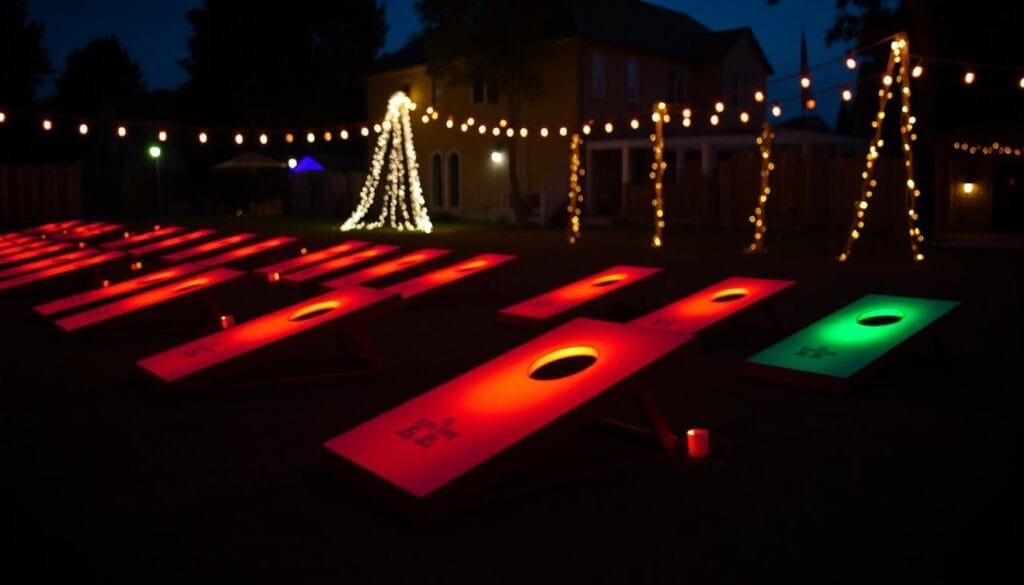
Our position is that integrated lighting is worth doing only where it is the point of the product — an illuminated cornhole board, for example — and not as an add-on to a standard game. For everything else, photoluminescent markings give most of the effect with none of the failure modes.
Which Games Suit Night Play
Cornhole
The best candidate. The board is a large flat surface, which is easy to mark with a glowing outline around the hole, and the bags can be made in a light colour that stays visible. An illuminated board is also the version that photographs best at events.
Tumble Tower
Glow on the block edges rather than the faces. A tower of glowing outlines reads clearly in the dark and looks striking in a photograph. Coating the faces instead makes the tower look flat and the blocks harder to distinguish.
Ring Toss
Glow bands on the pegs, and light-coloured rope rings. Rope takes a glow treatment less well than timber, so the pegs are the better surface.
Mölkky and Skittles
Glow numbers on the pins. This is the most useful application in the whole category, because the numbers are the part players have to read, and reading them is what makes the game work.
Practical Advice for the Buyer
- Do not build a whole range on glow. It is a variant of an existing product, not a category. Sell it as a second colourway.
- Test the charge-and-emit cycle yourself. Charge a sample in daylight for four hours and look at it two hours after dark. Most glow products look far better in a marketing photograph than in a garden.
- Light the space, not just the game. A product page that tells the customer to add two solar lights will sell better than one that promises the game lights itself.
- Keep the base product unchanged. Same dimensions, same species, same carton. A glow variant should not need new tooling.
Conclusion
Playing after dark is a lighting problem before it is a product problem. Photoluminescent markings are a good, cheap way to make the parts that matter visible; integrated LEDs are worth it only where the light is the product.
Tell us which game and which parts need to be visible, and we will tell you what a glow finish does to the cost and what testing it needs.
FAQs
How long does glow paint last?
It charges in a few hours of daylight and emits brightly for twenty to thirty minutes, then dimly for a few hours. It is a marker, not a light source.
Is glow-in-the-dark paint safe for children?
Only if the specific coating has been tested to EN71-3 or the ASTM equivalent. Ask for the report rather than the marketing claim.
Can you add LEDs to a wooden game?
It is possible for specific products, but it brings water ingress, battery access, repairability and additional compliance requirements. We will only recommend it where the lighting is the point of the product.
What is the cheapest way to play at night?
Light the play area. Two solar path lights or a string of festoon lights make every game in the garden playable and cost less than any glow variant.
Does a glow variant need new tooling?
No. It should use the same dimensions, species and carton as the standard product, with the glow applied as a marking rather than a structural change.
Sourcing Wooden Garden Games in Bulk?
Kangjie is the direct manufacturer behind these games — no trading company, no middleman margin. We supply Kubb, Croquet, Molkky, Ring Toss, Tumble Tower, Cornhole and more to importers, retailers and brand owners worldwide.
- Factory-direct pricing with transparent volume tiers (500 / 1,000 / 5,000 units)
- OEM & ODM: logo, packaging, size and finish built to your specification
- EN71 & ASTM F963 compliant; FSC-certified timber
- Bulk lead time 30–45 days, quotation within 24 hours