
The short answer is that ten pins became the American standard for a legal reason rather than a mathematical one: nine-pin bowling was banned in Connecticut in 1841 because of gambling, and a tenth pin was added to create a game that was not covered by the ban. That is the story as it is usually told, and it is worth separating what is documented from what has become folklore.
The longer answer covers a game that is several thousand years old, a German church ritual, a nineteenth-century standards body, and a small set of variants that survived outside the American mainstream.
Older Than Any of the Modern Rules
The Egyptian find
In the 1890s the archaeologist Flinders Petrie excavated objects in an Egyptian child’s grave — a set of stone balls and slim pins — dated to roughly 3200 BC. They were interpreted at the time as a game of the bowling family.
Worth being careful here: “interpreted as” is the accurate phrase. The objects are real and the date is real, but the conclusion that they were used for a game resembling bowling is an inference. Claims that bowling is 5,000 years old rest on that inference, which is why the number appears everywhere and is defended nowhere.
The German kegel ritual
The other origin story places the game in Germany, where parishioners rolled stones at a club — a Kegel — as a symbolic act, with the club standing in for a temptation or a sin. Knock it down and you were absolved; miss and you tried again.
This is a widely repeated account and it is plausible, but the documentary trail is thin. What is not in doubt is the word: Kegel is still the German word for a bowling pin, and Kegelbahn is still the word for a bowling lane. The vocabulary is real even where the ritual is uncertain.
The American Ban and the Tenth Pin
Connecticut, 1841
By the early nineteenth century, nine-pin bowling was being played in American saloons, and it had acquired a reputation for gambling and disorder. In 1841 Connecticut prohibited nine-pin alleys, with the stated purpose of suppressing the associated betting.
The ban is documented. What follows it is where the story becomes legend.
The tenth pin, and why the legend is suspicious
The popular account is that players simply added a tenth pin and renamed the game, on the reasoning that a ten-pin game was not a nine-pin game and therefore not prohibited.
It is a good story and it may well be true, but there is no contemporaneous documentation of the moment of invention. What is documented is that ten-pin bowling spread rapidly in the northeastern United States during the middle of the century, and that the ten-pin form became dominant while the nine-pin form did not.
Treat the loophole story as a legend with a plausible legal basis, not as an established fact. It is the sort of thing that gets repeated in bowling histories because it is memorable, not because anyone has found the minutes of the meeting.
Why ten works geometrically
The practical case for ten is stronger than the legal one. Ten pins arrange into a triangle of four rows — one, two, three, four — which is the smallest arrangement that produces a genuinely difficult strike while still allowing one.
Nine pins, in the older arrangement, produces a game where a strike is either too easy or depends on a layout that does not reward a pocket hit. Eleven or twelve pins produce a rack where the front pin absorbs so much of the impact that the back row barely moves. Ten sits at the point where a well-aimed ball into the pocket produces a chain reaction through the whole rack.
Standardisation
The American Bowling Congress was formed in 1895 and set about standardising pin dimensions, ball specification and lane dimensions. Before that, a “bowling alley” could mean almost anything. After it, the game could be replicated, compared and competed in, which is what turned it from a tavern pastime into a sport with leagues.
That standardisation is the real reason ten pins is the number most people know. Not the loophole, and not the geometry, but the fact that one body defined a specification and everyone else built to it.
The Variants That Survived
| Variant | Pins | Ball | Where |
|---|---|---|---|
| Ten-pin | 10 | Large, drilled for fingers | The international standard |
| Nine-pin | 9 | Large | Still played in parts of Europe |
| Five-pin | 5 | Small, hand-sized, no finger holes | Canada, where it was devised in 1909 |
| Candlepin | 10 | Small, about 11 cm, no finger holes | New England and the Canadian Maritimes; three balls per frame |
| Duckpin | 10 | Small, about 13 cm, no finger holes | Maryland and nearby states; short squat pins |
One correction worth making, because it circulates widely: duckpin bowling does not use giant balls. It uses small balls with no finger holes, roughly 13 cm in diameter, and short pins. The whole point of duckpin is that the small ball makes a strike very hard to achieve.
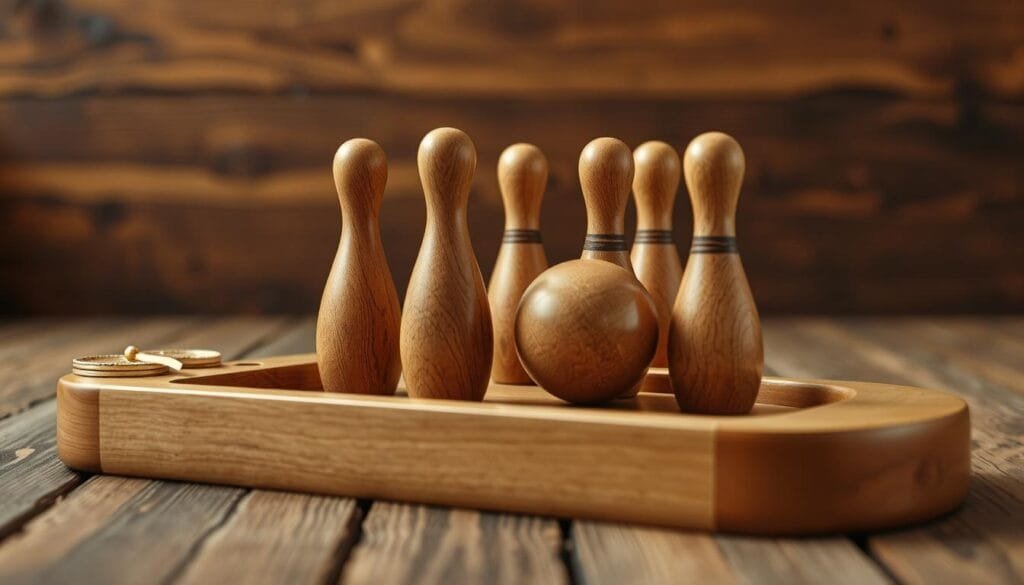
Wooden Skittle and Bowling Sets
If you are here because you are looking at wooden bowling sets rather than because you wanted bowling history, the relevant facts are different.
Wooden skittle sets are a traditional European garden product: a set of shaped pins and a wooden or composite ball, played on grass or a hard surface with the throwing distance adjusted. They are not a training tool for ten-pin and they do not follow ten-pin rules. They are their own game, closer to German Kegeln than to anything on an American lane.
The quality questions are narrow and specific:
- Pin weight consistency. Mismatched pins make the game feel arbitrary, and it is the defect buyers notice last and customers notice first.
- Base diameter and centre of gravity. A pin that is too easy to topple makes the game trivial; one that is too stable makes it frustrating. This is a design decision, not a manufacturing tolerance.
- The ball. Wooden balls mark and can split on a hard surface. A composite ball is more durable and plays differently. Decide which product you are selling.
- Numbering. If the pins are numbered for a scoring game, the numbers have to stay legible after a season of being hit. Engraved and filled is more durable than printed.
- Storage. Nine or ten pins plus a ball is a bulky set. A crate or a reinforced bag is what makes it portable.
Frequently Asked Questions
Did bowling really start in Egypt?
A set of stone balls and pins was found in an Egyptian grave and dated to around 3200 BC. Whether it was used for a game resembling bowling is an interpretation rather than an established fact.
Was the tenth pin really added to dodge a law?
That is the traditional account and it is plausible, but there is no contemporaneous documentation of the invention. The Connecticut ban on nine-pin alleys in 1841 is documented; the loophole is legend.
What is the hardest bowling variant?
Candlepin, by most accounts. The pins are tall and narrow, the ball is small, and the pins are not cleared between balls within a frame, so fallen pins stay on the lane as obstacles.
How fast do professional bowlers throw?
Typically around 17 to 20 mph at release, with some players reaching the low twenties. The exact figure matters less than consistency.
Can wooden bowling sets be customized?
Yes: pin numbering, engraved or printed branding, custom ball colours and custom crates. A new pin profile needs tooling and carries a setup cost, which is worth knowing before you ask for one.
Sourcing Wooden Garden Games in Bulk?
Kangjie is the direct manufacturer behind these games — no trading company, no middleman margin. We supply Kubb, Croquet, Molkky, Ring Toss, Tumble Tower, Cornhole and more to importers, retailers and brand owners worldwide.
- Factory-direct pricing with transparent volume tiers (500 / 1,000 / 5,000 units)
- OEM & ODM: logo, packaging, size and finish built to your specification
- EN71 & ASTM F963 compliant; FSC-certified timber
- Bulk lead time 30–45 days, quotation within 24 hours









