
Pine is the cheapest timber we work with, and it is the one most often specified for the wrong product. Used properly it is a good material: light, stable when dried correctly, easy to machine and easy to paint. Used for the wrong game it fails within a season, and the failure is blamed on the supplier rather than on the species.
This page sets out which wooden garden games genuinely work in pine, which do not, and what has to be specified to make a pine product last.
What Pine Is Good At
- Cost. It is the cheapest solid timber available at volume, which is why it is the only route to a low retail price in this category.
- Weight. Pine is light. For a product that has to be carried — a ring toss set, a skittle set, a folding board — that matters for both the customer and the freight cost.
- Workability. It cuts, sands and takes paint cleanly, which makes it the right choice for anything with a printed or painted finish.
- Availability. Consistent supply in standard sections, which means a reorder in eighteen months uses the same material as the first order.
- Fast growth. Plantation pine is a genuinely renewable material on a short cycle, unlike slow-growing hardwoods.
What Pine Is Not Good At
These are the properties that decide whether pine is suitable, and they are the ones buyers tend to skip.
- Hardness. Pine dents. On the Janka scale it is far below beech or birch, and any product that takes repeated impact will mushroom and split at the contact face.
- Durability outdoors. Untreated pine is not durable. Left in contact with wet ground it will rot within a couple of seasons, regardless of finish.
- Knots. Knots are weak points. A knot near the end of a baton or a peg is where the piece will break.
- Movement. Pine moves more than hardwood with humidity changes, which matters on flat surfaces such as boards and grids.
- Water absorption. End grain soaks up water quickly. Any pine product left outside needs sealed end grain, not just a coated face.
None of these make pine a bad material. They define what it should be used for.
Games That Work Well in Pine
Cornhole Boards
The best use of pine in the category. A board is a flat panel that takes no direct impact, it is usually painted or printed, and the frame carries the load. A braced pine frame with a plywood or pine deck is a sound, affordable product.
Specify: braced frame rather than a single skin, sealed end grain, and a painted or laminated playing surface. Untreated pine boards left out in the rain will delaminate at the frame joints.
Ring Toss and Skittle Sets
Pegs and skittles in pine are fine for a family set used on grass, because the ground absorbs most of the impact. Painted pine pegs with sealed ends will last several seasons.
Specify: no knots in the top 10 cm of the peg, and a rounded rather than a sharp top edge. A knot at the top of a peg is where it snaps.
Giant Board Games
Tic-tac-toe grids, four-in-a-row frames, oversized draughts boards. Pine is a reasonable choice because the pieces are large and handled rather than struck.
Specify: the grid frame in pine and the pieces in a harder species if the budget allows, because pieces take the knocks and the frame does not.
Painted Novelty Games
Animal-shaped skittles, painted ring toss sets, seasonal gift lines. Pine takes paint better than most hardwoods and the paint protects the timber, which solves the durability problem at the same time as it solves the design problem.
Yard Dice
Acceptable at the larger sizes, where the die has enough mass and the grass absorbs the landing. Not suitable for small dice that get thrown onto hard surfaces, where the corners will crush.
Games That Should Not Be Pine
- Kubb. The batons take direct impact on every throw. Pine batons split at the end grain within a season. Beech or another dense hardwood is the only sensible specification.
- Mölkky. The pins are struck repeatedly by a baton at speed. Pine pins deform and eventually break.
- Croquet mallets. The head has to absorb the impact of a ball. Pine heads split along the grain.
- Ladder toss frames. The rungs take repeated hits from weighted bolas, and a pine rung will fail at the joint.
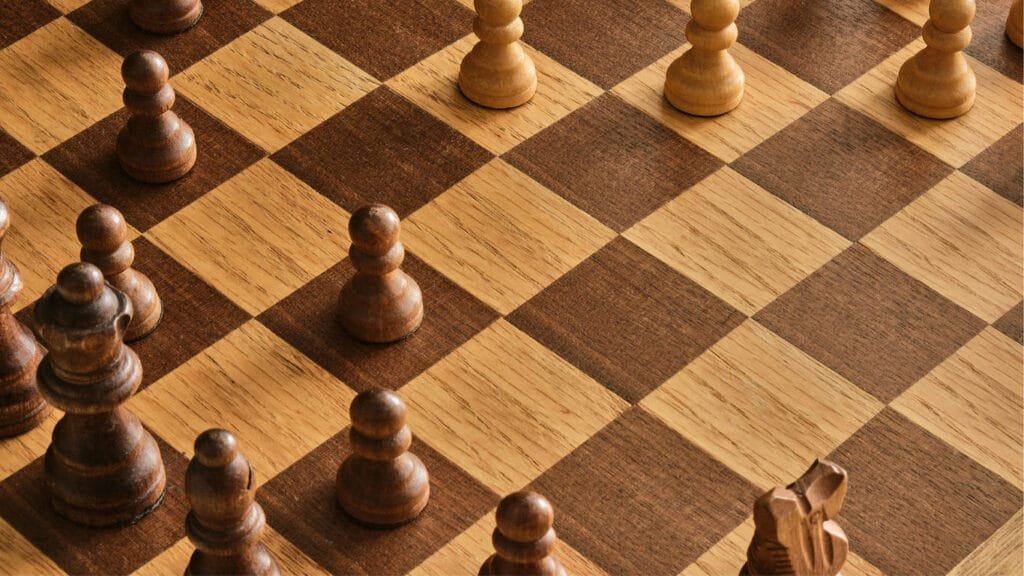
- Chess pieces. Pine is too light to feel like a chess piece and too soft to hold a crisp turned profile.
If a buyer specifies pine on one of these to hit a price, the honest answer is that the price will be met and the product will fail. Reducing the piece count or the size is a better way to reach the target than changing the species.
How to Make Pine Last
- Dry it properly. Pine has to be kiln-dried to a target moisture content in the 8–12% range before machining. Undried pine warps after assembly and there is no fix for it.
- Seal the end grain. Water enters through the ends far faster than through the faces. A product with coated faces and bare ends will fail at the ends.
- Choose the cut. For anything visible, specify knot-free or clear-grade stock. For structural parts, knots are acceptable if they are not at a stress point.
- Paint rather than oil. Paint forms a film that protects the timber; oil on pine is high maintenance and needs reapplication the customer will not do.
- Design out standing water. A recess that holds water will rot, however well it is finished. Drainage holes cost nothing.
Writing It on a Purchase Order
“Pine” alone is not a specification. A line that holds the factory to a standard reads:
- Species and grade, with the knot tolerance stated.
- Target moisture content at packing.
- Finish type, and whether end grain is sealed.
- Which parts are pine and which are a harder species.
- Whether FSC or PEFC chain of custody is required.
Conclusion
Pine is the right answer for flat panels, painted products, large handled pieces and anything where weight and cost matter more than impact resistance. It is the wrong answer for anything that gets struck. The distinction is not about quality, it is about which property the product depends on.
Tell us the game and the retail price, and we will tell you honestly whether pine can carry it or whether a different species is the only way to make the product work.
FAQs
Is pine strong enough for outdoor games?
For panels, frames and handled pieces, yes, provided it is dried correctly and the end grain is sealed. For anything that takes repeated impact, no.
Can pine be used for a Kubb set?
We would not recommend it. The batons take direct impact on every throw and pine splits at the end grain. Beech is the correct specification.
Does pine need pressure treatment?
Only if the product will be in ground contact or permanently outdoors. For a game that is used outside and stored under cover, a proper paint system with sealed ends is sufficient.
Is pine a sustainable choice?
Plantation pine grows on a short cycle, so the material itself is renewable. Whether a specific order carries an FSC or PEFC claim depends on the mill’s chain-of-custody status, which we can document on request.
What is the minimum order in pine?
500 sets, the same as our other species. Pine orders are usually cheaper per unit and have shorter material lead times because the stock is more readily available.
Sourcing Wooden Garden Games in Bulk?
Kangjie is the direct manufacturer behind these games — no trading company, no middleman margin. We supply Kubb, Croquet, Molkky, Ring Toss, Tumble Tower, Cornhole and more to importers, retailers and brand owners worldwide.
- Factory-direct pricing with transparent volume tiers (500 / 1,000 / 5,000 units)
- OEM & ODM: logo, packaging, size and finish built to your specification
- EN71 & ASTM F963 compliant; FSC-certified timber
- Bulk lead time 30–45 days, quotation within 24 hours









