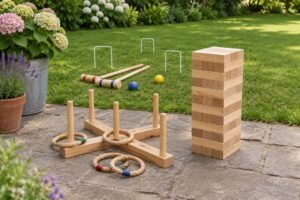
Buyers ask this question in two different moods. Some want to know what a specific product is made of before they list it. Others are choosing a species for a new line and want to know which one will survive a British winter, a North American summer, or a rental fleet that never gets put away.
The short answer for wooden garden games is birch, beech and rubberwood, with pine for painted work and robinia where the product will live outside permanently. Below is what each of those actually does, where it fails, and how to write the requirement into a purchase order so the factory cannot substitute quietly.
The Short Answer
Four species cover most of what you will see in this category:
- Rubberwood — the workhorse. Plantation-grown, widely available, machines cleanly, takes paint and print well.
- Beech — dense and hard, the choice for pieces that take impact, such as batons and mölkky pins.
- Birch — lighter, tight grain, good for blocks and boards where a clean finish matters.
- Pine — soft, cheap, fine for painted sets and indoor play, not for anything that has to absorb repeated hits.
Two more come up often enough to mention: acacia for decorative boards and robinia (black locust) where a game will be left outdoors all year, because it is one of the few species with genuine natural durability.
Why the Species Decides Almost Everything
Four properties separate a game that lasts from one that comes back as a complaint.
- Hardness. On the Janka scale, beech and birch sit well above pine. A pine Kubb set will dent and mushroom at the ends within a season of play; a beech one will not.
- Stability. Wood moves as humidity changes. Species with tight, straight grain move less, which matters most on flat pieces such as crokinole boards and dominoes, where a 1 mm warp makes the game unplayable.
- Natural durability. Beech and birch are not durable outdoors. Left in the rain they will discolour and eventually rot, whatever the marketing says. This is not a defect, it is the species, and it is why finish and storage instructions matter as much as the timber choice.
- Machinability. Harder species hold crisper edges and sharper engraving. Softer species fuzz at the cut, which shows up on laser-etched logos.
Rubberwood: The Default for Volume
Rubberwood comes from Hevea brasiliensis, the plantation tree grown for latex. When a tree stops producing latex, typically after 25 to 30 years, it is felled for timber. That is why it is often described as a by-product of the rubber industry, and why the supply is steady and the price is stable compared with hardwood cut from natural forest.
What it does well: it is straight-grained, machines cleanly, holds paint and print, and takes engraving without tearing. Density is moderate, so a rubberwood set is lighter to ship than the same set in beech — a real cost difference at container volumes.
Where it needs care: fresh rubberwood has a high moisture content and must be kiln-dried properly before machining. It also stains if left damp, and it is not naturally durable outdoors. A rubberwood game kept on a covered porch will last years; one left on wet grass will not.
Beech: For Pieces That Take a Beating
Beech is dense, close-grained and hard. It is the species we reach for when a piece has to absorb repeated impact — mölkky pins, kubb batons, croquet balls, skittle pins. It holds a machined edge sharply, which is why it is also the standard for chess pieces and draughts.
The trade-off is weight and movement. Beech is heavy, which raises freight cost, and it is more dimensionally active than rubberwood, so thick sections need proper drying and a design that allows for movement. It is also not durable outdoors, and it will grey and split if left exposed.
A beech set with a decent water-based finish and a storage bag is a good product. The same set without a finish is a returns problem waiting to happen.
Birch: Clean Grain, Consistent Colour
Birch is lighter than beech with a fine, even grain and very little colour variation between pieces. For anything where the pieces have to look identical — tumble tower blocks, dominoes, dice, puzzle parts — that consistency is worth more than hardness.
It machines and sands well, takes a clear finish without blotching, and is a good base for screen printing and laser engraving. Its weakness is the same as beech: not durable outdoors, and prone to staining if water sits on an unfinished face.
Pine and the Cheaper End of the Range
Pine is soft, light and inexpensive, and there is nothing wrong with it in the right application. Painted ring toss sets, indoor skittles, promotional items and children’s play pieces all work in pine.
It is the wrong choice for impact. Pine dents, the end grain soaks up water, and knots create weak points that split under repeated hits. If a buyer specifies pine on a Kubb set to hit a price, the honest answer is that the price will be met and the product will fail; better to reduce the piece count or the size than to change the species.
Moisture Content: The Number Nobody Asks About
This is the single most common cause of a wooden game failing in the field, and it almost never appears on a purchase order.
Timber has to be kiln-dried to a target moisture content before machining, typically in the 8–12% range for this kind of product. If it goes into a container at 15%, it will shrink in transit and arrive with gaps at the joints and warped boards. If it is over-dried, it will swell on arrival in a humid market and jam.
Ask the factory what the target moisture content is and how it is measured. A supplier who can answer that without checking is a supplier who measures it.
Finishes Matter as Much as the Timber
A good species with a bad finish is a bad product. For garden games the practical options are:
- Water-based lacquer — the default for toy-adjacent products. Low odour, fast drying, and the version to specify if the product will be tested to EN71-3.
- Hardwax oil — better for outdoor pieces because it can be refreshed without stripping, but it needs reapplication and the buyer has to be told so.
- Paint and print — fine on rubberwood and pine, less so on beech where the density resists absorption.
Whatever the finish, EN71-3 covers migration of certain elements from toy material and is the relevant test for a coated wooden game sold into Europe. Ask for the report for the specific coating, not a generic certificate.
How to Write It on a Purchase Order
“Wooden” is not a specification. A line that holds the factory to a species looks like this:
- Species, by botanical name where possible.
- Target moisture content at packing.
- Finish type, and the test standard it must meet.
- Whether FSC or PEFC chain of custody is required.
- Grain direction and colour matching requirements, if the pieces are visible in use.
Without those five lines, a quotation is not comparable with the next one, and a substitution is not a breach of anything.
Conclusion
Rubberwood for volume, beech for impact, birch for consistency, pine for painted work, robinia where the game stays outside. None of them is “the best wood” in the abstract; each is the right answer to a different set of constraints.
If you tell us the market, the retail price and whether the product lives indoors or out, we will tell you which species makes sense and what it does to the unit cost.
FAQs
Is rubberwood a sustainable choice?
It is plantation-grown and harvested at the end of its latex-producing life, so it does not come from cleared natural forest. Whether a specific order qualifies for an FSC claim depends on the mill’s chain-of-custody status, which is a separate question you can ask us to document.
Which wood is best for outdoor garden games?
For permanent outdoor exposure, robinia or another naturally durable species. For games that are used outside and stored under cover, beech or rubberwood with a proper finish is the practical choice and much cheaper.
Does a harder wood mean a safer toy?
No. Safety comes from design — rounded edges, no small detachable parts, correct wall thickness — and from the finish meeting EN71-3. Hardness affects how long the game lasts, not whether it is safe.
Can you match a specific wood from a sample?
Usually, yes. Send the sample or a clear close-up photograph with the grain and colour visible, and we will identify the likely species and quote alternatives if the original is not available at volume.
What is the minimum order for a specific species?
Our standard minimum is 500 sets. Unusual species may carry a higher minimum because the mill has to buy the board specifically for the order.
Sourcing Wooden Garden Games in Bulk?
Kangjie is the direct manufacturer behind these games — no trading company, no middleman margin. We supply Kubb, Croquet, Molkky, Ring Toss, Tumble Tower, Cornhole and more to importers, retailers and brand owners worldwide.
- Factory-direct pricing with transparent volume tiers (500 / 1,000 / 5,000 units)
- OEM & ODM: logo, packaging, size and finish built to your specification
- EN71 & ASTM F963 compliant; FSC-certified timber
- Bulk lead time 30–45 days, quotation within 24 hours