Pickleball is a paddle sport played on a court roughly a third the area of a tennis court, with a perforated plastic ball and a solid paddle. It was invented in 1965 in Washington State, and it has spent the last decade moving from retirement communities into schools, parks and garden ranges.
This article covers the dimensions, the four rules that matter in the first ten minutes, and an honest assessment of wooden paddles as a product.
The Court, Precisely
The dimensions are fixed and they are the reason the game works: the court is small enough that two people who have never played can rally within minutes.
| Measurement | Imperial | Metric |
|---|---|---|
| Court, doubles | 20 x 44 ft | 6.10 x 13.41 m |
| Court, singles | Same court, narrower service area | Same |
| Net height at posts | 36 in | 914 mm |
| Net height at centre | 34 in | 864 mm |
| Non-volley zone (the kitchen), each side | 7 ft from the net | 2.13 m |
| Service area depth | 15 ft | 4.57 m |
| Paddle, maximum length | 24 in combined | 610 mm |
| Ball | Perforated plastic, 26 to 40 holes | About 74 mm diameter, 22 to 26 g |
The comparison usually made is “a quarter of a tennis court”. The real figure is closer to a third: a tennis doubles court is 78 by 36 feet, or 2,808 square feet, and a pickleball court is 880. That difference matters commercially, because a third is still too big for most driveways, which is the claim that gets made most often.
The Four Rules That Matter in the First Ten Minutes
Serve underhand, below the waist. The paddle must move upward and contact the ball below waist height. No overhead serve exists in this game.
The double bounce rule. The serve must bounce before the receiver hits it, and the return must bounce before the serving side hits it. After those two bounces, either side may volley. This rule is what stops the game becoming a net rush, and it is the rule beginners forget.
Stay out of the kitchen. The seven feet either side of the net is a no-volley zone. You may enter it to play a ball that has bounced, but you cannot volley from it, and you cannot step in after a volley even if the ball is already dead.
Score only when serving, to 11, win by two. Traditional scoring. The serve rotates between the two players on a team before it passes to the other side.
Is It Actually Easy?
Yes to start and no to master, and the gap between those two is wider than the marketing suggests.
The first ten minutes are genuinely easy: the court is small, the ball is slow, and a rally happens immediately. What happens after that is the dink game, the soft exchange of shots just outside the kitchen, where the ball is placed rather than hit. That is where the sport actually lives, and it takes years.
For a garden product, this is good news. A set that gets a family rallying in ten minutes has done its job, and the ceiling being high is not a problem the product has to solve.
Wooden Paddles: What They Are and Are Not
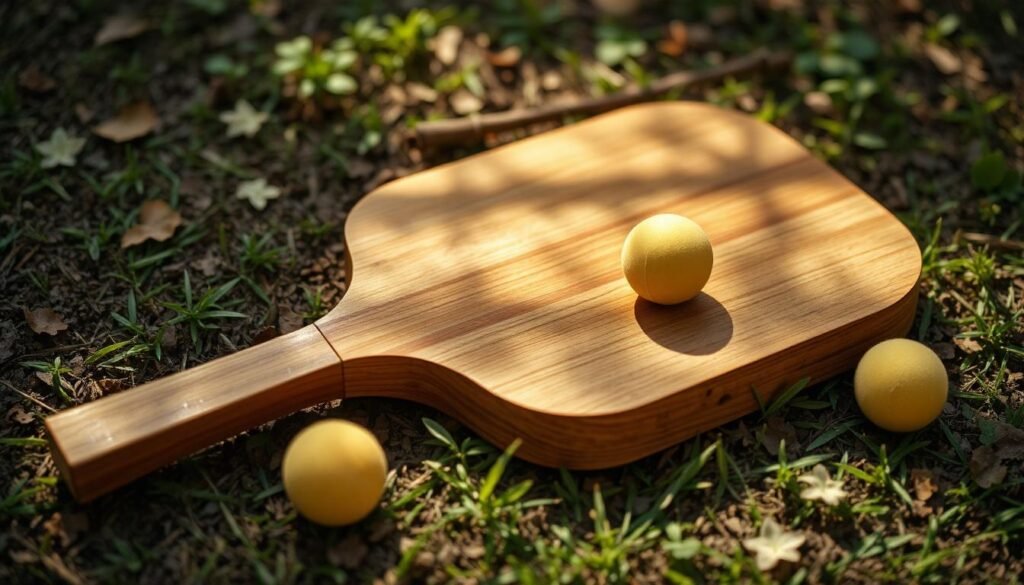
Wooden paddles are the original equipment. The first pickleball paddles were plywood, and wooden paddles are still permitted under the rules provided the surface is not textured and the paddle meets the size limit.
What they are: heavier than composite, less powerful, more durable, and considerably cheaper. A wooden paddle does not delaminate or crack the way a honeycomb core does, and it does not have a surface coating to wear through.
What they are not: what competitive players use. A composite paddle with a polymer honeycomb core is lighter and generates more power, and that is what anyone playing regularly will move to.
Two claims to avoid. “Tested to survive 10,000 hits” is not a real test standard and quoting it invites a question you cannot answer. And “same material as professional table tennis blades” is misleading: competition table tennis blades are thin veneer laminations, which is a different construction from a solid or plywood pickleball paddle.
Space, Honestly
A full court needs 6.10 by 13.41 metres plus run-off, which is roughly 9 by 17 metres of clear space. Most gardens do not have it and most driveways do not either.
What does work in a garden is a half-court or a reduced court, and a set sold for garden use should say so plainly rather than implying a full court fits anywhere. A product that oversells its space requirement generates returns from people who measured afterwards.
What to Specify
- Paddle dimensions and weight, and the ply construction if it is plywood. A 5-ply paddle plays differently from a 3-ply.
- Edge treatment, because the edge is where a wooden paddle takes its knocks and where a sharp corner is a real hazard.
- Handle length and grip material.
- Ball hole count and weight, which decide how the ball behaves far more than the colour does.
- Net system, if included: post height, tension method, and whether it stands without stakes.
- Carton dimensions and gross weight.
Minimum order 500 sets, samples 5 to 10 days, bulk production 30 to 45 days, quotation within 24 hours.
FAQs
What is pickleball?
A paddle sport on a 20 by 44 foot court, played with a perforated plastic ball, an underhand serve and a seven foot no-volley zone either side of the net.
Is it easy to learn?
Yes for the first ten minutes and no after that. The beginner game is genuinely accessible; the advanced game is a soft-shot battle near the net that takes years.
Are wooden paddles allowed?
Yes, provided the surface is not textured and the paddle is within the size limit. They are heavier and less powerful than composite paddles, which is why competitive players do not use them.
How much space do I need?
About 9 by 17 metres of clear space for a full court with run-off. A garden set is realistically a half-court or reduced-court product.
What is the minimum order?
500 sets, with volume pricing at 500, 1,000 and 5,000.
Sourcing Wooden Garden Games in Bulk?
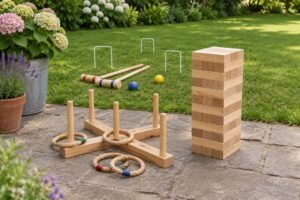
Kangjie is the direct manufacturer behind these games — no trading company, no middleman margin. We supply Kubb, Croquet, Molkky, Ring Toss, Tumble Tower, Cornhole and more to importers, retailers and brand owners worldwide.
- Factory-direct pricing with transparent volume tiers (500 / 1,000 / 5,000 units)
- OEM & ODM: logo, packaging, size and finish built to your specification
- EN71 & ASTM F963 compliant; FSC-certified timber
- Bulk lead time 30–45 days, quotation within 24 hours