Since the equipment rules were tightened in 2023, the honest answer has changed. There is no longer a paddle you can buy that is legally grittier than another one, because surface roughness is tested and capped.
So the question “which paddle provides the most spin” now has two answers, and neither of them is a product recommendation.
The first is that the differences between approved paddles are small and mostly come from the core rather than the face. The second is that most of the spin a recreational player generates comes from the swing, not the equipment.
What Spin Actually Is
Two variables, and only one of them is on the paddle face.
- Friction between the face and the ball. This is what surface roughness controls, and it is now regulated.
- Dwell time — how long the ball stays in contact with the face. Longer contact means more of the swing’s energy is converted into rotation.
Dwell time comes from the core. A thicker, softer core compresses more on impact and holds the ball a fraction longer. That is the real difference between a paddle that feels like it grips and one that feels like a trampoline, and it has nothing to do with grit.
The Rule Change
Paddles used in sanctioned play must appear on an approved list, and approval includes a surface roughness test and a deflection test. Deliberately adding roughness beyond the standard is not permitted, and several paddles were removed from the list after the rules were clarified.
The practical consequence: any claim that a specific paddle “generates more spin” than another approved paddle is either about dwell time, or it is marketing, or it is describing a paddle that is no longer legal for sanctioned play.

What Actually Differs Between Paddles
| Property | Typical range | Effect on spin |
|---|---|---|
| Core thickness | 13 mm or 16 mm | 16 mm gives more dwell and more spin. This is the biggest single factor |
| Core material | Polypropylene, aluminium, Nomex honeycomb | Softer cores give more dwell; honeycomb is firmer and faster |
| Face material | Fibreglass, carbon fibre, wood veneer | Carbon is stiffer and faster; fibreglass is softer and grips slightly more |
| Weight | 7.3 to 8.4 oz (207 to 238 g) | Heavier gives more plow-through and more spin on drives, at the cost of hand speed |
| Swing weight | 105 to 125 | Higher swing weight means more momentum into the ball |
| Shape | Standard, wide, elongated | Wide gives a bigger sweet spot; elongated gives reach and a higher swing weight |
If the goal is spin and nothing else, the answer is a 16 mm soft core, a fibreglass or carbon face, and enough weight that the paddle does not get pushed around at the kitchen line. That is a specification, not a brand.
The Technique, Which Matters More
A player with a basic paddle and good technique will out-spin a player with a top-of-the-range paddle and a flat swing. The mechanics are not complicated.
- Low to high. The paddle travels upward through contact. The steeper the path, the more spin and the less speed.
- Contact below the equator. Hitting under the ball’s centre line is what produces topspin. Hitting through the middle produces a flat ball.
- A loose grip. A tight grip locks the wrist and the paddle cannot rotate through contact.
- Hit into the court, not up. The impulse is forward and upward, not upward alone.
- Short backswing. At the kitchen line there is no room for a long swing, and the spin comes from the wrist and the contact point, not from the arm.
The Wooden Paddle Case
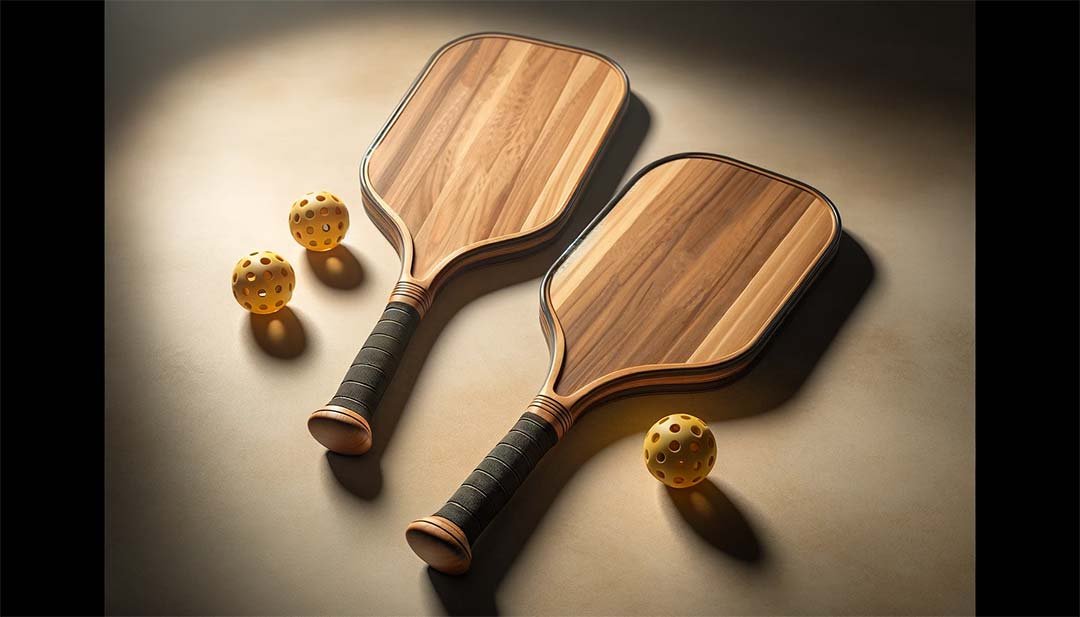
A wooden paddle produces very little spin, and it is worth being direct about it. A sealed wood face is smooth, so friction is low, and a solid hardwood face does not compress, so dwell is short.
That is not a defect. Wood is chosen for durability, impact tolerance and cost, and it wins on all three. It simply is not the spin option, and a supplier who claims otherwise is selling to someone who will find out on court.
How to Choose, in Order
- Core thickness first. 16 mm if spin and control matter, 13 mm if you want speed and a lower swing weight.
- Weight second. Pick the heaviest paddle you can move for a full session without arm fatigue. That number is personal and it is found by trying, not by reading.
- Face third. Fibreglass for a softer feel, carbon for stiffness.
- Grip size. Measured, not guessed. A grip that is too small makes the wrist do the work and the elbow pays for it.
- Approval status. If you play sanctioned events, check the list before buying.
Conclusion
There is no approved paddle that is meaningfully grittier than another, because roughness is capped. What separates them is dwell time, which comes from the core, and weight, which comes from how strong your arm is over a session.
Buy for a 16 mm soft core if spin is the goal. Then spend the rest of the effort on the swing, because that is where the spin actually comes from.
FAQs
1. Which paddle gives the most spin?
In approved play, none of them is legally rougher than another. A 16 mm soft core with a fibreglass face gives the most dwell, which is the property that produces spin.
2. Does a rough surface help?
It does, and added roughness beyond the standard is not allowed in sanctioned play. Paddles are tested for it.
3. Do wooden paddles spin the ball?
Very little. A sealed wood face is smooth and does not compress, so both friction and dwell are low.
4. Does a heavier paddle spin more?
Yes, on drives, because more mass means more momentum. It costs hand speed, which matters more at the kitchen line.
5. What is the single biggest technique change?
Contact below the ball’s equator with an upward swing path and a loose grip. That produces more spin than any equipment change.
Sourcing Wooden Garden Games in Bulk?
Kangjie is the direct manufacturer behind these games — no trading company, no middleman margin. We supply Kubb, Croquet, Molkky, Ring Toss, Tumble Tower, Cornhole and more to importers, retailers and brand owners worldwide.
- Factory-direct pricing with transparent volume tiers (500 / 1,000 / 5,000 units)
- OEM & ODM: logo, packaging, size and finish built to your specification
- EN71 & ASTM F963 compliant; FSC-certified timber
- Bulk lead time 30–45 days, quotation within 24 hours