
A game that does not get played is a product that does not get reordered. That makes “is it fun” a commercial question rather than a matter of taste, and it is answerable – fun is not a quality that some games happen to have, it is the result of a small number of design decisions that can be identified and checked.
Five properties account for most of it: meaningful decisions, interaction between players, a challenge that matches the player’s skill, a theme the mechanics support, and a length that ends before the interest does.
Here is what each one means in practice, and how to test for them before placing an order rather than after a season of slow sell-through.
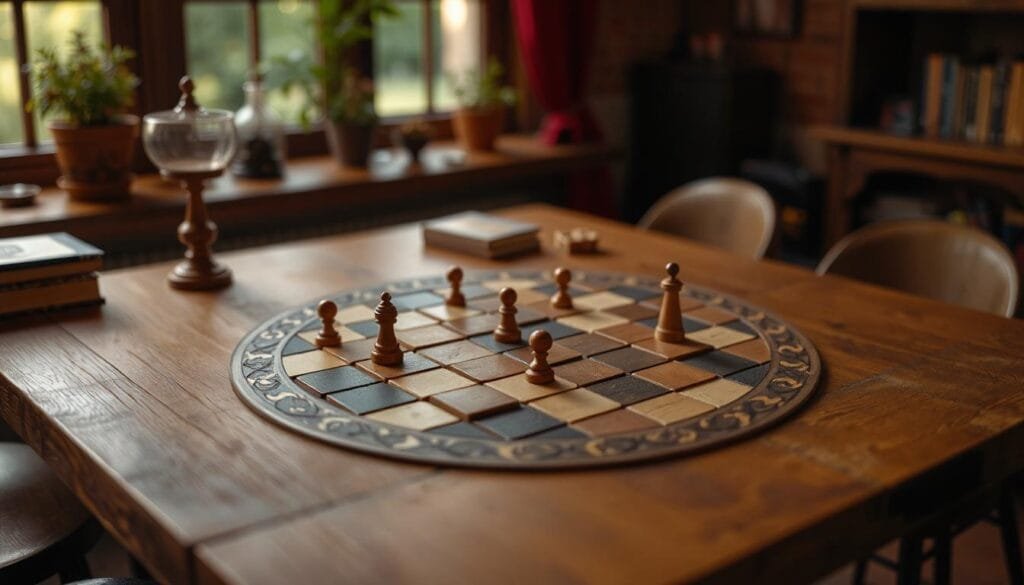
What Fun Is Made Of
Meaningful Decisions
A decision is meaningful when the player has to weigh two options that are both defensible, and when the choice has a consequence they can trace. Rolling a die and moving is not a decision. Choosing whether to block an opponent or advance your own position is.
The commercial consequence is that games without decisions get played once. The customer does not describe it as boring; they describe it as something they already know, and it goes in the cupboard.
Interaction Between Players
Games where each player builds their own thing in parallel feel like several people playing alone at the same table. That is not automatically bad, but it is a narrower product, and it rarely produces the table talk that makes a game get brought out again.
Interaction does not have to mean conflict. Trading, negotiating, blocking and cooperative problem-solving all count. What matters is that one player’s action changes another player’s situation.
The level should match the audience. A family game wants gentle competition; a games-night product can carry negotiation and direct conflict. Mismatching this is the most common reason a well-designed game fails with a particular buyer’s customers.
Challenge That Matches Skill
Too easy produces boredom, too hard produces frustration, and the band between them is narrow. The useful design property is not difficulty but adjustability: a game whose difficulty can be changed by a rule variant, a shorter track or a handicap serves a wider age range and therefore a wider market.
This is why throwing games work so well commercially. Moving the throwing line back for adults and forward for children adjusts the challenge without changing the rules, which is a design feature rather than an accident.
Theme and Immersion
A theme that is painted on rather than built in feels cheap, and customers notice even when they cannot articulate why. The test is whether the mechanics would still make sense if the theme were removed: if they would, the theme is decoration.
Where wood has a genuine advantage is in making the theme physical. A game about building has weight in the hand. A board that is a board rather than a printout changes how the object is perceived before a single rule is read.
That is also the commercial argument for component quality. A well-finished piece signals value at the point of sale, and it survives handling at the point of use. Cheap components break immersion faster than any rule can build it.
Rules and Replayability
Rules That Do Not Fight the Player
If the explanation takes longer than the first round, part of the table has already left. The target is a rule set that can be taught in two minutes and understood fully by the end of the first game.
Two details matter more than they appear to. First, the rulebook itself – a well-structured one is the difference between a game that gets played and one that gets searched for on a phone. Second, downtime: a player waiting four minutes between turns will check their phone, and once that happens the game has lost them.
Replayability
Three things create it: variable setup, multiple routes to a win, and hidden information. A game that feels solved after two plays has no second sale, and in a retail context it also generates no word of mouth.
Scalability is the quieter half of the same property. A game that works with two players and with five is easier to put on a table, which means it gets played more often.
The X-Factors
Three properties that are hard to design deliberately and easy to recognise when they are present.
Surprise. A unexpected outcome, a combination nobody saw, a result that makes the table react. This is what people describe when they say a game was fun rather than good.
Tactile satisfaction. The weight of a piece, the sound of wood on wood, the resistance of a hinge. This matters more in wooden games than in any other category, because the physical object is a large part of what the customer is buying. It is also the property most easily lost to cost-cutting: a thinner piece, a lighter finish, a looser joint.
The right length. A twenty-minute game should not feel like forty. A two-hour game has to justify its runtime. Matching length to weight is a design decision, and getting it wrong is why some well-made games never leave the shelf.
How to Use This When Buying
Five questions that can be answered from a sample and a rule set, without a focus group.
- Can I explain it in two minutes? If not, the product will need staff attention on the shelf, which limits which retailers can stock it.
- What is the first real decision a player faces, and how long until they face it? If it is more than a minute in, the opening is too slow.
- Does one player’s turn change another player’s position? If not, the game is parallel solitaire, which is a narrower product.
- How long is a turn, and how long is a game? Compare both against the audience the product is aimed at.
- Would it still work if the theme were removed? If yes, the theme is decoration and the price premium it justifies is thin.
The sixth question is about the object rather than the game: does it feel good to handle. That is the one a customer answers in three seconds in a shop, and it is the one a specification can control – piece mass, finish, edge treatment, joint tolerance.
Conclusion
Fun is a set of design properties rather than a quality some products happen to have. Meaningful decisions, real interaction, a challenge that can be adjusted, a theme the mechanics support, and a length that respects the player’s time account for most of it.
For a buyer, the practical use is a short checklist applied to a sample rather than to a catalogue. The games that pass it get reordered; the ones that fail it sell once and then sit.
Looking for games that get reordered?
We manufacture direct in Guangzhou: 500-set minimum, quotes within 24 hours, samples in 5–10 days, production in 30–45 days, EN71 and ASTM F963 compliance, FSC-certified timber: contact us
FAQs
1. Can a game be too simple to sell?
Yes, but simplicity is rarely the problem – the absence of a decision is. Tic-tac-toe is simple and sells; a game with no meaningful choice does not, however many rules it has.
2. How important are components compared to the rules?
In wooden games, components carry more of the purchase decision than the rules do, because the object is visible before the game is played. A good rule set with poor components sells once; a simple rule set with excellent components sells repeatedly.
3. What play length sells best?
It depends on the channel. Gift and family retail favours 15 to 30 minutes; games shops will carry longer. What matters is that the length matches what the box implies – a product that looks like a filler and plays for two hours generates complaints.
4. How do I test a game before ordering?
Play the sample with people who are not involved in the product, and watch where attention drops. That is more informative than any evaluation of the rulebook, and it costs an afternoon.
5. Which certifications apply?
EN71 for the EU, including EN71-3 for coating migration, with CE marking on the declaration of conformity; ASTM F963 and CPSIA for the US. Which applies depends on the market and the age grading rather than on the game itself.
Sourcing Wooden Garden Games in Bulk?
Kangjie is the direct manufacturer behind these games — no trading company, no middleman margin. We supply Kubb, Croquet, Molkky, Ring Toss, Tumble Tower, Cornhole and more to importers, retailers and brand owners worldwide.
- Factory-direct pricing with transparent volume tiers (500 / 1,000 / 5,000 units)
- OEM & ODM: logo, packaging, size and finish built to your specification
- EN71 & ASTM F963 compliant; FSC-certified timber
- Bulk lead time 30–45 days, quotation within 24 hours









