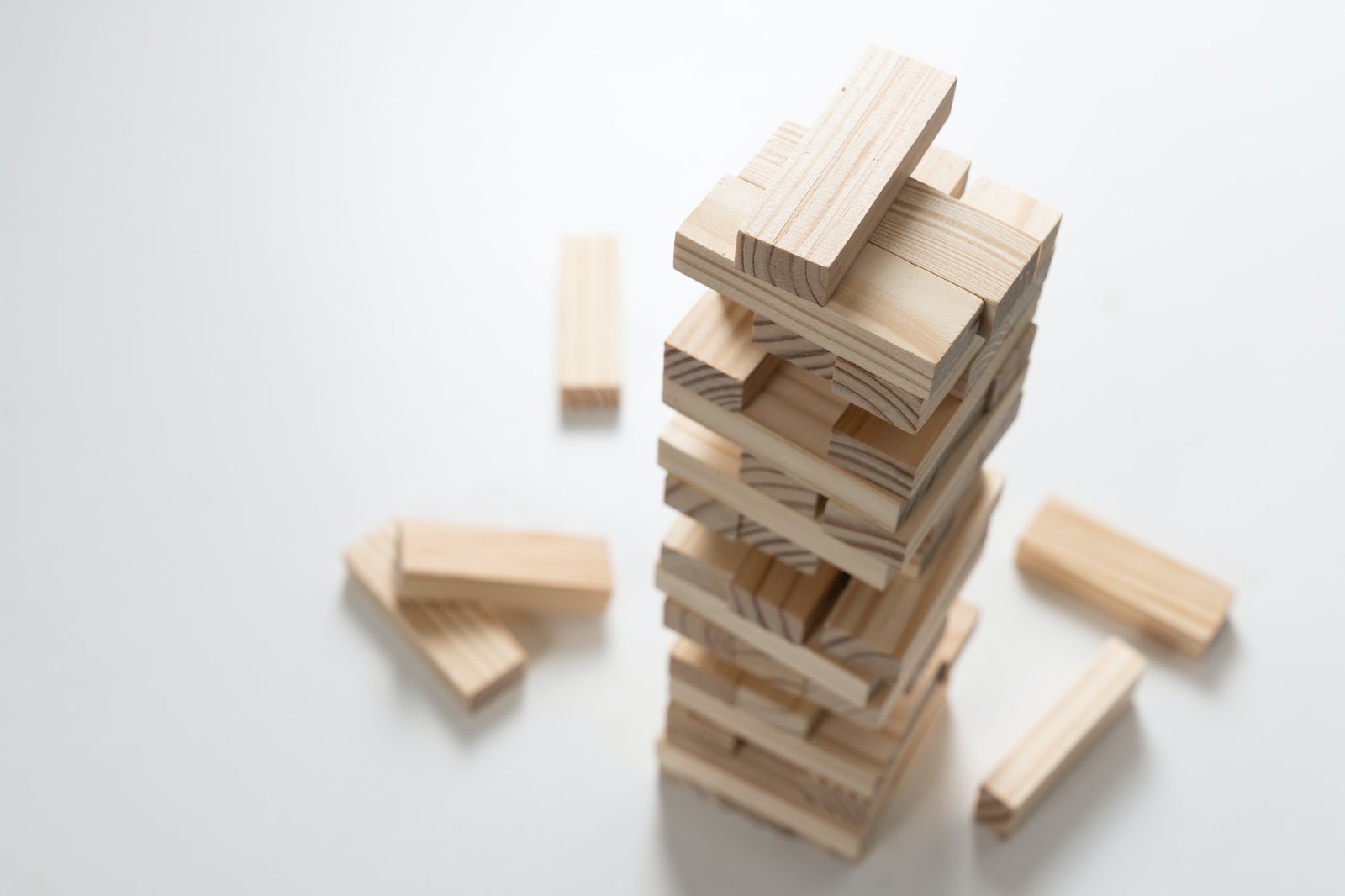
The block-stacking game has at least five common names in English, and the one a supplier uses tells you something about the market they sell into. It also matters legally: one of those names is a trademark, and putting it on your packaging is an exposure rather than a marketing decision.
The generic names are tumble tower, tower blocks, timber tower and stacking blocks. The trademarked name is Jenga, which belongs to Hasbro and cannot be used as a product name.
Here is which name to use where, what the naming difference costs you commercially, and the specification that actually decides whether a set plays well.
The Short Answer
The game is played with rectangular blocks stacked in alternating layers of three. Players remove one block at a time and place it on top, and the tower eventually collapses.
Because the trademarked name is unavailable to anyone outside the licence, the trade has settled on descriptive alternatives. The most widely understood is tumble tower. In the UK and Ireland, tower blocks is common. Timber tower and stacking blocks also appear, usually in gift and furniture retail rather than in toy aisles.
Why the Name Matters Commercially
Three practical consequences, and the first is the one that costs money.
Legal exposure. A trademark identifies the source of goods. Using a registered mark in a product name, on packaging or in a listing title suggests an association that does not exist, and the rights holder can act on it. A retailer who buys a container of sets labelled with someone else’s trademark is holding the inventory when the complaint arrives, which is why this matters to a buyer and not only to a factory.
Search behaviour. Most customers search for the name they know, which is the trademarked one. The workable approach is to use a generic name as the product name and the trademarked term only in descriptive copy – as a comparison the customer understands, not as the product’s identity. Listing platforms differ in how strictly they enforce this, so the wording has to be checked per channel.
Channel signals. A supplier who calls the product by a generic name is usually selling to trade. One who uses the trademark loosely is often selling to consumers and may not have thought about the packaging. Neither is necessarily a problem, but the second one is a conversation worth having before artwork is approved.
The Names You Will Actually See
- Tumble tower – the most common generic term in trade and retail listings. Safe to use as a product name.
- Tower blocks – the British usage. Also generic.
- Timber tower – emphasises the material rather than the action. Common in gift and homeware catalogues.
- Stacking blocks – broader, and often used for children’s versions where the game is stacking rather than removing.
- Giant tumble tower – the outdoor and event variant, usually 45 to 60 blocks rather than 54 at standard size.
The trademarked name should appear, if at all, only in a sentence that acknowledges what the customer already knows – and never on the carton, the label or the listing title.
What to Specify When Ordering
The naming question is settled in an afternoon. The specification is what determines whether the product is any good, and it is short.
- Block dimensions and tolerance. The single most important number. A set where blocks vary by half a millimetre stacks badly and feels cheap regardless of the timber. Ask for the tolerance in writing and check it with a caliper on the sample.
- Block count. 54 blocks in 18 layers is the standard. Giant versions run 45 to 60 with larger sections.
- Species. Beech and rubberwood are the usual choices for hardness and dimensional stability. Pine is a softwood – it works for economy sets but dents easily and moves more with moisture, so it is a different product rather than a cheaper version of the same one.
- Moisture content. Roughly 8–12% for outdoor use, 6–8% for indoor. Timber that goes into production wet will move after assembly, and the blocks will bind or rattle weeks after delivery.
- Finish. Sanded to a consistent grit with eased edges. A raw-sanded block splinters; an over-polished one is slippery and the tower falls too easily.
- Carry crate. Not an accessory on a 54-block set. It is how the product survives storage, and it is what makes the giant version sellable to venues.
MOQ and Lead Time
Minimum order is set by setup cost rather than by the factory’s preference. Tooling, programming and a first-article check have to be amortised, and 500 sets is roughly where that cost stops dominating the unit price while the product still competes with a stock item.
Production runs 30–45 days from deposit and sample approval. Sampling takes 5–10 days plus transit, built on the production line rather than by hand, with the charge credited against the order.
For a seasonal product the timing has to be worked backwards. Ocean transit adds roughly 30–40 days to Europe or 14–25 days to the US west coast, so a spring shelf date means an autumn order.
Giant Versions
The oversized format is the fastest-growing part of this category, and the reason is channel rather than product: it sells to bars, campsites, holiday parks, hotels and event hire, none of which can use a tabletop set.
Two engineering differences matter at that scale. Block mass has to be high enough that the tower is stable in light wind but low enough that a player can lift a block out without knocking the stack. And the crate becomes structural – a giant set that cannot be carried and stored is a set that stays where it was first used.
Eco-Friendly Options
The credible version of this claim is documentation rather than material choice. FSC-certified timber with chain-of-custody records tied to the specific order is what a European retail buyer will ask for, and it is verifiable.
Bamboo is sometimes offered as an alternative. It is a grass rather than a timber, it is dimensionally stable and it grows quickly – but it splits along the grain under impact, which is a poor match for a game whose entire mechanic involves blocks being knocked and dropped. For a stacking game, a hardwood with a documented source is the better answer than a novel material with a good story.
Conclusion
The game has four generic names – tumble tower, tower blocks, timber tower, stacking blocks – and one trademarked name that belongs on a comparison line at most, never on the box.
The naming question is easy. The product question is one number: block tolerance. Everything else about the set – species, finish, crate – supports that, and a set that fails on tolerance fails regardless of how good the rest of it is.
Ordering tumble tower sets?
We manufacture direct in Guangzhou: 500-set minimum, quotes within 24 hours, samples in 5–10 days, production in 30–45 days, EN71 and ASTM F963 compliance, FSC-certified timber: contact us
FAQs
1. What is the generic name for the block-stacking game?
Tumble tower is the most widely understood. Tower blocks is the British equivalent, and timber tower or stacking blocks are also used. All are generic and safe to use as a product name.
2. Can I use the trademarked name on my packaging?
No. The mark belongs to its owner and using it as a product name implies an association that does not exist. Use a generic name on the carton and listing title; the trademarked term can appear in descriptive copy at most, and platform rules on that vary.
3. How many blocks should a standard set have?
54 blocks in 18 layers of three is the standard. Giant outdoor versions typically run 45 to 60 blocks with larger sections, which changes the crate and the freight calculation rather than the rules.
4. What is the most important specification?
Block thickness tolerance. A set that varies by half a millimetre stacks badly and feels cheap regardless of the species. Ask for the tolerance in writing and measure the sample rather than judging it by hand.
5. Which wood should I specify?
Beech or rubberwood for hardness and dimensional stability, dried to roughly 8–12% for outdoor use. Pine is a softwood: it works for economy sets but dents and moves more, which makes it a different product rather than a cheaper version of the same one.
Sourcing Wooden Garden Games in Bulk?
Kangjie is the direct manufacturer behind these games — no trading company, no middleman margin. We supply Kubb, Croquet, Molkky, Ring Toss, Tumble Tower, Cornhole and more to importers, retailers and brand owners worldwide.
- Factory-direct pricing with transparent volume tiers (500 / 1,000 / 5,000 units)
- OEM & ODM: logo, packaging, size and finish built to your specification
- EN71 & ASTM F963 compliant; FSC-certified timber
- Bulk lead time 30–45 days, quotation within 24 hours