
Pickleball is a paddle sport played on a court roughly a third the size of a tennis court, with a perforated plastic ball, a solid paddle, and an underhand serve. It borrows from tennis, badminton and table tennis, and it is not a version of any of them.
The comparison with tennis is worth making properly, because most of it comes down to two numbers: the size of the court and the weight of the ball.
Side by Side
| Pickleball | Tennis | |
|---|---|---|
| Court, doubles | 13.41 x 6.10 m (44 x 20 ft) | 23.77 x 10.97 m (78 x 36 ft) |
| Court, singles | Same court | 23.77 x 8.23 m |
| Area | About 82 m2 | About 261 m2 |
| Net height at centre | 864 mm | 914 mm |
| Ball | Perforated plastic, 22 to 26 g | Felt-covered rubber, 56 to 59 g |
| Implement | Solid paddle, no strings | Strung racquet |
| Serve | Underhand, below the waist, cross-court | Overhead, above the shoulder |
| Scoring | To 11, win by 2, only the serving side scores | Games and sets, 15 / 30 / 40 |
| No-volley zone | Yes, 7 ft either side of the net | No |
The court area ratio is roughly three to one, and almost every other difference follows from it. On a pickleball court you are never more than about three metres from the ball. On a tennis court you can be twenty.
The Rules That Confuse Tennis Players
Three rules have no equivalent in tennis, and they are the ones that catch people out.
1. The Kitchen
The seven feet either side of the net is a no-volley zone. You may not volley a ball while standing in it, and you may not step into it to volley. You can stand in it to play a ball that has bounced.
The rule exists to stop tall players simply reaching over the net, and it is the reason the game has a soft game at all. Without it, pickleball would be a serve-and-volley contest decided by height.
2. The Double Bounce
The serve must bounce once on each side before anyone may volley. That is: the return of serve has to be allowed to bounce, and the serving side’s first shot has to be allowed to bounce too.
After those two bounces, volleying is allowed anywhere outside the kitchen. This rule is what makes the opening of a point structured and stops the net rush that dominates beginner tennis.
3. Only the Serving Side Scores
In traditional scoring, a rally only produces a point for the serving side. Lose a rally on your serve and the serve passes; you do not concede a point. Games go to 11, win by two.
Doubles serving is the part that takes longest to learn: the serve rotates between partners before it passes to the other team, so a team can lose the serve twice in a row before the point is over.
On the Popularity Claims
Pickleball has grown fast and the specific numbers change every year. The organisation that publishes them is the Sports & Fitness Industry Association, which releases an annual participation report, and the honest approach is to check the current edition rather than quote a figure from a blog.
What is safe to say is structural rather than statistical: the sport grew fast enough between 2020 and 2024 that court construction became a constraint, and it grew because the court is small, the ball is light, the serve is underhand and four people can play at once. Those four properties explain the growth without needing a percentage attached.
On the “Easier on the Joints” Claim
This one is repeated everywhere and it is not quite true.
Less running distance is real. Less joint stress is not automatically the result, because a short court means more direction changes per minute, and the ready position at the kitchen line is a semi-crouch held for the length of a rally. Achilles and knee injuries are common in players who moved from tennis expecting it to be gentler, and the mechanism is the sudden lateral push rather than the running.
What is genuinely gentler: the ball weighs a third of a tennis ball, so the impact through the arm is much lower, and the underhand serve removes the shoulder load of a tennis serve.
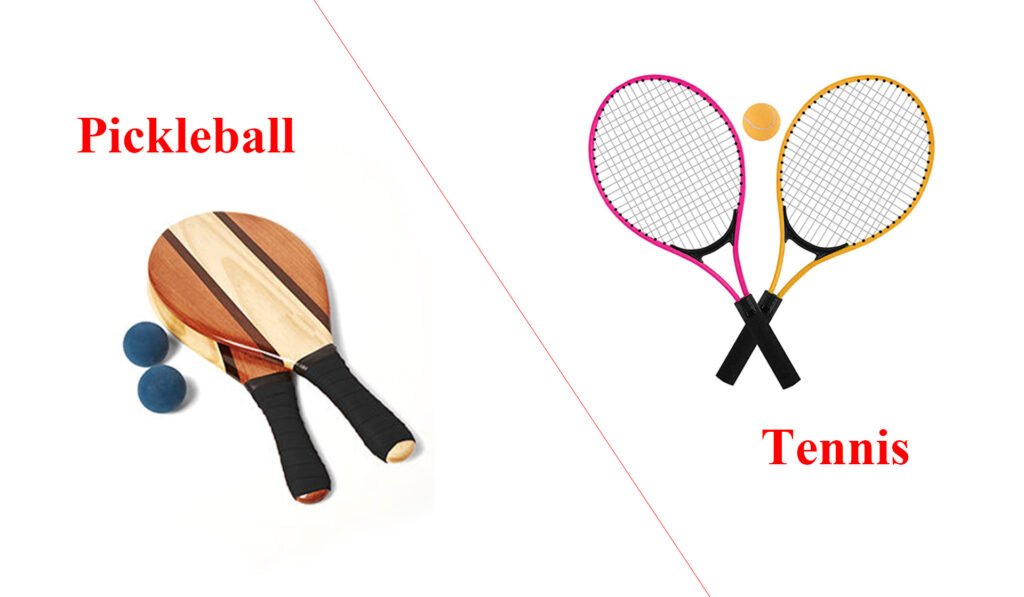
Equipment, and Where Wood Fits
A pickleball paddle is a solid face with a core. Composite paddles use a honeycomb core of polypropylene, aluminium or Nomex between face sheets of fibreglass or carbon, and run 200 to 230 g. Wooden paddles are a solid piece of hardwood, 300 to 400 g.
Paddles used in sanctioned play must appear on the governing body’s approved list, which tests size, surface roughness and deflection. Wooden paddles can and do pass.
Where wood wins is institutional use: a school, a club or a holiday park buying twenty paddles wants something that survives being dropped, stacked and left in a shed. Where wood loses is weight and power, which is why competitive players move on within a season.
Conclusion
Pickleball is a third the area, a third the ball weight, an underhand serve, and a no-volley zone that changes the whole shape of a point. Tennis is bigger, longer and physically harder.
They are not substitutes. Most people who play one also play the other, on different days, for different reasons.
FAQs
1. How big is a pickleball court?
13.41 by 6.10 metres, about a third of the area of a tennis court.
2. Can you play pickleball on a tennis court?
Yes, with a portable net at 864 mm. The tennis net is too high and the posts are in the wrong place, so taping lines alone is not enough.
3. What is the kitchen?
A 7 ft no-volley zone either side of the net. You cannot volley while standing in it.
4. How does pickleball scoring work?
To 11, win by two, and only the serving side scores. In doubles the serve rotates between partners before it passes.
5. Is pickleball easier on the knees than tennis?
Less running, more direction changes. The load moves rather than disappears, and Achilles injuries are common in players who switch.
Sourcing Wooden Garden Games in Bulk?
Kangjie is the direct manufacturer behind these games — no trading company, no middleman margin. We supply Kubb, Croquet, Molkky, Ring Toss, Tumble Tower, Cornhole and more to importers, retailers and brand owners worldwide.
- Factory-direct pricing with transparent volume tiers (500 / 1,000 / 5,000 units)
- OEM & ODM: logo, packaging, size and finish built to your specification
- EN71 & ASTM F963 compliant; FSC-certified timber
- Bulk lead time 30–45 days, quotation within 24 hours









