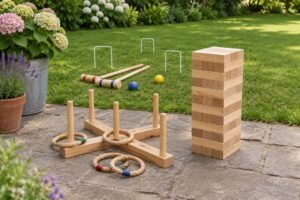
The game is croquet. Hoops set into the lawn, wooden or composite balls, and a mallet per player. It is the only game in the garden category with a codified rulebook, a court specification and a governing body, which is both its strength and its commercial problem.
This article covers what the equipment is, the two versions that share the name, what the game’s history actually is, and what a buyer should specify.
The Answer, and Why It Is Worth Knowing
Croquet is played by driving a ball through a sequence of hoops with a mallet, in a fixed order, and finishing at a peg. The sequence is what makes it a game rather than an activity: you are not just hitting a ball through a hoop, you are managing a route and, in the competitive version, using your opponents’ balls to advance your own.
That last part is what most people do not know. In Association Croquet you are allowed to hit an opponent’s ball and then take a further stroke with your ball placed against theirs, which sends theirs away and yours forward. The whole tactical game is built on that one rule.

What the Equipment Is
| Part | Specification | Notes |
|---|---|---|
| Mallet | 36 in / 910 mm, head 1.0 to 1.3 kg | Ash shaft, beech or dense hardwood head |
| Ball | 3 5/8 in / 92 mm, 16 oz / 454 g | Composite in competition, boxwood traditionally |
| Hoop | 3 3/4 in / 95 mm gap, 16 mm wire | Only 3 mm clearance on a 92 mm ball |
| Peg | About 18 in / 460 mm above ground | Banded in the four ball colours |
| Court | 35 x 28 yd / 32.0 x 25.6 m | Six hoops in a double diamond |
The hoop gap is the number that defines the game. A 92 mm ball through a 95 mm hoop is 1.5 mm of clearance on each side, which is why a straight stroke goes through and a slightly off-centre one does not. Garden sets widen that to 100 to 115 mm, and the difference between those two numbers is the difference between a competitive game and a family one.
The Two Versions
| Nine-wicket | Six-wicket / Association | |
|---|---|---|
| Hoops | 9, double diamond | 6, double diamond |
| Court | About 30 x 15 m, or whatever fits | 32.0 x 25.6 m, fixed |
| Stakes | 2, one at each end | 1 centre peg |
| Rules | A page | A book |
| Who plays it | Families, events, garden retail | Clubs, tournaments |
| What it is sold as | Almost every garden set | A club set |
Almost every croquet set sold into garden retail is a nine-wicket set, and almost every article about croquet describes the six-wicket game. That mismatch is why people measure their lawn against a regulation court, find it is a third of the size, and conclude they cannot play.
A Short, Accurate History
Croquet in something close to its modern form was standardised in England in the 1860s, and it spread to the United States within twenty years. The name’s origin is genuinely uncertain; both a French and a Dutch root have been proposed and neither is settled.
What is documented is that it was one of the first games to be played by both sexes together in Victorian England, which is a large part of why it spread. It was also an early Olympic sport, appearing in 1900.
The claim that it “dates from the 1850s” is close enough to be defensible, but the honest version is that the game existed in various forms before that and was codified in the 1860s.
Why It Works Commercially
Three reasons, and they are not the reasons most suppliers give.
The equipment is durable and the perceived value is high. A croquet set is a box of substantial objects. It photographs well, it feels expensive, and it lasts. That combination supports a premium price in a category where a lot of products are thin.
There is a large customisation surface. Mallet head colour, ball colour, bag, box, engraving on the mallet head and the peg. None of it changes the tooling, which means a private label order is straightforward.
The constraint is the court, not the product. This is the honest problem. Six-wicket croquet needs 32 by 25.6 metres, which most gardens do not have, and nine-wicket needs about 30 by 15 metres, which many do not have either. A croquet set sold to someone with a 10 metre garden is a set that gets used twice.
Which is why the nine-wicket set, with an honest court recommendation and a smaller adapted layout in the instructions, sells better than a six-wicket set with a regulation diagram nobody can follow.
What to Specify
- Hoop gap in millimetres, and hoop wire diameter and coating, including whether the coating extends below the soil line.
- Ball diameter, weight and material, with a roundness tolerance. A ball 0.5 mm out of round will not hold a line.
- Mallet head species and weight, shaft species, and the joint construction. A pinned joint survives; a glued butt joint does not.
- Moisture content at assembly, which is what prevents heads splitting in a dry shed.
- Whether the set is nine-wicket or six-wicket, stated explicitly, because a supplier who treats them as the same item is telling you something.
- Carton dimensions and gross weight.
What We Do Not Claim
Two things, because they appear in most croquet marketing and neither survives a question.
We do not claim a business case based on invented research. Numbers about morale improvements or demographic enthusiasm for croquet circulate widely and none of them can be traced to a study. If you need a market argument, use the one that is real: croquet has a low skill floor, a high skill ceiling, and works across ages in a way few outdoor products do.
We do not claim all-weather durability. A croquet set lives indoors and comes out to play. Hoops rust where they enter wet soil, mallet heads split if they dry out, and balls go out of round with humidity. Storing the set under cover is not a suggestion, it is what makes it last.
FAQs
What is the lawn game with hoops, balls and mallets?
Croquet. Six or nine hoops set into the lawn, a mallet per player, and a peg to finish at.
How much space does croquet need?
Six-wicket croquet needs 32 by 25.6 metres. Nine-wicket needs about 30 by 15 metres, and a workable adapted layout fits in 20 by 12 metres.
What is the difference between croquet and Association Croquet?
Association Croquet is the codified six-hoop game played in clubs. Nine-wicket is the backyard version with two stakes and a page of rules, and it is what most garden sets contain.
Is croquet a real sport?
Yes. It has a governing body, a written rulebook, a court specification and international competition. It was also an Olympic sport in 1900.
What is the minimum order?
500 sets, with volume pricing at 500, 1,000 and 5,000. Samples 5 to 10 days, bulk production 30 to 45 days, quotation within 24 hours.
Sourcing Wooden Garden Games in Bulk?
Kangjie is the direct manufacturer behind these games — no trading company, no middleman margin. We supply Kubb, Croquet, Molkky, Ring Toss, Tumble Tower, Cornhole and more to importers, retailers and brand owners worldwide.
- Factory-direct pricing with transparent volume tiers (500 / 1,000 / 5,000 units)
- OEM & ODM: logo, packaging, size and finish built to your specification
- EN71 & ASTM F963 compliant; FSC-certified timber
- Bulk lead time 30–45 days, quotation within 24 hours