We make wooden garden games, so the question of what to actually play with your own children comes up more often than you would think. The honest answer is that most of what we play is not a product. It is a variation on tag, and it costs nothing.
What follows is the list, ordered by age, with the reason each one works and the part that tends to go wrong. The reasons matter more than the games, because the reasons are what let you invent the next one.
The Rule That Applies to All of Them
Mixed ages need games with no elimination and no fixed team size. The moment a four-year-old is out and watching, the game is over for everyone, because the four-year-old will not stay out.
Every game below either has no elimination or has a mechanism that brings players back in. That is not sentimentality, it is the design constraint that decides whether a game gets played twice.
Ages 2 to 4
Hide and Seek, With Rules
The developmental point is separation: the child is practising being out of sight and being found again. The practical point is that you must not hide well. Hide somewhere they can find you in thirty seconds, and make a small noise so they can locate you.
What goes wrong: hiding too well, which produces panic rather than delight. The game is about the return, not the concealment.
Chasing, Without Catching
Being chased is thrilling and being caught is not, at this age. A chase where the adult is always almost caught, and never is, runs for twenty minutes. A chase where the adult wins runs for ninety seconds.
Rolling and Throwing
Any soft ball, rolled back and forth, is the foundation of every throwing game they will play later. The skill being built is tracking a moving object and timing a release.
Ages 4 to 6
Tag With a Rescue Mechanic
Standard tag eliminates by freezing. The fix is a rescue rule: a frozen player is freed when someone touches them. This single change keeps every player in the game and turns it from a chase into a cooperation problem.
A variant that works well with a mixed group: one person is the tagger and everyone else is an animal. Caught animals go to a hoop on the grass, and one designated player can free them all. The freed player then becomes the rescuer.
Hopscotch
Chalk and a stone. The value is not nostalgia: it is number recognition, single-leg balance and the sequencing of a hopping pattern. It is also one of the few games where a child can play alone for ten minutes, which matters.
What goes wrong: a grid that is too big for the child’s stride. Ten squares at adult size is a long course for a five-year-old. Draw it smaller.
Ladder Toss With a Real Ladder
A garage ladder laid against a wall, with soft balls or beanbags, scores 1 for the bottom rung, 2 for the middle and 3 for the top. It is a genuine target game with almost no equipment.
What goes wrong: rungs that are not level, and hard balls. Use beanbags or foam, and lay the ladder flat against something solid so it cannot fall.
Ages 6 to 9
Obstacle Courses
Tires, hoops, crates, a plank. The developmental value is proprioception: the child is learning where their body is in space while moving over something unstable. That is a real skill and it is not built on flat ground.
What goes wrong: courses designed to be impressive rather than safe. Anything the child has to jump down from should be under about half their height, and nothing should be able to tip.
Parachute Games
A large fabric circle, everyone holding an edge, and a ball on top. There is no winner, which is exactly the point: the game only works if everyone moves together. It is the best cooperative game in this list.
Water Balloon Piñata
Balloons tied to a branch and hit with a soft bat. It is fun and it is the highest-risk activity on this page.
What goes wrong: a blindfolded child swinging a bat with other children within range. Two rules fix almost all of it: a clear two-metre swing zone that nobody enters, and one adult holding the string rather than a child.

Ages 9 and Up
This is where the manufactured games come back in, because the children can now handle rules and losing.
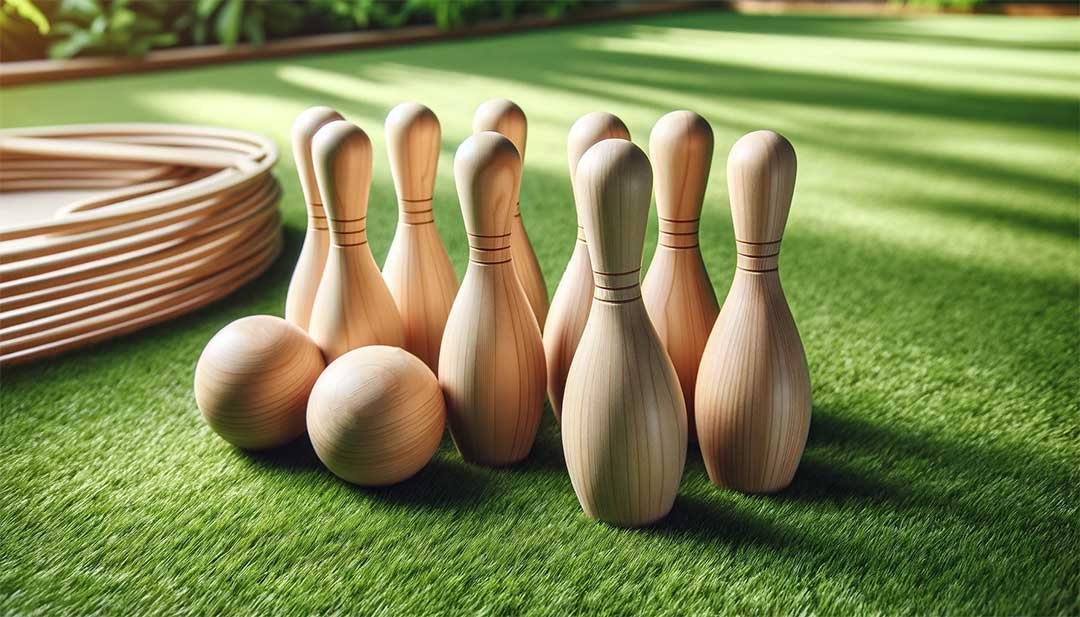
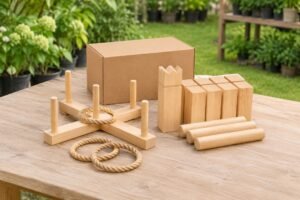
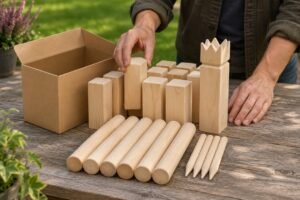
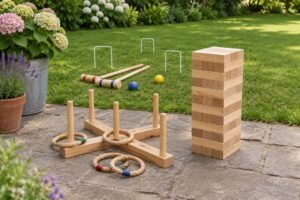
- Molkky or Kubb for the arithmetic and the patience. Both are genuinely strategic and both work with an adult and a child.
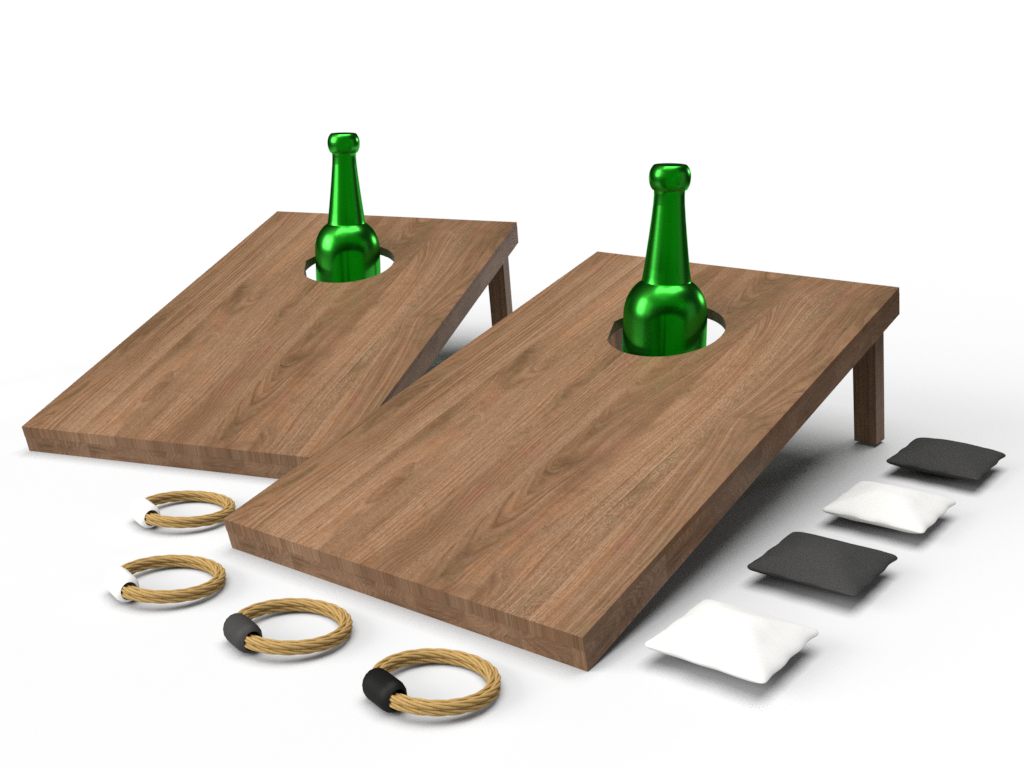
- Cornhole because a near miss still scores, which means a weaker player is never shut out.
- Tumble tower because it is the only game where everyone is watching the same object, so nobody is excluded by turn order.
What goes wrong at this age: an adult who plays to win. The game ends, and it ends badly.
Slip and Slide, and the One Real Risk
A plastic sheet and a hose. The injury is not the sliding, it is the run-up and the landing. Head-first slides and running starts on wet plastic are where the injuries come from.
Two rules: feet first only, and no running start. The rest is a hose and a hot afternoon.
Conclusion
The games that get played repeatedly are the ones with no elimination, a rescue mechanic, and a short setup. Everything on this list has at least two of those three.
The product matters less than the design of the game. A ladder and three beanbags will outperform a set that costs ten times as much if the rules keep everyone in.
FAQs
1. What is the best game for children of different ages?
Anything with a rescue mechanic. Freeing a caught player keeps the youngest in the game, which is what makes it playable with a mixed group.
2. At what age can a child play a real garden game?
Around six for cornhole and simple target games, eight or nine for Molkky and Kubb, which need arithmetic and patience.
3. Is a water balloon piñata safe?
With a two-metre swing zone and an adult holding the string, yes. A blindfolded child swinging near other children is the risk.
4. What is the most common mistake?
Designing a game that eliminates players. The eliminated child does not stay eliminated, and the game stops.
5. Do you need to buy anything?
No. Chalk, a hoop, a ladder and a soft ball cover most of this list.
Sourcing Wooden Garden Games in Bulk?
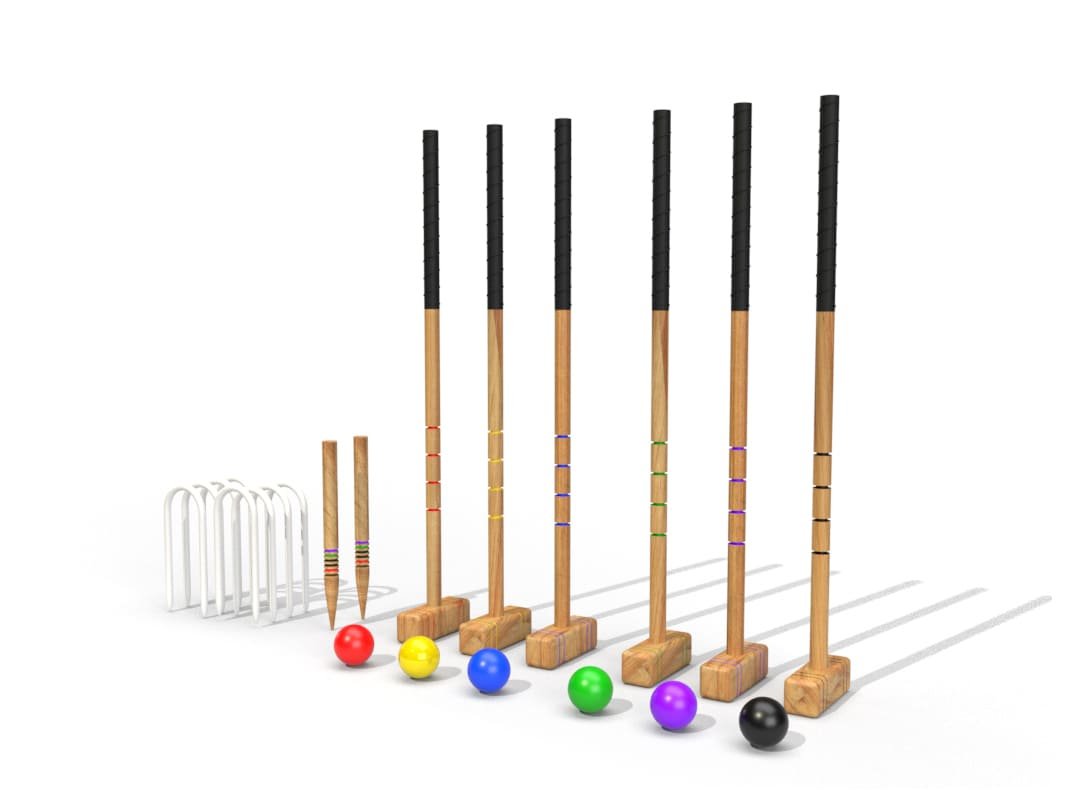
Kangjie is the direct manufacturer behind these games — no trading company, no middleman margin. We supply Kubb, Croquet, Molkky, Ring Toss, Tumble Tower, Cornhole and more to importers, retailers and brand owners worldwide.
- Factory-direct pricing with transparent volume tiers (500 / 1,000 / 5,000 units)
- OEM & ODM: logo, packaging, size and finish built to your specification
- EN71 & ASTM F963 compliant; FSC-certified timber
- Bulk lead time 30–45 days, quotation within 24 hours