Most custom garden game orders that disappoint do so for reasons that were decided before production started: the wrong timber for the exposure, a finish that will not survive a season, a size that turns out to be impractical to ship, or packaging that was never specified.
The details that matter are almost all physical rather than aesthetic, and they are cheap to get right at the quoting stage and expensive to fix afterwards.
Here is the specification checklist, in the order the decisions actually have to be made.
Why Customisation Matters for Wooden Garden Games
Standing Out in a Crowded Market
A stock garden game is a commodity and is priced like one. The same product with a specified species, a branded carry crate and a printed instruction card is a gift item, and is priced like one. The manufacturing difference between the two is small; the retail difference is not.
The purpose of customising is therefore to move the product out of price comparison, not to be different for its own sake.
Meeting Customer Preferences
The customisation buyers actually pay for is narrower than suppliers assume: a name, a colour that matches a room or a brand, and packaging that looks like a present. Elaborate novelty shapes sell in small numbers; a well-finished standard format with good branding sells in volume.
Choosing the Right Type of Wood
Hardwood vs. Softwood
The distinction that matters outdoors is not botanical but behavioural: how much the timber moves when it gets wet and dries out repeatedly.
- Hardwoods – oak, acacia, teak – move less, resist denting and hold up outdoors. They cost more and weigh more, which affects freight.
- Softwoods – pine, cedar, spruce – are cheaper and lighter but move more, so they need better drying and a more careful finish.
- Engineered board – plywood and similar – is dimensionally stable and the most cost-effective option for flat components, provided the edges are sealed.
Best Wood Types for Outdoor Durability
- Teak – naturally weather-resistant, highest cost, best for premium outdoor pieces.
- Acacia – dense and durable at a lower cost than teak, good for game pieces and frames.
- Oak – hard-wearing, takes a stain well, heavier for its strength than acacia.
- Cedar – rot-resistant and light, good for portable sets.
- Pressure-treated pine – cheapest outdoor option, but the treatment affects finish adhesion and needs sealing.
Whichever is chosen, moisture content is the specification that matters most. Outdoor timber should be dried to roughly 8–12%. Skip it and the game cups or splits within months, usually after it has shipped.
Design Considerations for Longevity
Weatherproofing
Several thin coats with sanding between them, plus sealed end grain, will outlast one heavy coat by a wide margin. End grain absorbs moisture far faster than the face and is the part most often skipped, which is why boards fail at the edges first.
UV resistance matters for anything that lives outside permanently. A finish without it will yellow or fade, and a printed surface will lose contrast within a season.
Smooth Edges vs. Rough Finishes
Rounded and sanded edges, not a sharp arris. This costs almost nothing at the factory and is the first thing a customer notices in the hand. It also matters for compliance: splintering is a defect under EN71 and ASTM F963.
Sizing and Weight: Practicality Matters
Standard Dimensions vs. Custom Sizes
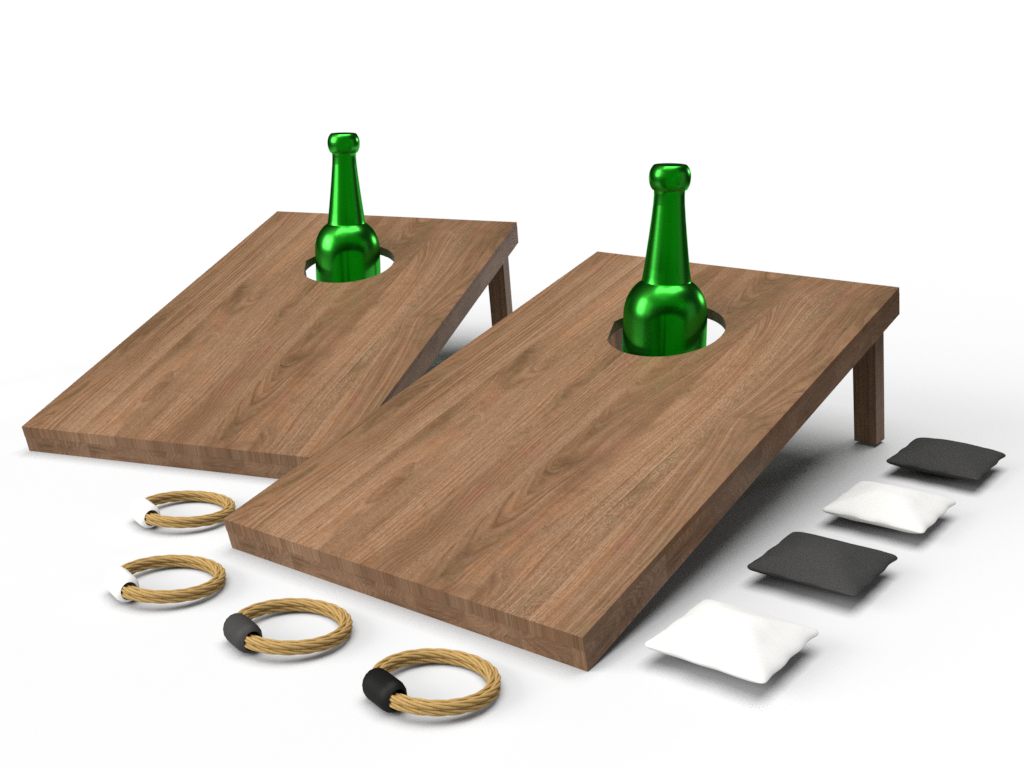
Standard dimensions exist for a reason. Cornhole boards are 24 × 48 inches with a 6-inch hole centred 9 inches from the top edge, front edge 4 inches off the ground and back edge 12 inches, with 27-foot throw lines for tournament play and 33 feet for casual play. Deviating from that makes the game harder to sell, not more distinctive.
Where custom sizing genuinely pays is in packaging and retail fit – a size that matches a carton or a shelf, rather than a size that changes the game.
Portability
Weight is a design constraint, not a detail. A set that is awkward to carry does not travel to a barbecue, and a set that does not travel sells once. Lighter species and flat-pack construction solve this; thicker hardwoods belong in a fixed outdoor setting.
Custom Engravings and Branding
Laser Engraving vs. Hand-Painting
Engraving is permanent, consistent across a batch and the cheapest addition. Its limit is resolution: below roughly 8 mm the detail closes up, so keep the mark simple. Hand-painting allows colour but depends on the painter, which makes batch consistency the risk rather than the cost.
How Much Branding Is Too Much
One mark, well placed, reads as a product. A mark on every surface reads as an advertisement. The practical rule is that branding should be on the part a customer looks at when the game is in use, not on every face.
Paint and Finish Options
Eco-Friendly Paints for Safe Play
Where the product is classified as a toy, coating compliance is not optional. EN71-3 covers heavy metal migration from coatings and surface materials in the EU; CPSIA covers lead and phthalate limits in the US. Water-based, low-VOC finishes are now standard for this reason.
Matte vs. Glossy
- Matte – rustic, hides scratches and fingerprints, the safer choice for outdoor use.
- Gloss – photographs well, shows every mark and every handling artefact.
- Semi-gloss – the practical middle for outdoor games: durable, cleanable, and not blinding in sunlight.
Assembly and Hardware Quality
Stainless Steel vs. Coated Screws
Coated screws rust at the head once the coating is breached, and rust stains timber. Stainless or galvanised fixings cost a little more per unit and prevent the most common warranty complaint in the category.
Pre-Assembled vs. DIY Kits
- Pre-assembled – convenient for the customer, but volumetric freight cost rises sharply.
- Flat-pack – much cheaper to ship, but requires hardware, a printed instruction sheet and a tolerance that makes assembly actually possible.
Flat-pack is usually the better economics for export. The hidden cost is documentation: an unclear instruction sheet generates support requests that cost more than the freight saved.
Packaging and Shipping Considerations
Avoiding Damage During Transit
Export cartons need to survive a pallet stack. That means the right board grade, corner protection on heavy items and internal bracing rather than more void fill. A single crushed corner turns a five-star review into a complaint, and returns cost more than the packaging saved.
Flat-Pack vs. Fully Assembled Shipping
Flat-pack reduces volumetric weight, which is often the dominant freight cost on lightweight games. Fully assembled suits retail displays and hospitality buyers who will not assemble anything. The choice should be made at the quoting stage, because it changes carton dimensions and therefore the whole freight calculation.
Certifications and Safety Standards
Why ASTM and EN71 Matter
These are market-access requirements. Wooden games sold as toys in the EU fall under EN71, with EN71-3 covering coating migration, alongside CE marking on the declaration of conformity. In the US, ASTM F963 and CPSIA apply. A retailer cannot place a non-compliant product on a shelf, so compliance is a precondition of the sale rather than a feature of it.
Non-Toxic Materials
Ask which coating is used and whether the coating supplier provides migration test documentation. A finished-product certificate that does not reference the coating is not sufficient evidence for EN71-3.
Budgeting Without Sacrificing Quality
Balancing Cost and Customisation
The three variables that move cost most are species, finish build and packaging. Branding is comparatively cheap. If the budget is tight, the efficient sequence is to protect the species and the finish and simplify the packaging, rather than to downgrade the timber and compensate with a printed box.
Volume and Minimum Order
A production run carries setup costs that do not scale with quantity – tooling, line changeover, sample approval, and material bought in mill lots. Spread over 500 sets that setup is visible in the unit price; spread over 5,000 it is not. Our standard minimum is 500 sets, and volume tiers are published rather than negotiated case by case.
Finding the Right Supplier
Questions to Ask Before Placing an Order
- What moisture content do you dry to, and can you show the reading?
- What tolerance do you hold on dimensions and on flatness?
- Is the sample made on the production line?
- Which certification applies to my market, and who issues the report?
- Is the delivery date counted from deposit or from sample approval?
Red Flags in Supplier Communication
- A quote that cannot be itemised by cost element.
- A sample timeline measured in months rather than days.
- A certification claim with no named issuing body.
- A refusal to state the delivery date’s starting point.
Real-Life Customisation Example
How a Small Retailer Differentiated a Standard Product
A retailer selling cornhole boards added a personalised name engraving on the frame and a printed carry bag, and moved the product from a general outdoor category into gifting. The manufacturing change was an engraving step and a different carton; the retail change was the price tier and the customer it appealed to. That is the pattern worth copying: small specification changes that shift the product’s category, rather than new designs.
Final Checklist Before Ordering
- Species and grade confirmed, with moisture content stated.
- Dimensions and tolerance confirmed in writing.
- Finish system named, with number of coats and UV resistance.
- Edges rounded and sanded; hardware stainless or galvanised.
- Coating compliance documented for the target market.
- Packaging specified: carton grade, corner protection, flat-pack or assembled.
- Branding placed and proofed at production size.
- Delivery date confirmed with its starting point.
- Inspection standard and AQL agreed.
Conclusion
Customising a wooden garden game is mostly a matter of specifying the physical details properly: species, moisture content, finish build, hardware, packaging and compliance. Aesthetic choices are the easy part and the least consequential.
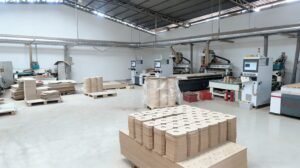
We manufacture wooden garden games in Guangzhou and sell direct: 500-set minimum, quotes within 24 hours, samples in 5–10 days, production in 30–45 days, EN71 and ASTM F963 compliance, FSC-certified timber.
FAQs
1. Can I get samples before a bulk order?
Yes. Standard custom samples take 5–10 days to produce plus 3–7 days in transit, and the charge is credited against the production order. The sample is made on the production line.
2. What is the easiest game to customise for a first order?
Cornhole. The construction is simple, the branding surfaces are large, and the product is understood by buyers without explanation.
3. How do I stop the design fading outdoors?
Specify a UV-resistant topcoat and, for printed surfaces, a sealed print rather than an unprotected one. Indoor display and full outdoor exposure need different finishes.
4. What markup is normal on custom games?
It depends on the channel rather than the product. A rough working assumption for specialty retail is a retail price of 2.5 to 3 times the landed cost, but the number that matters is what the market will pay, which is set by positioning rather than by cost.
5. Do you handle white-label and private-label orders?
Yes – logo, packaging, size and finish built to your specification, with an NDA signed before drawings are shared.
Specifying a custom wooden garden game?
Send the format, quantity, target market and retail price – we will come back within 24 hours with an itemised quote and the specification points that need deciding: contact us
Sourcing Wooden Garden Games in Bulk?
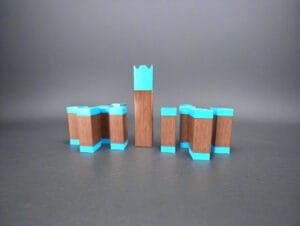
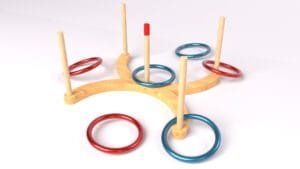
Kangjie is the direct manufacturer behind these games — no trading company, no middleman margin. We supply Kubb, Croquet, Molkky, Ring Toss, Tumble Tower, Cornhole and more to importers, retailers and brand owners worldwide.
- Factory-direct pricing with transparent volume tiers (500 / 1,000 / 5,000 units)
- OEM & ODM: logo, packaging, size and finish built to your specification
- EN71 & ASTM F963 compliant; FSC-certified timber
- Bulk lead time 30–45 days, quotation within 24 hours