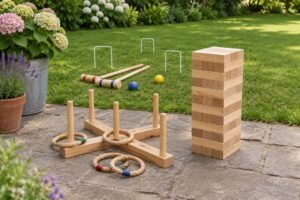
A garden party stalls for one reason: everyone is standing around holding a drink with nothing to do. Games fix that, but only if they suit the group. A game that needs eight players is useless at a party of five, and a game with a twenty-minute rules explanation will not get played at all.
Below are the outdoor games that actually get used at gatherings, grouped by what they need from the space and the crowd, plus the things worth checking before you buy a set — whether that is one for your own garden or five hundred for a retail line.
The Games That Actually Get Played
Tumble Tower
Blocks stacked in alternating layers, pull one, put it on top. Works for any number of players, needs no explanation, and the giant version is the single most photographed thing at most events. The only requirement is a flat surface and a bit of nerve.
If you are buying one, check that the blocks have been sanded on all six faces and that the faces are square. A tower that leans on its own is not a game, it is a countdown.
Cornhole
Two boards, eight bags, two teams. The reason it works at gatherings is that it is played in pairs, so four people are involved and everyone else can watch and heckle. It also scales: casual throwing and serious play use the same equipment.

Ring Toss
Pegs and rings, scored by which peg the ring lands on. The garden version has tall pegs and rope rings, which is what makes it suitable for children and for events where a hard projectile would be a problem. Small enough to pack away, big enough to be seen across a lawn.
Washer Toss
Washers thrown into a box with a central pipe. Heavier than it looks and much harder than it sounds, which is exactly why adults keep playing it. The box design matters: a single-wall box rattles and slides, a properly braced one sits still.

Kubb
A Swedish game of thrown batons and standing blocks. It looks like a simple knockdown game and is not: positioning, blocking and the order you clear the field all matter. Two teams, any size, and it holds attention for a full hour.
Mölkky
Twelve numbered pins and one baton. The scoring rule — exactly 50 wins, going over drops you to 25 — turns a throwing game into a decision-making one, because at 45 points you have to think about which pin to aim at. It is the game that converts sceptical adults.
Croquet
Mallets, balls and hoops on grass. Slower than the throwing games and better for a long afternoon than a quick round, but it is the one game that works for three generations at once, because nobody needs to be fast or strong.
Ladder Toss and Hook & Ring
Both are small, portable, and playable in a narrow space. Ladder toss uses bolas thrown at a three-rung frame; hook and ring is a single ring on a string swung at a hook, which is the pub game that ends up being played for two hours by people who said they were not playing.
How to Choose for Your Group
- Large mixed group, small garden. Tumble tower and hook and ring. Both need a flat surface, not a lawn.
- Four to eight people, decent lawn. Cornhole and ring toss, running as two stations.
- Two teams, competitive crowd. Kubb or Mölkky. Both have enough rules to feel like a real contest.
- Three generations, long afternoon. Croquet. Slow, sociable, nobody gets left out.
- Event or venue, high footfall. Giant tumble tower plus cornhole plus ring toss. Three stations absorb a crowd better than one big game.
What Separates a Good Set From a Cheap One
The differences are not visible in a product photograph, which is why cheap sets sell and then disappoint.
- Sandpaper finish. Every edge and face should be sanded, not just the visible ones. A splinter from a block that has been handled fifty times is the most common complaint in this category.
- Moisture content. Timber that was not properly kiln-dried will shrink after a season and the joints will open. Ask what the target moisture content is at packing.
- Hardware. Hooks that bend, screws that pull out of soft wood, and hinges that rust are the three failure points on every collapsible game.
- Bag or case. A game without a bag gets left out in the rain and then blamed for falling apart.
- Species. Beech for anything that takes impact, rubberwood for painted work, robinia if the set lives outside permanently.
If You Are Buying for Resale or Events
The requirements change once the buyer is not the player.
- Rental fleets need replaceable parts. Ask whether individual blocks, pegs or bags can be supplied separately. A rental set with one lost bag should not become scrap.
- Events need flat-pack or two-section construction. Freight is charged on volume, so a 100 cm peg that splits into two 50 cm sections saves real money at container volume.
- Retail needs the packaging to match the claim. If the box says outdoor, the finish and the storage instructions have to support that.
- Compliance is per product, not per company. EN71 in Europe and ASTM F963 in the United States apply to the specific item and the specific coating. A certificate for a different product proves nothing.
We build all of the games above in solid hardwood, from 500 sets, with EN71 and ASTM F963 compliance and FSC-certified timber available. Tell us the group size, the surface and the price point and we will tell you which games fit.
Conclusion
The right outdoor game is the one that matches the space, the number of people and how much they are willing to learn. Tumble tower and hook and ring for tight spaces, cornhole and ring toss for a lawn, Kubb and Mölkky for a competitive crowd, croquet for a long afternoon.
Buy for the finish and the hardware, not the photograph. That is where the difference between a set that lasts five summers and one that lasts one actually lives.
FAQs
How many games do I need for a party of twenty?
Three stations is the practical number. Two games create a queue; four means some sit unused. Giant tumble tower, cornhole and ring toss cover a mixed group well.
Which outdoor games work on a patio rather than a lawn?
Tumble tower, hook and ring, tabletop quoits and ladder toss with a weighted base. Anything that needs to be driven into the ground — croquet hoops, ring toss pegs — will not work on a hard surface without a base plate.
Are wooden games suitable for children?
Yes, provided the pieces are large enough not to be a choking hazard and the finish meets EN71-3 or the ASTM equivalent. Avoid games with hard projectiles for young children; rope rings are the safer choice over wooden hoops.
What is the minimum order for custom games?
500 sets per product. Mixed specifications within the same product can usually be combined to reach the minimum.
How long does a bulk order take?
Samples in 5–10 days once the specification is agreed, and production in 30–45 days after sample approval. Quotations are returned within 24 hours of a complete brief.
Sourcing Wooden Garden Games in Bulk?
Kangjie is the direct manufacturer behind these games — no trading company, no middleman margin. We supply Kubb, Croquet, Molkky, Ring Toss, Tumble Tower, Cornhole and more to importers, retailers and brand owners worldwide.
- Factory-direct pricing with transparent volume tiers (500 / 1,000 / 5,000 units)
- OEM & ODM: logo, packaging, size and finish built to your specification
- EN71 & ASTM F963 compliant; FSC-certified timber
- Bulk lead time 30–45 days, quotation within 24 hours