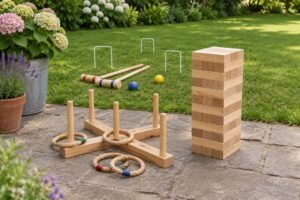
An outdoor game is not simply an indoor game played outside. The definition that actually holds is narrower: an outdoor game is one where the environment is part of the game rather than the background to it.
Wind, slope, light, ground texture and weather are not obstacles to be removed. They are inputs. A cornhole board on level ground and the same board on a slope are two different games, and that is the property that separates this category from everything else.
What follows is a working definition, a taxonomy that is actually useful for choosing, and the honest limits of the category.
The Working Definition
Three conditions, and a game needs all three.
- Played in open space. Not a room with a window open. The space is part of the equipment.
- Physical action is the mechanism. The game is decided by what bodies do, not by what cards are drawn.
- The conditions are variable. Wind, surface and light change between sessions and cannot be fully controlled.
The third condition is the one that matters. A bowling alley controls every variable; a garden does not. That is why outdoor games feel different even when the rules are similar.
The Environment as a Third Player
Every outdoor game has an opponent that is not the other person. A gust that takes a ring toss ring off course, a slope that makes one end of the cornhole court harder, a low sun in a player’s eyes at 7pm in July.
Good outdoor games are designed around this. Bad ones ignore it and become frustrating. A set that ships with weighted pieces is a set that has thought about wind; a set with light plastic pieces has not.
A Taxonomy That Is Actually Useful
Sorting outdoor games by category rather than by popularity tells you what a game demands before you buy it.
| Category | Examples | What it demands | Where it fails |
|---|---|---|---|
| Target | Cornhole, washer toss, Molkky, Kubb, croquet, bocce | Repeatable throwing or rolling, a measured distance | Uneven ground, long grass |
| Net and wall | Tennis, pickleball, badminton | A marked court and a level surface | Wind above about 20 km/h |
| Invasion | Football, ultimate, basketball | Space and a defined goal area | Small gardens, and neighbours |
| Fielding | Cricket, rounders, softball | A long axis and a soft ball | Windows |
| Chase | Tag, capture the flag | Numbers and open space | Two players, or a small space |
| Table and lawn hybrids | Shut the Box, dominoes, giant dice | A flat surface and calm air | Wind above about 15 km/h |
The taxonomy does something a list of games cannot: it tells you that if your space is small and your group is two, you are choosing between target and table games, and nothing else is available.

What Outdoor Games Actually Demand of the Ground
The single most common cause of a game not being played is the surface.
| Surface | Works for | Fails for |
|---|---|---|
| Mown lawn under 25 mm | Everything in the target category | Nothing |
| Long grass | Chase games, invasion games | Croquet, bocce, anything that rolls |
| Gravel or decking | Cornhole, washer toss, Kubb | Croquet, anything that needs to roll true |
| Sand | Kubb, Molkky, beach variants | Cornhole boards, which will not sit level |
| Tarmac | Washer toss, basketball, chalk games | Anything with a wooden piece that falls |
| Indoor floor | Table games, tumble tower with a rug | Anything with a rigid projectile |
Long grass is the trap. It looks like a lawn and it is not one, and a croquet ball in grass over twenty-five millimetres stops dead within a metre. The game does not fail, it just becomes tedious, and people stop.
The Benefits, Without the Exaggeration
Three claims survive scrutiny and the rest do not.
Daylight
Outdoor light on an overcast day is roughly 10,000 lux against 200 to 500 indoors. That difference sets the body clock, and it is the strongest documented effect of being outside.
Uneven ground
Standing and moving on grass or gravel recruits ankle and hip stabilisers that a flat floor does not. It is a balance stimulus, not a fitness one.
A shared task
A game gives a group something to look at together, which makes conversation easier than a room with no focus. That is a real and modest effect.
What Does Not Survive
Garden games are not exercise. Most sit at 2.5 to 3 METs, which is slower than a normal walk. Any claim that a cornhole set is a fitness product is a claim about standing up.
Safety, in Order of How Often It Happens
- Ankle sprains on uneven ground. The most common injury in the category, and it happens to people standing still.
- Sunburn. Boring and universal. An afternoon outside in June is more exposure than most people plan for.
- Swings near people. Croquet mallets, cricket bats and golf clubs need a clear zone. This is the injury that involves a bystander.
- Small parts. Anything that fits inside a cylinder 31.7 mm across and 57.1 mm deep is a hazard for children under three. Dice, counters and croquet clips all qualify.
- Dehydration. Underrated because the symptoms arrive after the game has finished.

What the Category Is Not
Two claims worth rejecting outright, because they appear constantly.
- “Biodegradable equipment.” A finished wooden game is glued, sanded and coated. It is not compostable, and a coating that made it compostable would not survive a season outdoors.
- “Tech-enhanced outdoor play.” Apps and GPS are fine as an organising layer. They are not what makes the game work, and a game that needs a phone to function is an indoor game with a walk attached.
Conclusion
An outdoor game is one where wind, slope, surface and light are part of the game rather than obstacles to it. That is the definition that predicts how a game will feel in a real garden.
The taxonomy is the useful part: target games for small spaces and small groups, net games for a marked court, chase games for numbers. Choose by category and the shortlist writes itself.
FAQs
1. What counts as an outdoor game?
One played in open space where physical action decides the result and the conditions vary between sessions. The variability is what separates it from an indoor game.
2. Are outdoor games good exercise?
Most are light activity at 2.5 to 3 METs. They are not a fitness programme.
3. What is the best outdoor game for a small garden?
A target game with a short distance: cornhole from one board, Molkky, or a ring toss. All fit in four by six metres.
4. Why does croquet fail on a lawn?
Grass over about 25 mm stops the ball within a metre. It needs mown grass, not a meadow.
5. Do wooden outdoor games biodegrade?
No. A finished game is glued and coated, and the coating is what keeps it usable outdoors.
Sourcing Wooden Garden Games in Bulk?
Kangjie is the direct manufacturer behind these games — no trading company, no middleman margin. We supply Kubb, Croquet, Molkky, Ring Toss, Tumble Tower, Cornhole and more to importers, retailers and brand owners worldwide.
- Factory-direct pricing with transparent volume tiers (500 / 1,000 / 5,000 units)
- OEM & ODM: logo, packaging, size and finish built to your specification
- EN71 & ASTM F963 compliant; FSC-certified timber
- Bulk lead time 30–45 days, quotation within 24 hours