
Two-player games are a distinct retail category, and most suppliers treat them as a subset of family games. They are not. A two-player game has to work with exactly two people for as long as they want to keep playing, which rules out party games, team games and anything that needs a crowd to be fun.
What is left is a small group of game families that have survived for decades or centuries, plus a handful of modern dexterity games. That is good news commercially: the traditional ones are public domain, which means you can manufacture them without a licence.
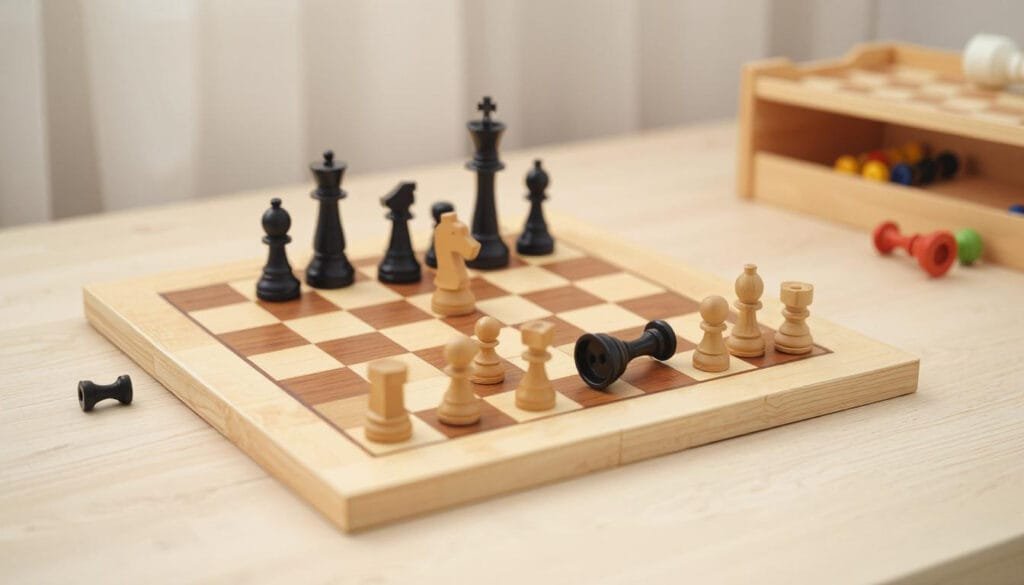
Why Two-Player Games Are Worth a Range
- They sell to a specific occasion. Date night, one parent and one child, two flatmates, a couple on holiday. The buyer knows what they want.
- They are giftable. A well-made two-player game in a wooden box is an easy present in a way that a party game is not.
- They use less material. Fewer pieces, smaller board, lower freight per unit. The economics are better than they look.
- They have a long shelf life. Traditional games do not date, so a range does not need replacing every season.
The counter-argument is that traditional games are commoditised. That is true of chess and backgammon and less true of everything else, which is where the margin sits.
The Four Families
1. Abstract Strategy
Two players, perfect information, no luck. The appeal is that the components can be beautiful and the rules fit on a card.
- Nine men’s morris — an ancient placement and movement game. Three pieces in a row forms a mill, which lets you remove an opponent’s piece. Simple to learn, genuinely deep.
- Fox and geese — an asymmetric hunt game, one fox against a flock. Very old, very portable, and unusual enough to stand out on a shelf.
- Halma and its descendants — race your pieces across the board. The two-player version is tighter than the six-player one most people know.
- Mancala and oware — sowing games played across Africa and Asia for centuries. A carved board and a handful of seeds; almost no manufacturing cost, very high perceived value.
- Chess, draughts and their variants — commoditised, but a good wooden set still sells as a gift.
2. Dexterity and Flicking
Physical skill rather than calculation, which makes them accessible to people who do not think of themselves as board game players.
- Crokinole — a round board with pegs and discs, flicked to the centre. The best two-player dexterity game in production and the one that justifies a premium price, because a good board plays differently from a bad one.
- Tumble tower — the stacking game. Works with two players, though it is at its best with more.
- Tabletop quoits and ring toss — small, cheap to produce, and the pub-game appeal carries them.
- Shut the box — a dice game with wooden flaps. Traditional, tiny, and a reliable gift line.
3. Dice and Chance
Backgammon is the anchor here, and a wooden backgammon set is one of the few products in this category that sells at a genuinely high price point. Beyond that: traditional dice games, and the many pub games built around a cup and five dice.
4. Puzzle and Patience
Not strictly two-player, but they sell in the same place to the same buyer. Wooden puzzle boxes, burr puzzles, and peg solitaire are all low-cost to produce, high-margin, and photograph beautifully.
The Trademark Question
This is the part of the category that catches manufacturers and buyers out, and it is worth being blunt about.
A large number of well-known modern two-player games are protected. Their names are registered trademarks and their rules and components may be covered by copyright or design protection. Making a wooden version of a game you do not own, and selling it under that game’s name or with recognisable components, is not a grey area — it is infringement, and it is the fastest way to lose a container at customs or a listing on a marketplace.
The safe territory is:
- Traditional and public-domain games. Morris, mancala, backgammon, draughts, dominoes, Pachisi and its descendants, pick-up sticks, shut the box, solitaire. These have been played for centuries and belong to nobody.
- Your own designs. A new mechanic, or a familiar mechanic with genuinely new components, is your intellectual property and can be protected.
- Generic descriptions. “Tumble tower” rather than the brand name, “flicking disc game” rather than a protected title.
If a supplier offers to make you a wooden version of a game you have seen in a shop, ask who owns the rights. If the answer is vague, the risk is yours, not theirs.
Specifications That Decide Whether It Sells
- Board flatness. On any flicking or rolling game, a board that warps by a millimetre is scrap. Specify the timber, the moisture content and the gluing method.
- Piece consistency. In a strategy game the pieces have to be identical in weight and size, or players notice and complain.
- Storage. A two-player game with 40 loose pieces needs a box with compartments. A cloth bag is cheaper and reads as cheap.
- Rules card. Traditional games have regional variants. Print one set of rules and stick to it, or you will get questions you cannot answer.
- Finish. Water-based lacquer for anything a child will handle; EN71-3 is the relevant test for the coating.
Building a Range
A workable two-player range has four or five products at different price points, all sharing a visual language:
- Entry — shut the box or pick-up sticks. Low cost, impulse purchase.
- Core — nine men’s morris or mancala. The volume seller.
- Premium — crokinole board or a boxed backgammon set. The margin product and the window display.
- Gift — a puzzle box or a compact travel set, priced for a present.
Sharing species and finish across the range means one production setup and a coherent shelf presence, which matters more in this category than having twenty products.
Conclusion
Two-player wooden games are a good category for a supplier who understands two things: that the traditional games are free to make and the modern ones are not, and that the difference between a premium product and a cheap one is flatness, consistency and finish.
Tell us the price points you want to hit and the market you sell into, and we will propose a range from the public-domain catalogue and quote it at 500, 1,000 and 5,000 units.
FAQs
Can you produce a wooden version of an existing board game?
Only if you own the rights to it or can show that it is in the public domain. We will ask before quoting, because manufacturing a protected game exposes both of us.
Which two-player games are safe to manufacture?
Traditional games with no living rights holder: nine men’s morris, fox and geese, mancala, halma, backgammon, draughts, dominoes, Pachisi variants, pick-up sticks, shut the box and peg solitaire. Crokinole is also generic, though specific board designs can be protected.
What is the minimum order?
500 sets per product. A mixed range can be ordered together as long as each product reaches a workable run.
How long does sampling take?
5–10 days once the design is agreed. For a board game we will send photographs of the assembled product alongside the sample, because flatness and fit are hard to judge from a single item.
Can the game be branded?
Yes — laser engraving on the board or lid, a printed rules card, and a branded box. On a strategy game, put the branding on the box or the underside, not on the playing surface.
Sourcing Wooden Garden Games in Bulk?
Kangjie is the direct manufacturer behind these games — no trading company, no middleman margin. We supply Kubb, Croquet, Molkky, Ring Toss, Tumble Tower, Cornhole and more to importers, retailers and brand owners worldwide.
- Factory-direct pricing with transparent volume tiers (500 / 1,000 / 5,000 units)
- OEM & ODM: logo, packaging, size and finish built to your specification
- EN71 & ASTM F963 compliant; FSC-certified timber
- Bulk lead time 30–45 days, quotation within 24 hours









