A minimum order quantity is the number of units a factory needs before it will start a production run. Buyers usually experience it as an obstacle. It is more useful to understand it as a price mechanism, because that is what it actually is: the point at which the fixed cost of setting up a run is spread thinly enough that the unit price makes sense.
Once you can see the setup cost behind a minimum, negotiating becomes a matter of arithmetic rather than persuasion.
This page explains where minimums come from, how customisation changes them, and what the realistic options are when a supplier’s number is higher than your plan.
Why Minimum Order Quantities Exist
A production run carries costs that do not scale with quantity. Before the first saleable unit exists, the factory has to:
- cut or buy tooling, jigs and fixtures for the specific product
- program machines and set up the line
- build and approve a sample
- buy raw material in the mill’s own minimum lot, not in your order quantity
- stop whatever was running before and change over
None of that becomes cheaper when the order is small. It is a fixed cost, and it has to be recovered either from the units or from the price.
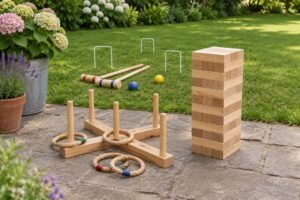
The arithmetic is simple. Suppose the setup for a garden game comes to 3,000 RMB and the variable cost per set is 20 RMB. At 500 sets, setup adds 6 RMB to every unit. At 5,000 sets it adds 0.60 RMB. Same factory, same product, a tenfold difference in the fixed-cost contribution – which is why a supplier quoting a low volume will either refuse, or quote a unit price that looks unreasonable until you see the setup line.
That is also why an itemised quote matters. When setup is shown as its own line, the minimum stops being an arbitrary wall and becomes a number you can reason about.

How Customisation Changes the Minimum
Custom work raises the fixed cost, so it raises the minimum. Three elements do most of the damage:
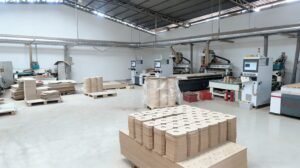
- New tooling. A new shape or a new joint needs a jig. That is a one-off cost that exists only because the product is custom.
- Artwork and pre-production. Logo placement, colour matching, packaging dielines and print proofs all take time before anything is manufactured, and none of it scales with quantity.
- Material minimums. Timber and board come in mill lots. If your order needs half a lot, you either buy the lot or pay a premium for a split.
The practical implication: a variant on an existing product – different colour, different branding, different packaging – can often run at a lower minimum than a genuinely new design, because the tooling already exists. If your volume is limited, ask which of your requirements are variants and which require new tooling. That single question can halve the minimum.
How We Structure Minimums
A 500-Set Minimum
500 sets is our standard minimum for a custom run. It is enough to cover setup and hold a consistent batch, and it is low enough to test a design in a real market before committing to container volume.
There is an honest floor below that. Under a few hundred sets, the setup contribution per unit rises to where the price stops competing with a stock item, and at that point the better advice is to wait rather than order. We will say that rather than quote a number that does not work.
Factory Direct, No Intermediary
We manufacture rather than trade, so there is no layer adding its own margin and its own minimum on top. Volume tiers are published rather than negotiated case by case, and the person quoting the order controls the line that will produce it.
Quotation Speed
Quotes come back within 24 hours of a clear specification, itemised by material, labour, finish, branding setup and packaging. If the minimum is the constraint, say so in the enquiry – the quote can then show what changes at your volume rather than at ours.
How to Work Within a Minimum
Start With a Real Forecast
Suppliers extend flexibility to buyers who look like a repeat customer. A forecast – even a rough one – that shows a first order followed by two more within a year is a different conversation from a single speculative order. It does not need to be a commitment; it needs to be credible.
State the Constraint Early
If your budget or storage limits you to 300 sets, say that in the first email rather than after the quote. There are usually options – a stock construction with custom branding, a smaller piece count, a different pack format – but they only get proposed if the constraint is known.
Use a Stock Item to Test the Market
A custom run is not the only way to validate demand. Buying a stock product at low volume, selling it, and then committing to a custom design with proven sell-through is slower but considerably cheaper than holding 500 sets of a design that does not move.
When a Larger Order Makes Sense
Unit Cost Falls With Volume
As the setup contribution spreads, the unit price drops – and beyond that, material purchasing improves at higher volumes because the factory can buy full mill lots. The saving is real, but it is only a saving if the stock sells. Inventory that sits for a season is a cost, not a discount.
Commercial Leverage
A larger order gives you room to negotiate payment terms, shipping arrangements and future minimums. It also moves you up the production calendar, which matters in a seasonal category where the difference between March and July is the difference between a full-price season and a markdown.
Certification Is Part of the Cost
Testing is a fixed cost too, and it is one buyers often forget when comparing quotes. A wooden game sold as a toy in the EU needs EN71 testing, with EN71-3 covering heavy metal migration from coatings. The US requires ASTM F963 and CPSIA. FSC-certified timber needs chain-of-custody documentation tied to the order.
Two consequences follow. A quote that excludes testing is not cheaper, it is incomplete. And a very small order may not justify a test report at all, which is another reason the minimum exists.
Ask which standard applies to your product and who issues the report. A supplier who cannot answer that is not in a position to make a compliance claim.
Options When the Minimum Is Too High
A Trial Run at a Higher Unit Price
Some factories will run below the standard minimum at a higher unit cost, because the setup is being recovered from fewer units. It is a legitimate arrangement, but it should be quoted explicitly as a trial run with its own price, not presented as the normal rate.
Consolidated Orders
Two buyers ordering the same product can place one combined run and split it. This works well between importers serving different territories, and it is common enough that factories are used to the request. The complication is that one party has to hold the order and take responsibility for the split.
Timing the Order to the Season
Factories have quieter periods, usually after the main shipping season closes and before the next one is booked. A smaller order placed in a quiet window is more likely to be accepted, because the alternative for the factory is an idle line rather than a lost order.
Summary
A minimum order quantity is the visible form of a fixed setup cost. It falls when tooling already exists, when the specification is a variant rather than a new design, and when the order can be scheduled into a quiet production window. It rises with new tooling, new artwork and new packaging.
The workable approach is to state the constraint at the start, ask for an itemised quote that shows the setup line, and treat the minimum as arithmetic rather than as a negotiating position. Our standard is 500 sets, quotes within 24 hours, samples in 5–10 days, production in 30–45 days – and if your volume sits below that, we will tell you what the alternatives actually cost.
Working out whether a custom run is viable at your volume?
Send the specification and the quantity you can commit to. We will come back within 24 hours with an itemised quote showing what changes at your volume: contact us
Sourcing Wooden Garden Games in Bulk?
Kangjie is the direct manufacturer behind these games — no trading company, no middleman margin. We supply Kubb, Croquet, Molkky, Ring Toss, Tumble Tower, Cornhole and more to importers, retailers and brand owners worldwide.
- Factory-direct pricing with transparent volume tiers (500 / 1,000 / 5,000 units)
- OEM & ODM: logo, packaging, size and finish built to your specification
- EN71 & ASTM F963 compliant; FSC-certified timber
- Bulk lead time 30–45 days, quotation within 24 hours