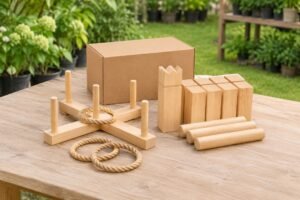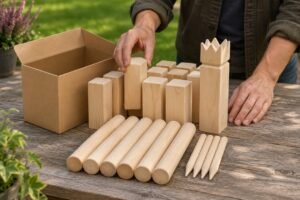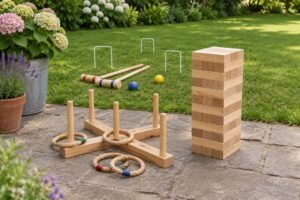
Customisation is usually described as a creative service. Commercially it is a pricing decision. A stock wooden game sits in a category where the buyer compares unit cost against every other identical product on the shelf. The same game with a specified species, a branded lid and a printed rules card sits in a category where the buyer compares fit, and the price comparison stops.
That shift – from commodity comparison to fit comparison – is the entire commercial argument for customising. Everything else is detail about how much it costs to make the shift.
Here is what customisation actually changes, what each change costs, where the supplier problems really come from, and how to protect the design once you have paid for it.

Why Customisation Changes the Price You Can Charge
Two identical tumble towers made from the same timber are worth different amounts depending on three things that are not the timber.
- The species and finish. Beech sanded to 180 grit and left raw reads as a garden toy. The same beech with a hardwax oil finish, eased edges and a consistent tone reads as a tabletop object.
- The branding. A laser-engraved logo on the lid turns a generic product into a corporate gift, which is a different market with a different budget.
- The packaging. A plain carton sells at toy price. A printed box with a window, a rules card and a cotton bag sells at gift price. The manufacturing difference between those two boxes is small; the retail difference is not.
None of those three changes the way the game plays. All three change who will buy it and what they will pay. That is what a buyer is actually purchasing when they commission a custom run – not novelty, but a different position on the shelf.
What Can Actually Be Customised
It is worth separating the requests, because they are quoted very differently and conflating them is where disappointing quotes come from.
A Variant on an Existing Product
Size, colour, stain, branding, packaging or piece count changed on a construction that already exists. The tooling is reused, so the run goes at the standard minimum and the unit cost moves very little. This is where most profitable custom work sits, because the buyer gets a differentiated product without paying for development.
A New Design
A format that does not exist yet. It needs a prototype, possibly new tooling, and a tolerance study on the parts that have to fit together. It is a project rather than a variation, and it needs to be quoted and scheduled as one.
Wood Species and Finish
The cheapest lever on perceived value, because it changes the product’s category without changing its construction.
- Dense hardwoods – oak, acacia, beech – for outdoor use and premium positioning.
- Softwoods – pine, cedar – for lighter, cheaper sets, with the caveat that they move more with moisture.
- Plywood – the cost-effective choice for flat components such as cornhole boards, provided the edges are sealed.
Whatever the species, moisture content is the specification that decides whether the product survives its first season. Outdoor timber should be dried to roughly 8–12%; indoor pieces to roughly 6–8%.
Branding and Packaging
Laser engraving, print, branded cartons, carry bags, inserts and rules cards. Engraving is the cheapest addition and the easiest to get wrong: below roughly 8 mm the detail closes up, so the mark has to be simplified for production size rather than approved at screen size.
How Customisation Affects Your Cost Structure
Custom work carries a setup cost – tooling, programming, a first-article check, sometimes a printing plate. That cost does not disappear; it gets spread across the order.
The arithmetic is worth doing before the quote arrives. A setup cost of 3,000 RMB spread across 500 sets adds 6 RMB per unit. The same setup spread across 5,000 sets adds 0.6 RMB. On a product retailing at 35 euros, the first case is a rounding error and the second is invisible.
That is why the minimum quantity matters more than the unit price in a custom quote. Below a few hundred sets the setup cost per unit rises to where the product stops competing with a stock item, and at that point the honest advice is to wait and order at a volume that works rather than to order small and lose the margin.
The other half of the arithmetic is what customisation saves. A differentiated product does not get compared on price, does not need discounting to clear, and does not come back as a return because the customer expected something else. Those three effects usually outweigh the setup cost, which is why the calculation is worth doing rather than assuming custom is expensive.
Solving the Supplier Problems That Actually Cost Money
The complaints buyers bring to a first conversation are consistent, and each has a specific cause.
Price
Most price differences between suppliers are specification differences in disguise. A quote that is 20% lower usually has thinner boards, a cheaper species, a single coat of finish or no edge sealing. The way to compare is an itemised quote – material, labour, finish, packaging and Incoterm as separate lines – so the difference is visible rather than argued about.
Lead Time
Garden games are seasonal, so a late shipment is a commercial loss rather than an inconvenience. Two mechanisms prevent it: a delivery date with a stated starting point, and a written acknowledgement of the factory calendar. Chinese New Year and the first week of October each remove two to three weeks from the year, and orders placed without accounting for them arrive late every time.
Production runs 30–45 days from deposit and sample approval to goods ready at the port. Ocean transit is additional.
Sampling
A sample that takes six weeks usually means the item is not in production, or is being hand-built outside the normal line. Neither tells you what the order will look like. Standard custom samples take 5–10 days to produce plus 3–7 days in transit, built on the production line, with the charge credited against the order.
Certification
EN71 for the EU, with EN71-3 covering heavy metal migration from coatings, alongside CE marking on the declaration of conformity. ASTM F963 and CPSIA for the US. FSC-certified timber with chain-of-custody records tied to the specific order. The question to ask is not whether certificates exist but which standard applies to your product and who issued the report.
Communication
One contact who holds the file, so nothing needs re-explaining. Quotes back within 24 hours for a clear specification, technical questions within two working days, shipment issues the same day. Most of what buyers describe as a communication problem is actually a file-ownership problem.
Protecting Your Design
A non-disclosure agreement is the standard first step before drawings are exchanged, and it should cover the design files as well as the finished product, and survive the end of the commercial relationship.
It is worth being clear about what an NDA does and does not do. It creates a contractual claim if a design is disclosed or reused, which is useful leverage and a real deterrent. It does not stop a factory from making a similar product for someone else if the design is generic enough to be independently arrived at. The practical protections are narrower and more effective: keep the distinctive elements in the parts that are hard to copy – the branding, the packaging, the specific combination – and place production with a manufacturer whose business depends on repeat custom rather than on one-off copying.
Direct Factory Versus Trading Company
A trading company adds a margin and a communication layer. That is sometimes worth paying for – a good one consolidates several factories, handles inspection and absorbs risk – but it should be a deliberate choice rather than an accident.
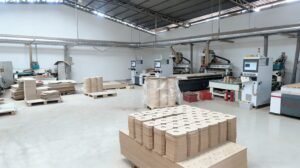
The way to tell them apart is the business licence. Check the registered scope: a company registered for trade is a trading company, whatever the website says. A second test is technical: ask what moisture content the timber is dried to, and who owns the finishing line. A factory answers with numbers and a process. A trader forwards the question.
Where to Start
- Send the specification. Format, dimensions, species, finish, branding, packaging, quantity, target market and target retail price. The commercial context matters more than the drawing, because it determines which construction is appropriate.
- Get an itemised quote. Within 24 hours for a complete specification. Compare lines rather than totals.
- Approve a production sample. 5–10 days to produce. Approve in writing, against the sample rather than against a drawing.
- Confirm the date and the calendar. Production 30–45 days from deposit and sample approval, with the holiday closures written into the schedule.
Conclusion
Customising a wooden garden game is worth doing because it moves the product out of price comparison, and the levers that achieve that are the cheapest ones available: species, finish, branding and packaging.
The cost is a setup charge spread across the order, which is why volume matters more than unit price in a custom quote. The risk is not that custom work is expensive – it is that it gets specified loosely, quoted against a different specification, and delivered against a third one.
Planning a branded wooden game line?
We manufacture direct in Guangzhou: 500-set minimum, quotes within 24 hours, samples in 5–10 days, production in 30–45 days, EN71 and ASTM F963 compliance, FSC-certified timber: contact us
FAQs
1. Does customisation make the product more expensive?
It adds a setup cost that is spread across the order – roughly 6 RMB per unit at 500 sets and 0.6 RMB at 5,000 for a typical setup. On a gift-tier product that is usually recovered by the higher price the product supports.
2. What is the minimum order?
500 sets for a variant on an existing product. A genuinely new design may need a higher minimum to absorb tooling, and it is quoted as its own project.
3. Can I brand the packaging as well as the product?
Yes, and packaging is usually the largest single lever on retail price. It needs to be specified before production rather than after, because artwork approval and printing sit on the critical path.
4. Will you sign an NDA?
Yes, before drawings are exchanged, covering design files as well as the finished product and surviving the end of the relationship.
5. Which certifications can you provide?
EN71 for the EU, ASTM F963 and CPSIA for the US, and FSC chain-of-custody where certified timber is specified. Which one applies depends on your market and how the product is classified.
Sourcing Wooden Garden Games in Bulk?
Kangjie is the direct manufacturer behind these games — no trading company, no middleman margin. We supply Kubb, Croquet, Molkky, Ring Toss, Tumble Tower, Cornhole and more to importers, retailers and brand owners worldwide.
- Factory-direct pricing with transparent volume tiers (500 / 1,000 / 5,000 units)
- OEM & ODM: logo, packaging, size and finish built to your specification
- EN71 & ASTM F963 compliant; FSC-certified timber
- Bulk lead time 30–45 days, quotation within 24 hours