Outdoor game manufacturing looks like a simple category from the outside, which is why buyers are surprised by how much variance there is between suppliers quoting what appears to be the same product.
The variance is not in the product. It is in the timber grade, the drying standard, the finish system and whether the factory can repeat a batch – none of which appear on a price list.
This page covers why sourcing in this category is harder than it looks, what the four recurring problems are, and what a manufacturer has to be able to demonstrate before an order makes sense.
Why Sourcing Outdoor Games Is Harder Than It Looks
The product looks forgiving. A tumble tower is a stack of blocks; a cornhole board is a sheet of plywood with a hole in it. That apparent simplicity is the problem, because it invites suppliers to compete on price alone and it hides the specifications that decide whether the product survives a season.
Four specifications do most of the work, and none of them are visible in a photograph:
- Moisture content. Timber for outdoor use should be dried to roughly 8–12% depending on species and exposure. Undried wood moves after assembly.
- Finish build. Several thin coats with sanding between them, plus sealed end grain. One heavy coat looks fine in a photo and fails in a season.
- Hardware. Stainless or galvanised fixings on anything that stays outside. Coated screws rust at the head and stain the timber.
- Consistency across the batch. Colour and grain matching, which is the defect buyers notice first and complain about longest.
A supplier who cannot discuss those four with numbers is not in a position to guarantee anything about the product.
The Four Problems Buyers Actually Face
- Prices that cannot be compared. Two quotes for a “cornhole set” can differ by half and both be accurate – different board thickness, different timber grade, bags included or not, branding setup amortised or charged separately, different Incoterms. Without a written specification and an itemised quote, the comparison tells you nothing.
- Delivery dates that are not dates. A range with no starting point is not a commitment. Production counted from deposit is a different number from production counted from sample approval, and both exclude ocean transit.
- Sampling that takes too long. A sample quoted at six to eight weeks usually means the item is not in production, or the sample is being built by hand outside the normal line. Neither tells you what the order will look like.
- Certification that appears late. EN71 for the EU, ASTM F963 and CPSIA for the US. Discovering at customs that the report covers a different product is an expensive way to learn this.
What a Suitable Manufacturer Looks Like
The profile is unglamorous. It is a factory that already exports into your market, treats custom work as normal rather than exceptional, and answers technical questions with numbers.
- Export experience in your market. They should know the standards and the paperwork already, not be learning them on your order.
- Custom as core business. A factory that mostly sells stock items schedules custom runs as an exception, which is where delays come from.
- A scale that fits. Large enough to hold a production schedule, small enough that a 500-set order is worth their attention.
- Documentation on request. Test reports, FSC chain-of-custody and inspection records available without a negotiation.
How We Address Those Problems
Pricing
We manufacture rather than trade, so there is no intermediary margin inside the quote. Quotes are itemised by material, labour, finish, branding setup and packaging, with the Incoterm stated on the document – which means you can see what each element costs and remove one deliberately if the budget requires it.
Delivery
Production runs 30–45 days from deposit and sample approval to goods ready at the port, quoted as a date rather than a range. If the date comes under pressure, you hear about it when the risk appears rather than when the date passes.
Sampling
Standard custom samples take 5–10 days to produce plus 3–7 days in transit, and the sample charge is credited against the production order. The sample is built on the production line, so approving it means approving what will actually be manufactured.
Certification
EN71 for the EU, ASTM F963 and CPSIA for the US, and FSC-certified timber with chain-of-custody records tied to the specific order. We will tell you which standard applies to your product rather than sending a generic certificate.
Customisation and Confidentiality
Customisation is the cheapest way to move a product out of price comparison. Species, stain, finish sheen, piece count, board size and packaging can all change without new tooling, which means they run at the standard minimum rather than as a separate project.
Confidentiality is a separate matter and needs to be documented. A mutual NDA signed before drawings are exchanged, covering design files as well as the finished product and surviving the end of the commercial relationship. Ask for it at the quoting stage; a supplier who hesitates is telling you something.
Direct Factory Access
The operational benefit of buying direct is not only price. It is that a technical question reaches the person who can answer it, that a quality issue is resolved on the floor rather than negotiated between two companies, and that a schedule change is communicated by the person making it.
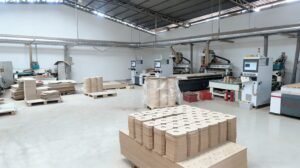
The practical check is simple: ask for a video call from the workshop and ask who owns the finishing line.
What to Verify Yourself
Any claim on a website, including this one, should be checked against documents. Five things are worth confirming before a first order:
- The business licence, and whether the registered scope is manufacturing or trade.
- An itemised quote with the Incoterm stated.
- A sample taken from the production line, not from the workshop bench.
- Which certification applies, and who issues the report.
- The delivery date’s starting point, in writing.
Building a Working Relationship
The relationship is kept by uneventful execution rather than by hospitality. That means confirming orders and changes in writing, reporting progress before it is asked for, flagging problems early, and keeping pricing stable through the season.
From the buyer’s side, two things make a measurable difference: paying to terms, and giving a real forecast even if it is rough. A supplier who can see a twelve-month view will hold a production slot when a forecast slips. One who has only ever seen a single order will not.
Are Outdoor Game Manufacturers Worth It?
Yes, if the manufacturer is verified and the specification is written. The category rewards buyers who specify and punishes buyers who compare prices on unspecified products, because the difference between a good and a bad set is entirely in the parts of the specification that a quotation does not show.
Next Step
Write the specification, request itemised quotes from three factories, take a sample from the production line, and confirm the delivery date’s starting point. Those four steps cost nothing but attention and remove most of the risk.
Summary
Sourcing outdoor games is a verification exercise rather than a search exercise. The supplier profile that works is a factory with export experience in your market, custom work as core business, a realistic minimum, and documentation available on request.
We manufacture wooden garden games in Guangzhou and sell direct: 500-set minimum, quotes within 24 hours, samples in 5–10 days, production in 30–45 days, EN71 and ASTM F963 compliance, FSC-certified timber.
Looking for an outdoor game manufacturer?
Send the product, quantity and target market – we will come back within 24 hours with an itemised quote and a production date: contact us
Sourcing Wooden Garden Games in Bulk?
Kangjie is the direct manufacturer behind these games — no trading company, no middleman margin. We supply Kubb, Croquet, Molkky, Ring Toss, Tumble Tower, Cornhole and more to importers, retailers and brand owners worldwide.
- Factory-direct pricing with transparent volume tiers (500 / 1,000 / 5,000 units)
- OEM & ODM: logo, packaging, size and finish built to your specification
- EN71 & ASTM F963 compliant; FSC-certified timber
- Bulk lead time 30–45 days, quotation within 24 hours