
No. Skittles and ten-pin bowling share an ancestor but they are different games with different equipment, and the difference matters if you are sourcing one of them.
The short version: skittles is played with a small ball or a thrown object at nine wooden pins on a flat surface, outdoors or in a pub alley. Ten-pin bowling is played with a heavy drilled ball at ten pins on a 60-foot oiled lane. Below is what separates them, and which one suits which market.
What Skittles Is
Skittles is a family of European pin games rather than a single set of rules. The common form has nine wooden pins arranged in a diamond, and players throw a small ball or a wooden ball at them from a short distance, aiming to clear them in as few throws as possible.
Regional versions differ enough that the equipment is not interchangeable:
- British skittles — nine pins in a diamond, played in a covered alley with a hard ball.
- German Kegel — the ancestor of ten-pin, with its own pin counts and lane conventions.
- Dutch and Belgian variants — outdoor forms played on grass or clay.
- Nordic forms — related to Mölkky and Kyykkä, thrown rather than bowled.
If a buyer asks for “skittles” without specifying which, that is the first question to ask.
What Ten-Pin Bowling Is
A standardized indoor game: ten pins in a triangle, a ball of up to about 7.3 kg with drilled finger holes, a lane of just under 20 metres finished with oil, and a scoring system built on strikes and spares across ten frames.
It is a facility business, not a product business. The lane, the pinsetter and the ball return are the product; the balls and shoes are consumables.
The Differences That Matter
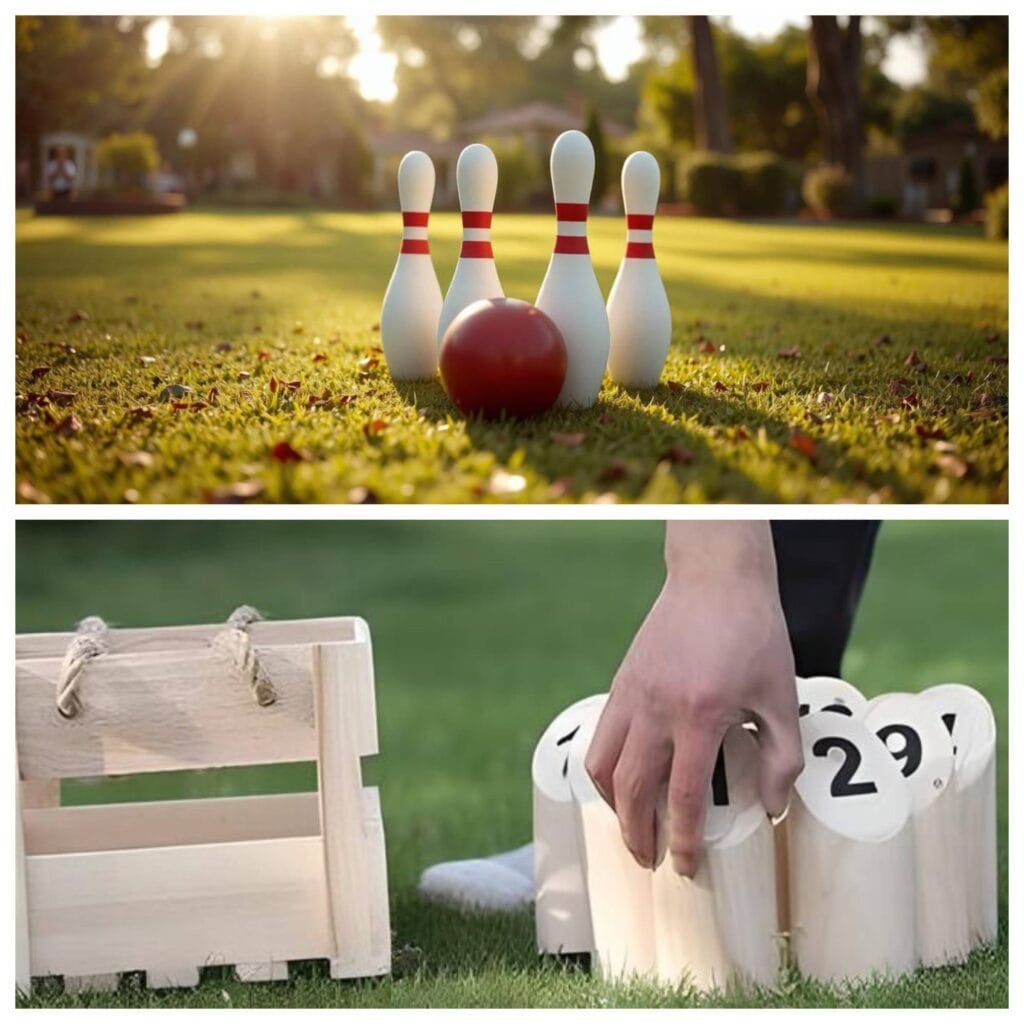
| Skittles | Ten-pin bowling | |
|---|---|---|
| Pins | 9, in a diamond | 10, in a triangle |
| Ball | Small, often wooden, no finger holes | Heavy, drilled, composite |
| Surface | Any flat surface, grass or a short alley | Oiled lane, ~19 m |
| Scoring | Fewest throws, or pins down | Frames, strikes and spares |
| Setting | Portable, sets up anywhere | Fixed facility |
| Who buys it | Retail, pubs, events, gift | Venues, leagues |
Why the Confusion Exists
- Shared ancestry. Both descend from European pin games, and the German Kegel tradition runs through both.
- Shared vocabulary. “Pin”, “strike”, “alley” all appear in both, with different meanings.
- Translation. Mölkky and Kyykkä are routinely described in English as “Finnish skittles”, which adds a third meaning to the same word.
Which One Suits Your Market
- Garden and gift retail. Skittles, in a portable wooden set. Cheap to make, light to ship, and it works without a facility.
- Pubs and hospitality. Skittles, in a heavier version for an indoor alley or a terrace.
- Events and rental. Skittles at oversize, or Mölkky if you want a numbered-pin scoring game.
- Bowling equipment. Not our category. Balls are composite and drilled; that is a different supply chain.
Sourcing Notes for Skittles
- Pins. Beech. They take repeated impact from a ball and softer species deform at the base.
- Ball. Hardwood, turned and finished smooth. A ball with a flat spot will not roll true.
- Pin count. Nine is the standard; confirm the layout your market expects.
- Finish. Water-based lacquer; EN71 and ASTM F963 if sold as a toy.
- Minimum 500 sets; samples 5–10 days; production 30–45 days after approval.
One Correction Worth Making
Wooden games are built for outdoor use, not for outdoor storage. Beech and rubberwood will discolour and eventually split if left out through a wet winter, whatever the finish. Telling a customer otherwise produces a complaint in the second season, and it is the most common piece of bad advice in this category.
Conclusion
Skittles and bowling are cousins, not the same game: nine pins against ten, a small ball against a drilled one, a portable set against a fixed lane. For a product range, skittles is the one you can actually manufacture and ship.
Tell us the pin count, the ball size and the market, and we will quote a skittles set with the layout specified.
FAQs
Can you use a bowling ball for skittles?
Technically, but it is far too heavy for the pins and the surface. A skittles ball is small and light by design.
Which game is older?
Pin-and-ball games go back centuries across Europe, and both skittles and bowling descend from them. Ten-pin bowling as it is played today was standardised in nineteenth-century America; skittles retains the older, more varied regional forms.
Are wooden skittles weatherproof?
No. They are built for outdoor play and need dry storage. Left outside through a wet winter, beech pins will discolour and split.
How many pins are in a set?
Nine in the standard diamond layout. Some regional variants use different counts, so confirm before ordering.
What is the minimum order?
500 sets. Different pin sizes can usually be combined within one order.
Sourcing Wooden Garden Games in Bulk?
Kangjie is the direct manufacturer behind these games — no trading company, no middleman margin. We supply Kubb, Croquet, Molkky, Ring Toss, Tumble Tower, Cornhole and more to importers, retailers and brand owners worldwide.
- Factory-direct pricing with transparent volume tiers (500 / 1,000 / 5,000 units)
- OEM & ODM: logo, packaging, size and finish built to your specification
- EN71 & ASTM F963 compliant; FSC-certified timber
- Bulk lead time 30–45 days, quotation within 24 hours









