
Giant dice look like the simplest product in the wooden game range and they are not, because a die has to be three things at once: a cube within tolerance, a fair randomiser, and a surface that survives being thrown onto gravel several hundred times.
This is how the product is actually made at volume, and which of the steps decide whether the set you receive is a game or a prop.
Step One: The Cube
Everything starts with the cube, and the tolerance is tighter than people expect. A die that is visibly out of square will roll unevenly, and players notice long before they can explain why.
The practical tolerance is around 0.5 mm across all three dimensions on a 90 mm die. Below that the die is a die; above it, it is a decorative block that happens to have pips on it.
Two ways to make the cube. Cutting from solid stock on a saw with a stop gives a good cube but consumes more material and is slower. Machining from a laminated or glued-up blank allows a larger die from cheaper stock, but the glue lines have to be invisible and the blank has to be flat before cutting.
For anything above a few hundred units, the second method is normal and there is nothing wrong with it, provided the supplier can tell you which method they use.
Step Two: The Corners and Edges
A cube with sharp edges is not a die, it is a brick. It will not roll, it will skid, and it will damage whatever it lands on. Every edge needs a radius.
The radius is a design decision, not a finishing afterthought. A small radius, around 2 to 3 mm, keeps the cube looking crisp and rolls acceptably on a hard surface. A larger radius, 6 to 10 mm, rolls better on grass and is far more forgiving to handle, but the die starts to look like a cushion.
For a garden product that will be thrown onto grass or gravel, the larger radius is the right answer. For a tabletop or display product, the smaller one.
Step Three: The Pips
Three methods, with three very different lifespans.
Engraved and paint-filled. The pip is cut into the face and filled with paint. Durable, and the pip stays legible after years of use. This is what a product meant to be played with should use.
Printed or applied. Faster and cheaper, and it fails first. A printed pip on a wooden face wears at the edges and can lift in damp conditions.
Inlaid. A contrasting timber or resin set into a drilled recess. The most expensive and the most durable, and the option that reads as premium.
Whichever method, two rules apply. The layout has to be correct — opposite faces must sum to seven — and the pip size has to scale with the die. Pips sized for a 16 mm die look lost on a 90 mm face.
The Layout, Since It Gets Wrong
| Face | Opposite face | Sum |
|---|---|---|
| 1 | 6 | 7 |
| 2 | 5 | 7 |
| 3 | 4 | 7 |
There is also a handedness convention: with the 1 face up and the 2 facing you, the 3 should be on your right. A set that gets this wrong is not unfair, but it is the detail a knowledgeable customer will notice.
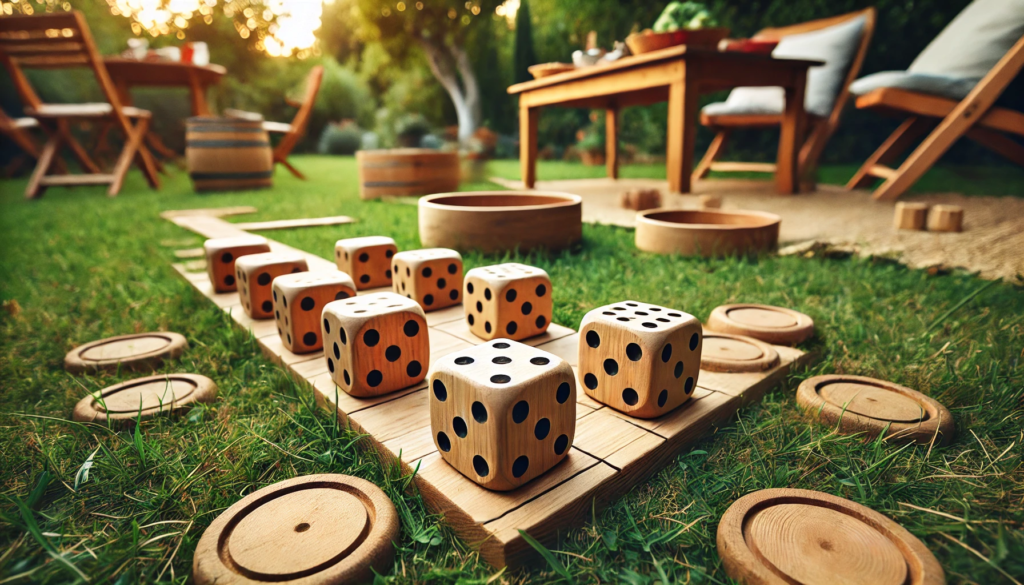
Step Four: Sanding and Finish
Sand in sequence: rough to remove machining marks, then 120, then a finish pass at 180 to 220. Going straight to a fine grit produces a surface that looks smooth and feels fuzzy, because the fibres have been pushed over rather than cut.
The pips need the same treatment as the faces, inside the recess. This is the step that gets skipped under time pressure and the one a customer notices first.
Finish is either a hardwax oil, which soaks in and can be repaired locally, or a water-based exterior lacquer, which sits on the surface and resists water better. For a die that will be thrown onto grass repeatedly, the lacquer is usually the better choice.
Step Five: What Makes It Fair
Three things, and only one of them is about the cube.
- Dimensional consistency. All dice in a set should be within the same tolerance. A set where one die is slightly larger rolls differently, and in a game where you roll five, that matters.
- Mass consistency. Dice of the same size should weigh the same. A die with an internal void will not roll fairly, and a void is exactly what you get from a badly glued-up blank.
- Surface consistency. All faces finished the same way. A die with one rougher face will tend to settle on it.
Ask for the weight tolerance across the set. A supplier who can answer that question makes the product; one who cannot is buying it in.
Timber Choice
Density is what matters here, not appearance. A dense timber resists denting on impact and gives the die the weight that makes it feel like an object rather than a prop.
- Rubberwood. Dense, consistent, machines cleanly, and available from plantation sources. The best value for a playing die.
- Beech. Hard and even, takes a crisp pip, widely used for turned and machined wooden products.
- Maple and birch. Good density and a fine grain that holds detail. More expensive than rubberwood and better looking.
- Pine. Avoid. It dents under impact, the hard-soft grain contrast makes the pips uneven, and it is too light to feel right.
- Walnut and mahogany. Premium appearance, denser, and the right choice for a gift product.
What Giant Dice Are Used For
Two products get sold as giant dice, and they are bought by different customers.
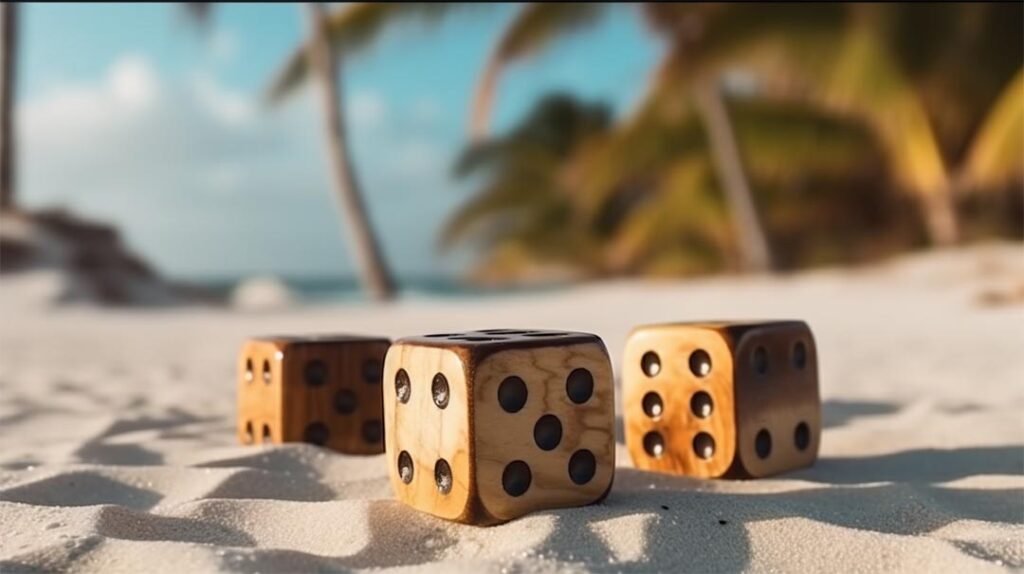
A yard dice game. A set of five or six dice and a score pad, played to a push-your-luck scoring system. This is a complete game and it is the version that sells as a gift or a family product. It needs a bag, a rule card and a carton that shows the game.
A decorative or event prop. One or two oversized dice used as a photo prop, a table centrepiece or a lawn decoration. This version sells to venues, wedding planners and event hire. It does not need a game at all, and it should not be priced as one.
Deciding which of these you are buying changes the specification: the game version needs a consistent set, a bag and a rule card; the prop version needs a larger size and a better finish, and does not need fairness.
Compliance
If the product is sold as a children’s game, it needs testing to EN 71 for Europe or ASTM F963 for the United States, with reports from a recognised laboratory. The finish is the usual failure point, because heavy metal migration limits apply to the coating.
Two product-specific points: a large wooden die is heavy enough to hurt if thrown at a person, so an age statement belongs on the box, and any bag included with the set is part of the product and has to be tested with it.
Frequently Asked Questions
What size should giant dice be?
90 mm is the common size for a yard game: large enough to be visible and easy to throw, small enough to pack five or six in a bag. Anything above 120 mm becomes a prop rather than a playing piece.
How many dice are in a set?
Five or six for a yard game, one or two for a decorative set. State it on the carton, because a customer buying a gift expects a playable set.
Which timber do you use?
Rubberwood or beech for playing sets, walnut for premium lines. Dense timber matters more than appearance, because the die takes repeated impact.
Can the dice carry our branding?
Yes. The six faces are flat surfaces, so an engraved logo can replace or sit alongside a pip. It is worth confirming which face, because replacing a pip changes the layout and the layout is not negotiable.
What is the minimum order?
Around 500 sets per design for a custom run. Samples go out five to ten days after the specification is agreed, and bulk production runs thirty to forty-five days after sample approval.
Sourcing Wooden Garden Games in Bulk?
Kangjie is the direct manufacturer behind these games — no trading company, no middleman margin. We supply Kubb, Croquet, Molkky, Ring Toss, Tumble Tower, Cornhole and more to importers, retailers and brand owners worldwide.
- Factory-direct pricing with transparent volume tiers (500 / 1,000 / 5,000 units)
- OEM & ODM: logo, packaging, size and finish built to your specification
- EN71 & ASTM F963 compliant; FSC-certified timber
- Bulk lead time 30–45 days, quotation within 24 hours









