
Making one wooden tic tac toe set is an afternoon’s work. Making five hundred identical ones is a manufacturing problem, and the two have almost nothing in common. The grid has to sit in the same place on every board, the pieces have to stack and store without rattling, and the finish has to survive being handled by a child and left on a patio.
This is a walkthrough of how the product is actually built at production volume, written for someone who has to specify it rather than someone who wants to make one in a garage. The decisions that matter are flagged, along with the ones that look important and are not.
The Process in Five Steps
Cut the board and the pieces, cut the grid, sand everything, finish everything, pack. That is the whole product. The complexity is entirely in holding tolerance across those five steps at volume, which is why a set made by hand and a set made on a production line look identical in a photograph and feel completely different in the hand.
Step One: The Board and the Grid
There are three ways to put a grid on a wooden board, and they produce three different products.
Laser engraved. A shallow burned line, typically 0.5 to 1 mm deep. Fast, consistent, and it does not wear off. The limitation is that the burn darkens the wood and the line width is fixed by the laser, so a fine grid on a soft timber can bleed slightly at the edges. This is the best option for volume and the one most buyers choose.
CNC carved. A cut groove, usually 2 to 3 mm wide and 1 to 2 mm deep. It gives a physical channel that the pieces sit in, which feels better in play. It costs more in machine time and it removes material, so the board has to be thick enough to take it without weakening.
Printed or inlaid. A printed face on a veneered panel, or a contrasting timber inlaid into the board. Both look premium and both are the most expensive. Printed faces on a garden product need a sealed overcoat, or the print will lift at the edges within a season.
Whichever route you choose, the specification that matters is alignment: the grid has to be centred to within a millimetre or two on every board, and the nine squares have to be equal. A grid that is visibly off-centre reads as a defect even to a customer who could not say why.
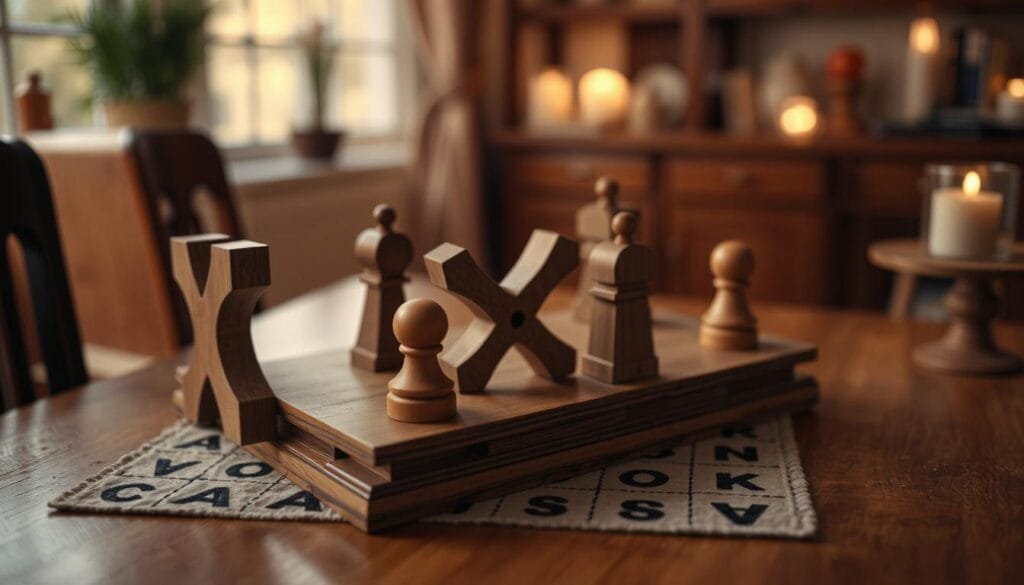
Step Two: The Pieces
The X and O pieces are where most of the perceived quality lives, and where most of the cost difference between suppliers sits.
- Uniform thickness. All pieces in a set should be the same thickness, to within a fraction of a millimetre. A set where the O’s are thicker than the X’s feels wrong immediately.
- Consistent silhouette. An X cut on a CNC router is identical every time. An X cut by hand is not, and a set with visibly different X’s looks homemade in the wrong way.
- Edge radius. Every piece edge should be rounded. A sharp edge on a small piece is both unpleasant to hold and a compliance issue if the product is sold for children.
- Storage. A set with nowhere to put the pieces loses them, and a set with missing pieces is a return. A cloth bag or a routed recess in the board solves it for very little cost.
Step Three: Sanding
The sequence matters more than the final grit. Rough sanding to remove machining marks, then a pass at 120, then a finish pass at 180 to 220. Skipping the intermediate grits and going straight to a fine paper produces a surface that looks smooth and feels fuzzy, because the fibres have been pushed over rather than cut.
On the pieces, the edges and the inside of any routed recess need the same treatment as the faces. This is the step that gets skipped under time pressure, and it is the step a customer notices first.
Step Four: Finish
Two families of finish, and the choice depends on where the product will live.
Hardwax oil. Soaks in, leaves the timber feeling like timber, and can be repaired locally by wiping more on. It offers less surface protection than a film finish and needs re-oiling periodically. This is the right choice for a product where feel matters.
Water-based lacquer. Sits on the surface as a film. More resistant to water and staining, and better for a product that will be used outdoors or wiped down. It cannot be repaired locally, only refinished.
Either is fine. What is not fine is an unspecified finish, because the finish is what carries the toy safety compliance for heavy metal migration, and it is what decides how the product looks after one summer.
Step Five: Packing
For a garden game, the carton is part of the product. Three things are worth specifying: a cloth or cotton bag for the pieces, a carton with an internal divider so the board does not slide against the pieces in transit, and a printed sleeve or box that photographs well enough for an online listing.
Also worth asking about: whether a spare piece is included. It costs almost nothing at the factory and it removes an entire category of complaint.
Wood Choice, Honestly
| Timber | Cost | Real behaviour | Best for |
|---|---|---|---|
| Pine | Low | Dents easily, takes engraving unevenly because of the hard-soft grain contrast | Entry price point |
| Birch plywood | Mid | Dimensionally stable, consistent surface, good engraving | The best value for a board |
| Rubberwood | Mid | Dense and even, machines cleanly, widely available from plantation sources | Pieces and solid boards |
| Bamboo | Higher | Hard and stable, but it is a grass and it does not resist moisture on its own. Any weather claim depends entirely on the finish, not the material | A premium-looking board with a good finish |
| Cedar | Higher | Naturally rot resistant, soft, and it dents under impact | Outdoor structures, not playing surfaces |
Two claims in this category should be avoided. Bamboo is not weatherproof on its own, and cedar is not a good playing surface despite being rot resistant. Both are common in product copy and both invite a complaint.
What Changes at Five Hundred Sets
Below about a hundred units, a set is a workshop product: cut, sand and finish one at a time. At five hundred, it becomes a line product, and four things change.
Jigs replace skill. Grid position, hole position and piece shape move from the operator’s eye to a fixture. This is what produces consistency, and it is also what makes a design change expensive, because the jig has to be remade.
Finishing becomes a batch process. Pieces are finished in racks rather than individually, which is faster but means the finish thickness depends on rack density. Worth asking about.
Timber is bought by the batch. Colour will vary between production runs. A reorder that does not match the first shipment is normal, and it should be planned for rather than discovered.
Tooling has a cost. Laser programs and CNC fixtures are a one-off setup. At 500 units it is a small addition per set; at 50 units it is most of the price.
Compliance
If the product is marketed to children, it needs testing to EN 71 for Europe or ASTM F963 for the United States, with reports from a recognised laboratory. The finish is the usual failure point, because heavy metal migration limits apply to the coating, not to the timber.
For US imports, the importer issues the Children’s Product Certificate on the basis of the test reports, and a tracking label has to be applied to the product and its packaging. Neither of those is the factory’s responsibility, however helpful the factory is.
Frequently Asked Questions
Which timber should I specify?
Birch plywood for the board and rubberwood for the pieces is the combination that gives the best result for the money. Pine is cheaper and dents; bamboo looks premium and depends entirely on the finish.
How long does production take for 500 sets?
Samples in five to ten days after the specification is agreed, bulk production in thirty to forty-five days after sample approval. Shipping time is separate and depends on the destination and mode.
Can we have custom designs?
Yes: custom grid layout, custom piece shapes, engraved logos, custom colours and custom packaging. Changes that need new tooling carry a setup cost, and it is worth being told when that cost does not make sense at your volume.
Do you sign confidentiality agreements?
Yes, before drawings are shared. If a design is to be exclusive to you, that has to be stated in writing at the start, because it affects how the tooling is scheduled and used.
What does a set cost per unit?
It depends on the timber, the grid method, the piece count and the packaging, and the range is wide enough that a single figure would be misleading. Send a specification and the quantity, and you will get a quotation within 24 hours that itemises what each choice adds.
Sourcing Wooden Garden Games in Bulk?
Kangjie is the direct manufacturer behind these games — no trading company, no middleman margin. We supply Kubb, Croquet, Molkky, Ring Toss, Tumble Tower, Cornhole and more to importers, retailers and brand owners worldwide.
- Factory-direct pricing with transparent volume tiers (500 / 1,000 / 5,000 units)
- OEM & ODM: logo, packaging, size and finish built to your specification
- EN71 & ASTM F963 compliant; FSC-certified timber
- Bulk lead time 30–45 days, quotation within 24 hours









