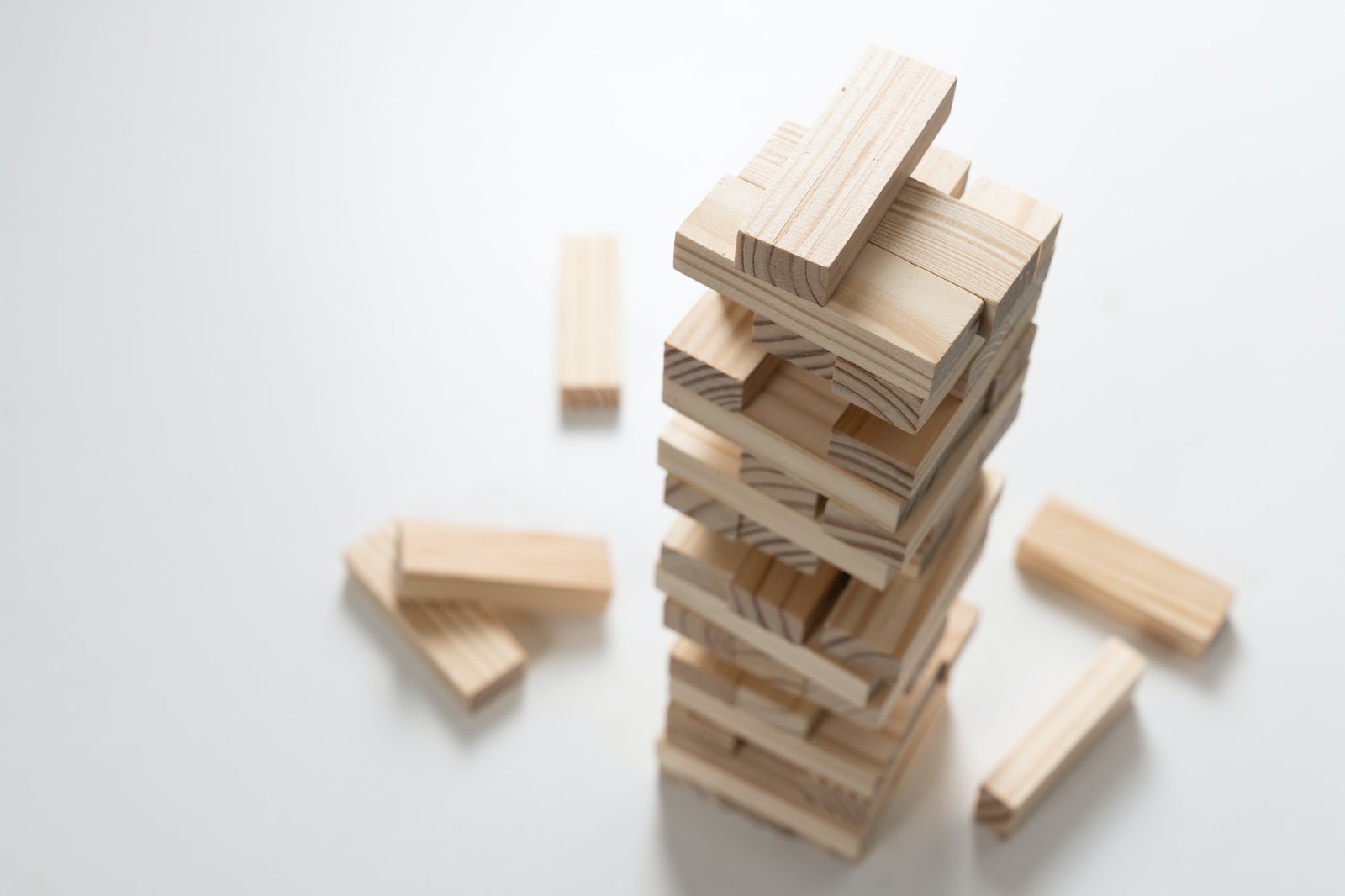
There is a lot of bad advice about building a giant tumble tower, and most of it comes from confusing it with a piece of furniture. The blocks are not joined. They are not glued, screwed, dowelled or bracketed. They are loose, and the looseness is the game.
What the project actually requires is 54 blocks cut to an identical thickness, from timber that has already finished moving. That is a machining problem, not a carpentry problem, and it is the reason a homemade set so often plays badly even when it looks right.
The Short Answer
A standard set is 54 blocks in 18 layers of three, with a block ratio of 3 : 1 : 0.6. The classic block is 75 by 25 by 15 mm, giving a tower 270 mm tall.
A giant set is the same thing scaled by a single factor applied to all three dimensions. That keeps the proportions and therefore the way the game plays.
| Scale | Block (mm) | Tower height | 54 blocks in pine | 54 blocks in beech |
|---|---|---|---|---|
| 1x | 75 x 25 x 15 | 270 mm | 0.8 kg | 1.1 kg |
| 2x | 150 x 50 x 30 | 540 mm | 6.1 kg | 8.8 kg |
| 3x | 225 x 75 x 45 | 810 mm | 20.5 kg | 29.5 kg |
| 4x | 300 x 100 x 60 | 1,080 mm | 48.6 kg | 70 kg |
The weight column is the one that decides the project. A 3x set in beech is nearly 30 kg, which is not a garden game, it is a piece of equipment that two people carry. Pine at 3x is 20 kg, which is manageable. Anyone recommending oak or maple for a giant set has not weighed one.
Do Not Glue or Screw Anything
This is worth stating separately because it is the most common error in guides on this subject. Advice like “assemble the blocks using strong adhesive and reinforce with screws” describes a different object entirely.
If the blocks are fixed together, there is no game. The whole mechanism is that each block is held in place by friction and the weight above it, and that removing one redistributes load onto its neighbours. Bond them and you have built a decorative tower.
The only fasteners in a tumble tower set are the ones in the storage bag.
Choosing the Wood
| Species | Density (kg/m3) | Behaviour | Verdict |
|---|---|---|---|
| Pine | 480 to 520 | Light, cheap, dents at the corners, but stable and easy to work | Best for a first giant set |
| Spruce | 400 to 470 | Lighter still, softer, marks easily | Fine at 2x, marginal at 3x |
| Beech | 680 to 730 | Hard, heavy, excellent wear, moves more with humidity | Premium; too heavy at 4x |
| Ash | 650 to 700 | Tough, shock resistant, straight grain, good to machine | Excellent, costs more |
| Oak | 700 to 750 | Heavy, expensive, moves a lot, tannins stain | Wrong choice for this product |
| Birch ply | 700 | Dimensional stable but has a ply edge on every block | Not suitable |
Two practical notes. First, all 54 blocks must come from the same batch, ideally the same boards. A set with blocks from different sources will have different densities, and blocks of different weights behave differently when the tower gets unstable. Second, buy kiln-dried stock at 8 to 12 percent moisture content and let it sit in your workshop for a week or two before cutting, so it finishes moving before you dimension it.

Cutting 54 Identical Blocks
This is where the project succeeds or fails, and it needs three operations rather than one.
- Dimension the stock. Plane or rip your boards to a single width and thickness. Every block gets its width and thickness from this one setup, so there is no per-block variation in two of the three dimensions.
- Plane to final thickness. A thicknesser is the only tool that will give you 54 blocks within 0.2 mm of each other. If you do not have one, buy pre-dimensioned stock instead of trying to plane by hand.
- Cross-cut to length with a stop block. Set a stop on the mitre gauge or fence so every block is cut at exactly the same length. This is the step that produces a set where the tower stands.
A laser cutter is the wrong tool. It will cut 45 mm solid timber, slowly, with a charred edge that has to be sanded off, and the char is uneven. A table saw or bandsaw plus a thicknesser is faster and more accurate.
The tolerance to aim for is plus or minus 0.2 mm in thickness. Not because a 0.5 mm variation is visible, but because eighteen layers multiply it: 0.5 mm per block can become 9 mm of lean across a tower. Measure with calipers, not a tape.
Sanding and Edges
Sand to 180 grit. Going finer than that polishes the surface and reduces friction, which is the opposite of what you want.
Chamfer every edge by 1 to 1.5 mm. A sharp 90 degree edge chips the first time a block is dropped, and a chipped edge stops the block sitting flat, which shows up as a wobble in the tower that no amount of careful stacking fixes.
Do not round over more than about 2 mm. A heavily rounded edge reduces the contact area between blocks, and the tower becomes noticeably less stable.
Finish: Less Than You Think
Most finishing advice for this project is wrong, and it is wrong in the same direction: people apply a film finish because it looks better and protects the wood, and it ruins the game.
Any film finish, whether varnish, lacquer, polyurethane or marine varnish, reduces the friction between blocks. Less friction means the tower slides rather than grips, and a tower that slides collapses in a way that feels arbitrary rather than earned.
Marine varnish deserves a specific mention because it appears in almost every guide. It is formulated for boats: soft, flexible, and designed to stay slightly tacky so it does not crack with the hull. On a game block it is the worst possible choice.
What to use instead: nothing, or a very thin coat of paste wax, buffed dry. If the set will be used outdoors and you want some protection, a thin penetrating oil wiped dry after ten minutes is the compromise, accepting that it darkens the wood slightly.
Storage
A cotton or canvas bag, stored dry and off the ground. Wooden blocks absorb moisture and swell, and a set that has swelled unevenly no longer stacks straight.
Do not store them in a sealed plastic bag. It traps condensation, and condensation on a stack of blocks produces mould in the gaps within a month.
When Buying Beats Building
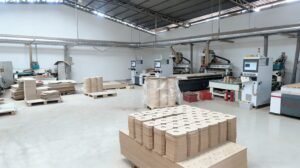
For one set, building is a good weekend and a set you will be proud of. For anything above about ten sets, the machining setup dominates: the jigs, the stop blocks, the thickness calibration and the waste from dimensioning all have to be amortised, and a factory that does this every day will beat a workshop doing it once.
Our minimum order is 500 sets. Samples take 5 to 10 days once the specification is agreed, and bulk production runs 30 to 45 days. If you are specifying a set rather than building one, the three numbers that matter are the block dimensions, the thickness tolerance and the moisture content at machining.
FAQs
What are the dimensions of a giant set?
Scale the standard 75 by 25 by 15 mm block by a single factor. 3x gives 225 by 75 by 45 mm and an 810 mm tower, which is the most common giant size.
Should I glue or screw the blocks?
No. The blocks must be loose. A fixed tower is not a game.
How many blocks do I need?
54, in 18 layers of three. Some giant sets use 60, which makes for a longer game and a taller tower.
What finish should I use?
None, or a thin wax buffed dry. Avoid varnish, lacquer and marine varnish, all of which reduce the friction the game depends on.
How much does a giant set weigh?
About 20 kg in pine at 3x, and nearly 30 kg in beech. That weight difference is the main reason pine is the sensible species for a large set.
Can I order a custom set in bulk?
Yes. Minimum order 500 sets, samples 5 to 10 days, production 30 to 45 days, quotation within 24 hours.
Sourcing Wooden Garden Games in Bulk?
Kangjie is the direct manufacturer behind these games — no trading company, no middleman margin. We supply Kubb, Croquet, Molkky, Ring Toss, Tumble Tower, Cornhole and more to importers, retailers and brand owners worldwide.
- Factory-direct pricing with transparent volume tiers (500 / 1,000 / 5,000 units)
- OEM & ODM: logo, packaging, size and finish built to your specification
- EN71 & ASTM F963 compliant; FSC-certified timber
- Bulk lead time 30–45 days, quotation within 24 hours