
Finding a wooden chess set manufacturer is easy. Finding one that can tell you the king height, the base diameter, the square size and the weighting method without going away to check is harder, and that is the actual test.
This article is a buying guide rather than a directory. It covers what a chess set specification consists of, which materials carry legal restrictions, how to evaluate a sample in ten minutes, and what to ask a supplier before you commit to a run.
First, the Specification a Chess Set Actually Has
Chess sets are sold on appearance and bought on dimensions, and the dimensions are what make a set playable.
| Parameter | Typical value | Why it matters |
|---|---|---|
| King height | 95 mm for tournament play; 75 to 110 mm across the retail range | Sets the scale of everything else |
| King base diameter | Roughly 40 to 45 percent of the king height | A piece that is too narrow at the base looks unstable and tips easily |
| Square size | About 1.15 to 1.25 times the king base diameter | Squares too small look crowded; too large look empty |
| Board size | Eight squares plus a border | The border is where captured pieces sit and where notation is printed |
| Weighting | Steel inserts in the base of the larger pieces | Weighted pieces feel correct and are harder to knock over |
| Base covering | Felt or baize | Protects the board and stops pieces sliding |
A supplier who cannot give you these numbers is a supplier who has not made the product. A supplier who gives you the king height but not the base diameter has given you half a specification.
Materials, and the Legal Part
This is the section that most buying guides skip, and it is the one that can stop a shipment.
Boxwood is the traditional light timber for chess pieces. Fine, even grain, dense, and it holds turned detail exceptionally well. It is the correct answer for the white pieces on any set meant to be played with.
Ebony is the traditional dark timber. It is dense, it takes a high polish, and several Diospyros species are subject to trade restrictions. Do not assume an ebony set can be imported without paperwork.
Rosewood, including sheesham. Widely used for commercial sets because it is beautiful and machines well. Since 2017 the genus Dalbergia has been listed on CITES Appendix II, which means international trade requires permits. This is the single most important compliance point on a wooden chess set and it is routinely ignored by suppliers who describe the timber as “Indian rosewood” without mentioning it.
Maple and walnut. The practical alternative pair. Maple for the light pieces, walnut for the dark. Neither is CITES-restricted, both machine well, and the contrast is good. For a commercial set this is the combination that avoids the paperwork problem entirely.
Beech. Hard, even and inexpensive, and the standard choice for turned pieces at a lower price point. Beech is not soft — it is a dense timber — and it stains and ebonises well.
Pine. Avoid for pieces. It dents, it does not hold fine detail, and it is too light to feel like a chess piece.
How to Evaluate a Sample in Ten Minutes
Four checks, in this order.
Set the pieces up. Put all thirty-two on the board. Any piece that wobbles, any knight that leans, any pawn that is visibly a different height from its neighbours is a rejection. Do this before you look at the finish, because the finish is designed to distract from exactly this.
Weigh two pieces of the same type. They should be close. A set where the pawns vary noticeably in weight was made without a weight check, and a set made without a weight check was made without any other check either.
Look at the base. The felt should be applied flat, cut to size and not lifting at the edge. A base that is already lifting on a new sample will be gone in a month.
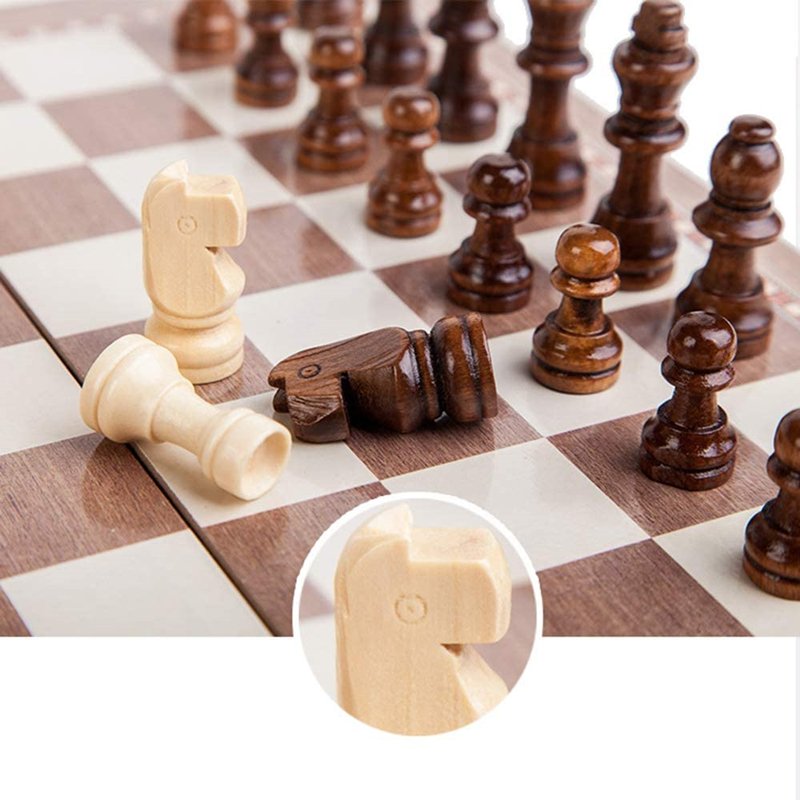
Turn a knight over. The knight is the hardest piece to carve or machine and it is where the quality shows. Look at the inside of the base and the detail on the mane. A knight that is a smooth blob from behind was made quickly.
What to Ask Before Ordering
- Which species, exactly. Not “walnut” but which walnut, and whether any CITES-listed timber is involved.
- Weighting method. Steel insert, drilled and filled, or not weighted at all. And what the insert is made of, because lead has no place in a product handled by children.
- How the pieces are made. CNC turning and carving, or hand work. Both are legitimate; the price should reflect which.
- Square size and board construction. Veneered panel or solid, and how the squares are aligned.
- Finish. Type and coat count, and whether the inside of the base is sealed.
- Consistency between runs. How a reorder is matched to the first batch, because timber colour varies.
What “Best” Means Depends on the Customer
There is no single best manufacturer, because there are three different products being bought.
A tournament set. Correct Staunton proportions, 95 mm king, weighted, felted, in boxwood and a dark timber. Bought by clubs and serious players, who will measure it.
A gift set. Larger king, heavier pieces, a board with a border and often a storage compartment. Bought by people who will judge it by feel and by how it looks on a table.
An oversized garden set. A different product entirely: large pieces, a mat or a ground board, and durability under outdoor conditions. Sold into garden retail, hotels and events.
Decide which of these you are buying before you ask for quotations, because a supplier who quotes for all three without asking is quoting for none of them.
Frequently Asked Questions
What is the standard tournament king height?
95 mm, with a base diameter of roughly 40 to 45 mm and squares of about 55 to 58 mm. Those three numbers go together; changing one without the others produces a set that looks wrong.
Is rosewood a problem to import?
It can be. The genus Dalbergia is on CITES Appendix II, which means permits are required for international trade. If you are specifying a rosewood set, ask the supplier directly which species and what documentation they can provide, and check the requirement for your own market.
Should pieces be weighted?
For anything above an entry price point, yes. Weighted pieces feel correct and are harder to knock over. Confirm the insert material, because lead has no place in a product handled by children.
Can you make a custom design?
Yes, within limits. A new king profile needs tooling, which carries a setup cost that only makes sense at volume. Custom board sizes, custom timber pairs, engraved bases and custom packaging are all straightforward.
What is the lead time?
Samples in five to ten days after the specification is agreed, bulk production in thirty to forty-five days after sample approval. Chess pieces involve a lot of turning and finishing, so a large piece count per set affects the schedule.
Sourcing Wooden Garden Games in Bulk?
Kangjie is the direct manufacturer behind these games — no trading company, no middleman margin. We supply Kubb, Croquet, Molkky, Ring Toss, Tumble Tower, Cornhole and more to importers, retailers and brand owners worldwide.
- Factory-direct pricing with transparent volume tiers (500 / 1,000 / 5,000 units)
- OEM & ODM: logo, packaging, size and finish built to your specification
- EN71 & ASTM F963 compliant; FSC-certified timber
- Bulk lead time 30–45 days, quotation within 24 hours









