Dominoes and mahjong are both tile games played at a table, both involve drawing and discarding, and both are often photographed side by side in the same product category. Beyond that, they are not really relatives. They differ in tile count, in how much information is hidden, in what a turn actually consists of, and in what it costs to manufacture a good wooden set of each.
For anyone stocking or specifying these products, that last point matters as much as the rules. Below is what each game actually is, where they genuinely overlap, and what the differences mean when you are choosing what to put on a shelf.
The Short Answer
Dominoes is a matching game built on a small set of numbered tiles, with almost everything visible on the table. Mahjong is a set-collection game built on a much larger tile set, where most of the information is hidden in players’ hands and the skill lies in reading what has been discarded.
Dominoes is easier to teach, cheaper to make well, and travels better. Mahjong is deeper, more culturally specific, and considerably more expensive to produce to a standard a serious player will accept. They compete for the same shelf space but not for the same customer.
What Dominoes Actually Is
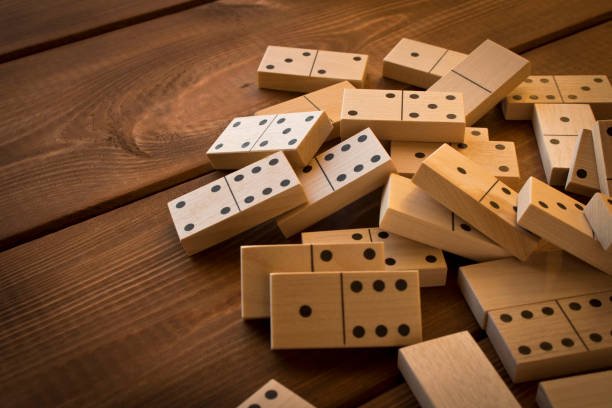
A standard double-six set contains 28 tiles. Each tile carries two numbers from zero to six, and every possible pair appears exactly once. Larger sets exist: double-nine gives 55 tiles, double-twelve gives 91. The tile count is the single most important specification, because it determines which games the set can support.
The core mechanic is matching. You play a tile whose end matches an open end on the layout. If you cannot play, you draw, or you pass, depending on the variant. The most widely played family of games, block and draw dominoes, is decided by whoever empties their hand first, with the pip count of the remaining tiles breaking ties.
There is also a scoring family, usually called Muggins or All Fives, where points are awarded whenever the open ends add up to a multiple of five. This is the version that turns dominoes from a luck-driven game into an arithmetic one, and it is the version most likely to appeal to players who find the basic game too simple.
What makes dominoes work commercially is that the rules scale down. A six-year-old can play a matching game with the same tiles that adults use for All Fives. One product covers a very wide age range.
What Mahjong Actually Is
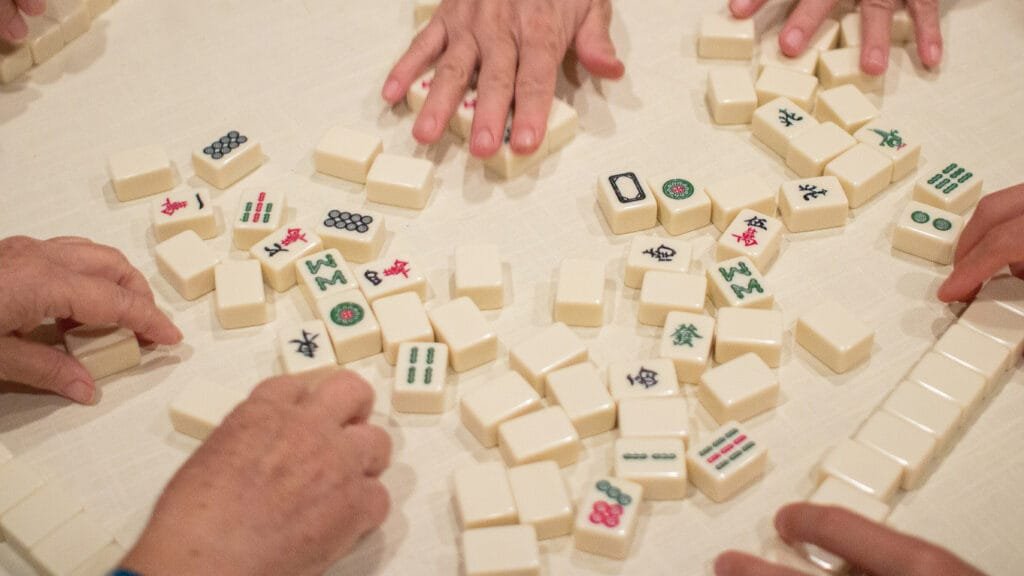
A standard mahjong set contains 144 tiles. Of those, 136 are the playing tiles: three suits numbered one to nine, each appearing four times, plus four winds and three dragons, each appearing four times. The remaining eight are bonus tiles, usually four flowers and four seasons, which score but do not form part of the hand structure.
A turn is a draw and a discard. Between those two actions a player may claim a discarded tile to complete a set, which is what creates the interaction. A winning hand is normally four sets and a pair, with additional patterns scoring extra.
This is the structural difference that matters. In dominoes, the layout is public and the hidden information is only your own hand. In mahjong, every other player’s hand is hidden, and the only evidence you have is what they have discarded and what they have claimed. That is a fundamentally different kind of game, closer to rummy than to dominoes.
Regional rule sets vary enormously. Cantonese, Japanese riichi, Taiwanese and various Southeast Asian versions share the tile set but differ in scoring, in the number of tiles dealt, and in whether bonus tiles are used at all. A set sold into one market may not suit another, and the rulebook that ships with it should say which variant it covers.
Where They Genuinely Overlap
| Dimension | Dominoes | Mahjong |
|---|---|---|
| Core action | Match an open end | Draw, then discard |
| Information | Layout is public | Hands are hidden |
| Tile count | 28 in a double-six set | 144 |
| Typical game length | 10 to 20 minutes | 20 to 60 minutes per hand |
| Players | 2 to 4, sometimes more | Usually exactly 4 |
| Learning time | Under 5 minutes | 30 minutes or more |
| Packed weight | Light, one small box | Heavy, a case is normal |
Both are social games played around a table, both reward attention, and both have a long enough history that they carry a sense of occasion. That is where the similarity ends.
Where They Diverge Commercially
Demand Pattern
Dominoes sell steadily almost everywhere, with no strong seasonality and no strong regional pattern. Mahjong demand is concentrated: it is very strong in China, Japan, Korea and across overseas Chinese communities, and it has a smaller but real following in Europe and North America among players who have picked it up through travel or family.
That means mahjong is a high-value niche and dominoes is a broad-volume product. A retailer stocking both is usually doing it for two different reasons, not because the products are substitutes.
Price Sensitivity
A decent wooden domino set is an accessible purchase. A decent mahjong set is not, because 144 tiles of consistent thickness, correctly engraved faces and a proper case add up to a much higher unit cost before you get to anything decorative. Buyers who price mahjong as if it were dominoes with more pieces usually end up with a product that serious players reject on feel alone.
Tooling and Process
This is the part that surprises people. Dominoes are forgiving to manufacture: the tile is a simple rectangle, the face is either engraved or printed, and tolerance drift of a fraction of a millimetre is invisible in play. Mahjong is not forgiving, because players stack and slide the tiles constantly. Thickness has to be consistent across all 144 pieces or the wall will not build cleanly, and the engraved faces have to stay legible after years of handling.
If you are sourcing wooden mahjong, the questions to ask are about thickness tolerance across the full set and about how the faces are marked, not about the box.
What This Means If You Are Stocking Them
Three practical conclusions.
Do not treat them as one category. Dominoes is a volume line with wide appeal and low unit cost. Mahjong is a considered purchase with a specific audience. They need different price points, different copy and, usually, different retail partners.
Specify the variant. For dominoes, the tile count decides which games the set supports, so state it. For mahjong, the rule set decides who the product is for, so state that too. A mahjong set with no indicated rule variant is a set that half its buyers will not be able to use as intended.
Check the feel, not the finish. Both games are tactile. A set that looks right in a photo and feels wrong in the hand does not sell twice. If you cannot inspect a physical sample before committing to a run, that is the single biggest risk in either product.
A Note on Making These in Wood
Wooden dominoes are a natural fit: the material suits the tile, the weight feels right, and the pieces can be engraved with a brand or a custom back pattern without changing the tooling. This is a product where customization is genuinely cheap.
Wooden mahjong is possible but is a different project. The face markings need to be legible at 144 pieces, the thickness has to hold across the whole set, and the case becomes part of the product rather than packaging. If you are considering it, it is worth treating it as a separate development with its own sampling cycle rather than as an extension of a dominoes order.
Frequently Asked Questions
Are these games suitable for children?
Dominoes, yes, from about six years old in the basic matching form. Mahjong is generally better suited to older children and adults, mainly because of the length of a hand and the number of rules, not because of the pieces.
Can the designs be customized?
For wooden dominoes, yes, straightforwardly: engraved backs, printed faces, custom boxes, custom pip colours. For mahjong, customization is limited by legibility, so the realistic options are the tile back, the case and the rulebook.
Which has the higher resale value?
Mahjong, generally, because the material cost and the piece count are higher and the second-hand market is active in the regions where the game is played. Dominoes is a consumable in comparison.
Do you supply both?
We manufacture wooden dominoes as a standard line. Wooden mahjong is quoted as a separate development because of the tolerance and marking requirements. If you are looking at both, send the specifications separately and we will tell you honestly which one we can do well and which one we would rather not take on.
Sourcing Wooden Garden Games in Bulk?
Kangjie is the direct manufacturer behind these games — no trading company, no middleman margin. We supply Kubb, Croquet, Molkky, Ring Toss, Tumble Tower, Cornhole and more to importers, retailers and brand owners worldwide.
- Factory-direct pricing with transparent volume tiers (500 / 1,000 / 5,000 units)
- OEM & ODM: logo, packaging, size and finish built to your specification
- EN71 & ASTM F963 compliant; FSC-certified timber
- Bulk lead time 30–45 days, quotation within 24 hours